Advertisement
Markets
The remittance giant is extending its blockchain strategy beyond Stellar, connecting Solana wallets and applications to its global cash infrastructure.
Share
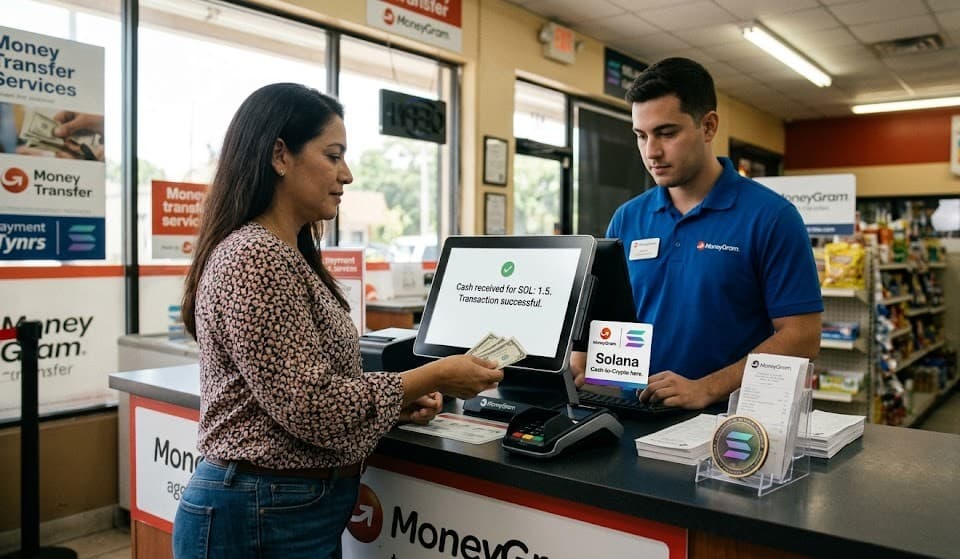
MoneyGram is expanding its Ramps service to Solana, enabling wallets, exchanges, and developers on the network to connect digital assets to its cash infrastructure spanning 170+ countries, without building their own banking or cash-out systems.
MoneyGram is expanding its cash-to-crypto infrastructure to Solana, bringing its MoneyGram Ramps service to wallets, exchanges and developers building on the blockchain.
The move extends a strategy that MoneyGram has been developing for several years: connecting digital assets to the company's global network of physical cash locations, allowing users to move between crypto and local currency without requiring each wallet or application to build its own banking and cash-out infrastructure.
MoneyGram Ramps supports cash deposits in more than 25 countries and cash withdrawals across more than 170 countries and territories, according to the company. Its network reaches roughly 60 million active customers.
The significance of the Solana expansion is therefore less about adding another blockchain to MoneyGram's platform and more about broadening the digital rails connected to its existing cash network.
MoneyGram's blockchain strategy began well before its latest Solana integration.
In 2021, the company partnered with the Stellar Development Foundation and Circle to connect USDC with MoneyGram's physical network, enabling consumers to convert between USDC and local cash. The model gave digital wallets an entry and exit point into the traditional financial system through MoneyGram's existing cash infrastructure.
The company subsequently expanded its blockchain ambitions beyond providing an on- and off-ramp.
In June, MoneyGram launched MGUSD, its own U.S. dollar-backed stablecoin, initially on Stellar. The stablecoin was designed to operate across MoneyGram's existing payments network, bringing digital-dollar functionality closer to the company's core remittance business.
MoneyGram's latest move adds another layer to that strategy.
Rather than limiting its cash-access infrastructure to the blockchain where MGUSD launched, the company is making its Ramps infrastructure available to applications operating on Solana.
That distinction matters. MoneyGram's stablecoin and its cash-access infrastructure do not have to depend on the same blockchain.
MoneyGram has also been deepening its relationship with Solana.
In June, the company joined Solana's developer platform and became a validator on the network, signaling that its relationship with the blockchain extends beyond simply using it as a transaction rail. Solana described the move as part of MoneyGram's effort to connect traditional payment rails with blockchain infrastructure.
The Ramps expansion now puts that relationship closer to the end user.
A wallet or application built on Solana can use MoneyGram's infrastructure to connect digital assets with local cash, potentially avoiding the need to establish separate relationships with banks, payment providers and physical cash networks in each market.
That is particularly relevant for stablecoins, whose utility increasingly depends on what happens outside the blockchain itself.
A stablecoin can move globally in seconds, but its usefulness to consumers and businesses ultimately depends on whether it can be converted into local currency, spent, or accessed through familiar financial channels.
MoneyGram's physical network addresses that last-mile problem.
MoneyGram is not alone in looking at blockchain as an extension of traditional remittance infrastructure.
Western Union has also been developing a stablecoin strategy around Solana. The company announced USDPT, a dollar-backed stablecoin designed to integrate digital assets into its global money-transfer network.
The two companies are approaching the opportunity differently, but the underlying direction is similar.
Their competitive advantage is not the ability to create another crypto wallet or stablecoin. It is the existing infrastructure that connects digital value to consumers in markets where cash remains an important part of the financial system.
For MoneyGram, that means hundreds of thousands of retail locations and agents can become part of a blockchain-enabled payments architecture rather than remaining separate from it.
The development also highlights where the next stage of stablecoin adoption could take place.
Much of the industry's attention has focused on stablecoin issuance, blockchain transaction volumes and institutional settlement. But for cross-border payments, the critical infrastructure is often the point where digital value becomes usable local money.
MoneyGram is positioning its cash network as that bridge.
The model increasingly looks like:
wallet → stablecoin or digital asset → blockchain → MoneyGram → local currency
The blockchain provides the digital transfer layer. MoneyGram provides the physical distribution and cash-conversion layer.
That makes the company's network potentially useful regardless of which blockchain a wallet or application uses.
The Solana expansion also changes the way MoneyGram's blockchain strategy can be viewed.
Its earlier work with Stellar established the cash-to-digital-asset model. MGUSD moved the company further into stablecoin infrastructure. Its Solana engagement now broadens the blockchain connectivity behind its cash network.
The result is less a bet on one blockchain than an attempt to make MoneyGram itself part of the infrastructure connecting multiple digital-asset ecosystems to the traditional financial system.
For stablecoins, that may prove more important than simply adding another token or network.
The central question is no longer only where digital dollars move onchain. It is how easily those digital dollars can enter and exit the financial system in the markets where people actually use them.
MoneyGram's Solana expansion puts its global cash network directly into that equation.

Disclaimer of Warranty
The information provided in this article is for general informational purposes only. We make no warranties about the completeness, reliability, and accuracy of this information. Read full disclaimer

Editor's Picks
In the Same Space
ARK Invest’s $1.3B Fund Heads to Ethereum Through Tokenization

News Desk

Sep 25, 2026

3 min
Binance Invests $100M in Circle, Extends USDC Partnership for Five Years
News Desk
Sep 22, 2026
2 min

JPMorgan Predicts Bitcoin Rally Against Gold Amid Shifting ETF Strategies
News Desk
Sep 18, 2026
3 min
Bitcoin ETFs Lose $288.7M in Fresh Wave of Investor Selling
News Desk
Sep 16, 2026
2 min