Advertisement
Companies & Deals
Share
CA
Senior Arabic Editor


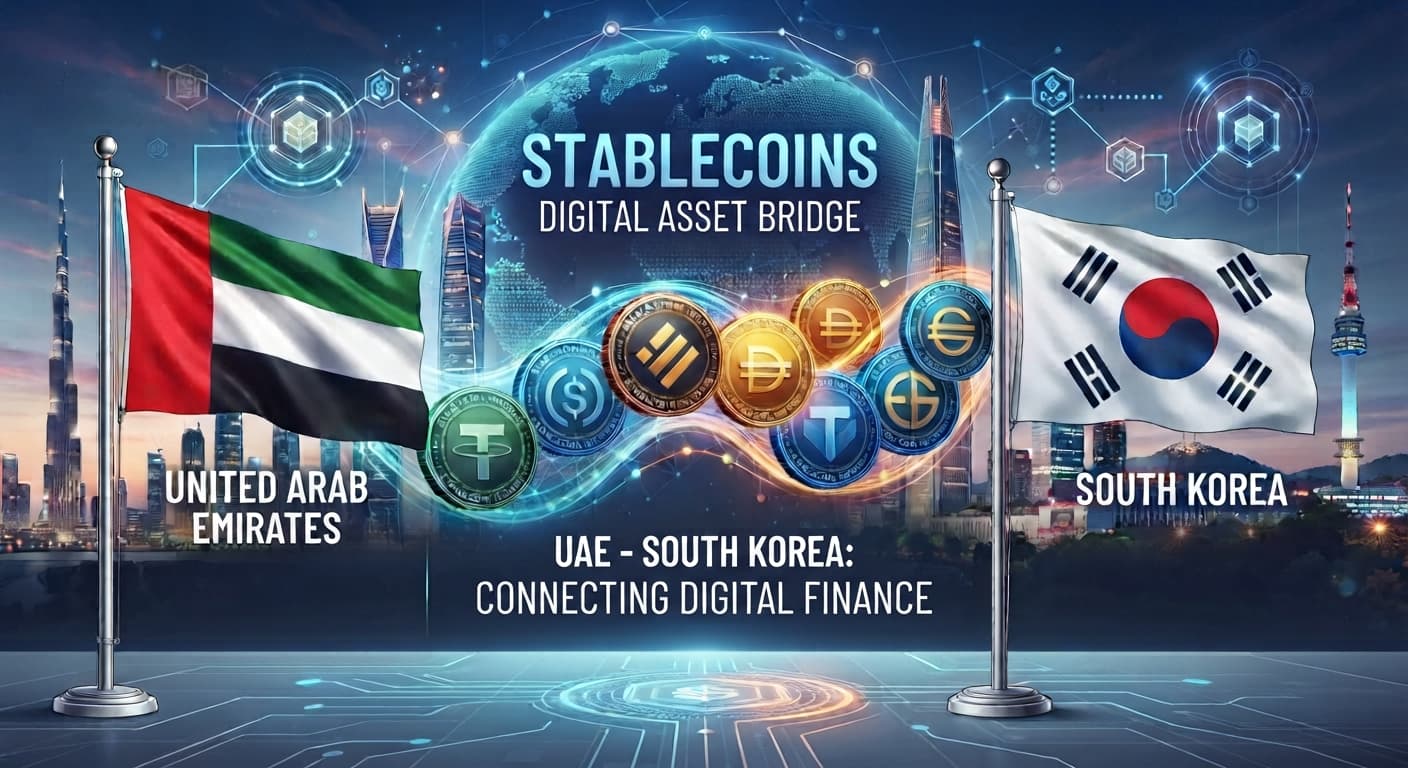
South Korea's Hanwha Finance group has signed agreements with Abu Dhabi's ADIO and ADGM to explore tokenized real-world assets, stablecoins, and cross-border payment infrastructure under a framework the parties call a 'Digital Asset Silk Road' connecting the two markets.
South Korea’s Hanwha Finance is expanding its ties with Abu Dhabi’s financial ecosystem, bringing tokenized assets, stablecoins and cross-border payments into a broader effort to connect the two markets through digital financial infrastructure.
Hanwha Life, Hanwha General Insurance, Hanwha Investment & Securities and Hanwha Asset Management, which together operate under the Hanwha Finance umbrella, announced the expanded cooperation on September 17, following agreements reached with the Abu Dhabi Investment Office (ADIO) and Abu Dhabi Global Market (ADGM) during the Abu Dhabi Investment Forum in Seoul a day earlier.
The group has framed the initiative around a “Digital Asset Silk Road” connecting South Korea and Abu Dhabi. Rather than focusing on a single digital asset product, the partnerships explore how tokenization, stablecoins, payments and traditional financial institutions could work together across borders.
Under one of the agreements, Hanwha Life partnered with ADIO to deepen cooperation in digital finance across three main areas: developing a digital asset ecosystem, strengthening financial and capital market links between South Korea and Abu Dhabi, and advancing innovation across digital banking and financial services.
The collaboration includes exploring opportunities involving digital assets and the tokenization of real-world assets, potentially creating new links between conventional capital markets and emerging blockchain-based financial infrastructure.
A separate memorandum of understanding brings together Hanwha Asset Management, ADGM and Hana Financial Group to explore stablecoins and cross-border financial infrastructure.
Potential areas of cooperation include digital asset and payment infrastructure, as well as cross-border payment and remittance solutions connecting South Korea and Abu Dhabi. The parties also intend to explore ways of building a sustainable and interoperable digital asset ecosystem.
Taken together, the agreements point to a broader financial infrastructure play.
While one track examines tokenized real-world assets and closer capital market connectivity, the other focuses on stablecoins, payments, remittances and the infrastructure required to move value between jurisdictions.
In that context, stablecoins could play a role beyond being another class of digital assets. They could potentially form part of the settlement and payment infrastructure connecting tokenized assets with financial markets.
Traditional financial institutions, meanwhile, could provide custody, distribution and asset management services, while regulated financial centers such as ADGM provide the framework within which these models can be developed.
The result is an attempt to explore an interconnected financial architecture spanning assets, money and capital rather than launching isolated blockchain products.
The partnerships come as ADGM continues to expand as an international financial center.
Assets under management within ADGM increased 54% year-on-year during the first half of 2026, while the workforce across its jurisdiction approached 50,000, reflecting the broader expansion of Abu Dhabi’s financial ecosystem.
The emphasis on interoperability and cross-border payments also aligns with a wider debate in Abu Dhabi over how the next generation of financial infrastructure should develop.
Recent ADGM research into cross-border payments has examined a future in which conventional banking infrastructure, stablecoins, tokenized deposits, central bank digital currencies and programmable settlement systems could operate alongside one another. Interoperability is central to that vision, particularly when it comes to achieving scale, efficiency and trust across different networks.
Seen through that lens, the Hanwha partnerships are less about creating a standalone digital asset ecosystem and more about exploring connections between emerging digital infrastructure and existing financial markets.
The agreements also come as the UAE continues to position itself as a major center for regulated digital assets.
Through ADGM and its Financial Services Regulatory Authority (FSRA), Abu Dhabi has developed frameworks spanning virtual assets, fiat-referenced tokens and tokenized financial instruments.
The regulatory agenda has continued to evolve into areas including staking, anti-money laundering controls, tokenization and decentralized finance, giving traditional financial institutions a framework within which to explore digital asset applications.
This puts Abu Dhabi in a position that extends beyond attracting crypto businesses. Its regulatory and financial infrastructure could increasingly serve as a bridge between tokenized assets, digital money, cross-border payments and conventional capital markets.
The partnerships form part of expanding economic and financial ties between South Korea and Abu Dhabi.
Rashed Abdulkarim Al Blooshi, Chief Executive of ADGM’s Registration Authority, said growing economic ties between the UAE and South Korea are creating opportunities for Korean companies and investors seeking to expand into Abu Dhabi and the wider region, with the financial center providing access to capital and the emirate’s growing financial ecosystem.
The relationship also extends beyond digital infrastructure. Hanwha Finance has partnered with ADGM as a principal partner of Abu Dhabi Finance Week 2026, scheduled for December, extending a relationship developed around the 2025 edition of the event.
The emerging model brings together four parts of the financial system.
Tokenization can provide a digital representation of real-world assets and financial instruments, potentially creating new methods of issuance, trading and asset management. Stablecoins, meanwhile, could provide a digital settlement and payment mechanism, particularly where transactions involve moving value between jurisdictions.
Financial institutions can provide the custody, distribution and asset management infrastructure required to connect these technologies with established markets, while regulators determine the conditions under which the different components can interact.
The significance, therefore, lies less in simply adding stablecoins or tokenized assets to existing financial products and more in exploring how these technologies could operate together within an interoperable financial architecture.
The partnerships do not mean that a stablecoin-based financial corridor between South Korea and Abu Dhabi has already been established. The agreements remain exploratory, focusing on potential cooperation across infrastructure, payments, remittances and digital assets.
What makes the initiative notable is the convergence of several developments that have often progressed separately: real-world asset tokenization, stablecoins, cross-border payments, institutional financial infrastructure and regulation.
That convergence reflects a broader change in how digital assets are being approached. Instead of developing solely as a parallel financial market, blockchain-based assets and settlement mechanisms are increasingly being examined as components of mainstream financial infrastructure.
For Abu Dhabi and South Korea, the next stage will be whether those discussions translate into functioning products and infrastructure. If they do, the Hanwha partnerships could offer an early test of how tokenized assets, stablecoins, payments and traditional financial institutions can be connected across jurisdictions within regulated markets.

Disclaimer of Warranty
The information provided in this article is for general informational purposes only. We make no warranties about the completeness, reliability, and accuracy of this information. Read full disclaimer

Editor's Picks
In the Same Space
Deutsche Bank Moves Into Institutional Crypto Custody With Bitcoin, Ether and Stablecoins

News Desk

Sep 17, 2026

4 min

ECB Pontes: Central Bank Money vs. Stablecoin Settlement
News Desk
Sep 22, 2026
4 min

VARA Approves Alya Marrakchi as Managing Director of GC Exchange FZE
Chantal Assi
Sep 21, 2026
4 min
MFTA Report: ADGM Expands Digital Asset and Staking Regulatory Framework
Chantal Assi
Sep 22, 2026
7 min