Advertisement
Institutional Adoption
Share
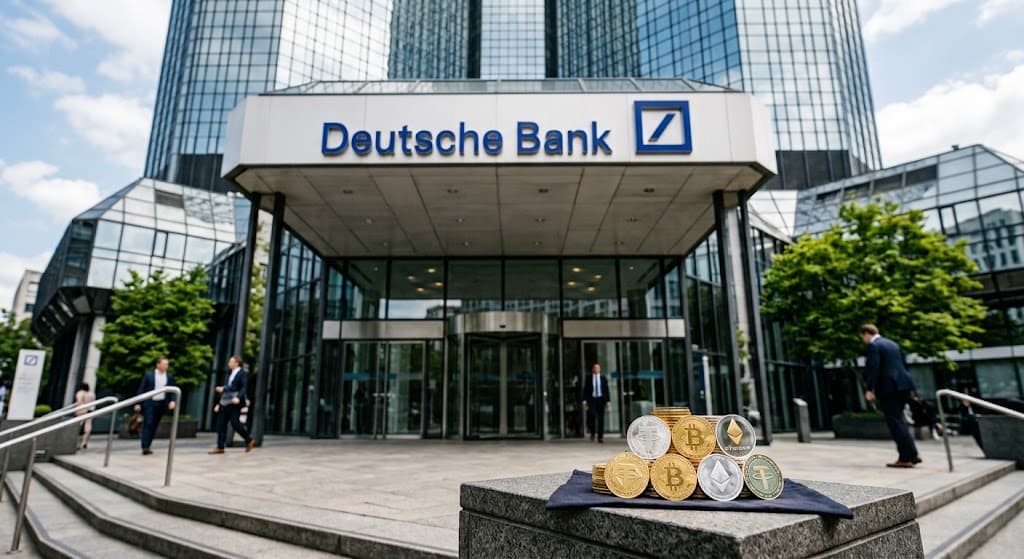
Deutsche Bank will launch regulated digital asset custody for institutional and corporate clients in Europe this year, initially supporting Bitcoin, Ether, and selected stablecoins, with plans to expand to tokenized financial instruments.
Deutsche Bank is preparing to launch a digital asset custody service for institutional and corporate clients in Europe, adding Bitcoin, Ether and selected stablecoins to its regulated financial-services infrastructure.
The German bank said the service is expected to go live with its first clients this year, subject to completion of the applicable regulatory process. The offering will initially serve clients of Deutsche Bank's Corporate Bank and Investment Bank, including corporates, asset managers, hedge funds, depositaries, brokers and government institutions.
The move puts one of Europe's largest banks directly into the institutional digital asset custody market, a segment that has increasingly attracted major financial institutions.
Deutsche Bank's initial custody offering will support selected digital assets, including Bitcoin and Ether, alongside selected stablecoins.
The bank will provide custody and transfer capabilities, allowing institutional clients to safeguard digital assets and transfer them to third parties through its infrastructure.
The service is being developed with Taurus, the Swiss digital asset infrastructure provider, which Deutsche Bank has previously partnered with on its digital asset strategy.
Deutsche Bank said the initial rollout will be followed by a gradual expansion of supported assets, depending on client demand, regulatory requirements, risk management and the bank's internal product-approval process.
The bank is also positioning custody as part of a wider digital asset strategy.
Deutsche Bank said it intends to expand the service to include custody of tokenized financial instruments, extending its role beyond native digital assets.
The approach reflects a broader shift among major financial institutions toward building infrastructure that can handle both crypto assets and blockchain-based representations of traditional financial instruments.
That trend is already visible across the banking sector. Citi, for example, has been developing digital asset infrastructure that includes Bitcoin custody alongside a broader push toward 24/7 digital asset services.
Standard Chartered has similarly expanded from digital asset custody into institutional Bitcoin and Ether trading in the UAE, while also integrating custody and tokenization into its broader digital asset strategy.
The growing focus on custody reflects one of the central infrastructure requirements for institutional participation in digital assets.
Rather than relying solely on crypto-native custodians, institutions can increasingly access digital assets through established financial institutions operating within regulated frameworks.
BNY, for example, expanded its institutional digital asset custody operations into Abu Dhabi earlier this year, initially supporting Bitcoin and Ethereum with plans to extend into stablecoins and tokenized real-world assets.
In the United States, Block has also sought to establish a federally regulated trust bank focused on Bitcoin and stablecoin custody, highlighting a similar move toward embedding digital asset safekeeping within regulated banking structures.
Deutsche Bank's announcement adds a major European banking institution to that developing infrastructure layer.
The bank expects to begin serving its first custody clients in 2026, subject to the completion of the applicable regulatory requirements.
Deutsche Bank said its digital asset strategy is designed to complement, rather than replace, traditional financial infrastructure.
“Digital assets are not a replacement for the traditional financial system but an important complement to it,” Gerald Podobnik, Co-Head of Deutsche Bank's Corporate Bank, said in the announcement.
The initial custody service therefore represents a narrower step than a full-scale move into crypto trading or issuance. But with Bitcoin, Ether, stablecoins and eventually tokenized financial instruments on the roadmap, the bank is building a digital asset infrastructure layer within its existing institutional business.
The move comes as global banks increasingly add custody, trading, settlement and tokenization capabilities to their digital asset offerings, bringing blockchain-based assets closer to established financial-market infrastructure.

Disclaimer of Warranty
The information provided in this article is for general informational purposes only. We make no warranties about the completeness, reliability, and accuracy of this information. Read full disclaimer

Editor's Picks

As U.S. Crypto Legislation Stalls, Circle Launches Its Own Financial Network

Walid Abou Zaki

Sep 16, 2026

9 min

Stablecoin Yield Fight Helps Derail CLARITY Act in Senate
Walid Abou Zaki
Sep 15, 2026
8 min
Why Zondacrypto’s Collapse Would Unfold Differently in the UAE
Walid Abou Zaki
Aug 28, 2026
8 min
Read More Articles

In the Same Space

USDU Expands UAE Reach With Crypto.com App Integration
News Desk
Sep 10, 2026
4 min
DDSC and Network International Launch UAE’s First In-Store AED Stablecoin Pilot
News Desk
Sep 9, 2026
2 min
UAE's Fuze Finance Expands Into Switzerland With Regulated Crypto Infrastructure and Institutional Push
Anna K.
Sep 8, 2026
4 min

Bitcoin ETFs Attract $731M in Strongest Inflows Since January
News Desk
Sep 4, 2026
3 min