Advertisement
Regulation & Policy
Share

WA
CEO & Editor-in-Chief


The US Senate voted 49–50 against advancing the Digital Asset Market Clarity Act, falling short of the 60-vote cloture threshold, as disputes over stablecoin yield, bank deposit competition, and political ethics objections combined to block the bill.
The US Senate’s failure to advance the Digital Asset Market Clarity Act was publicly shaped by partisan disagreements and concerns over political conflicts of interest. Beneath that political confrontation, however, was an equally consequential economic dispute: whether stablecoins should be allowed to compete with bank deposits by offering holders rewards or yield.
Senators voted 49–50 on Tuesday against invoking cloture on the motion to proceed to H.R. 3633, commonly known as the CLARITY Act. Supporters needed 60 votes to move the legislation toward floor debate.
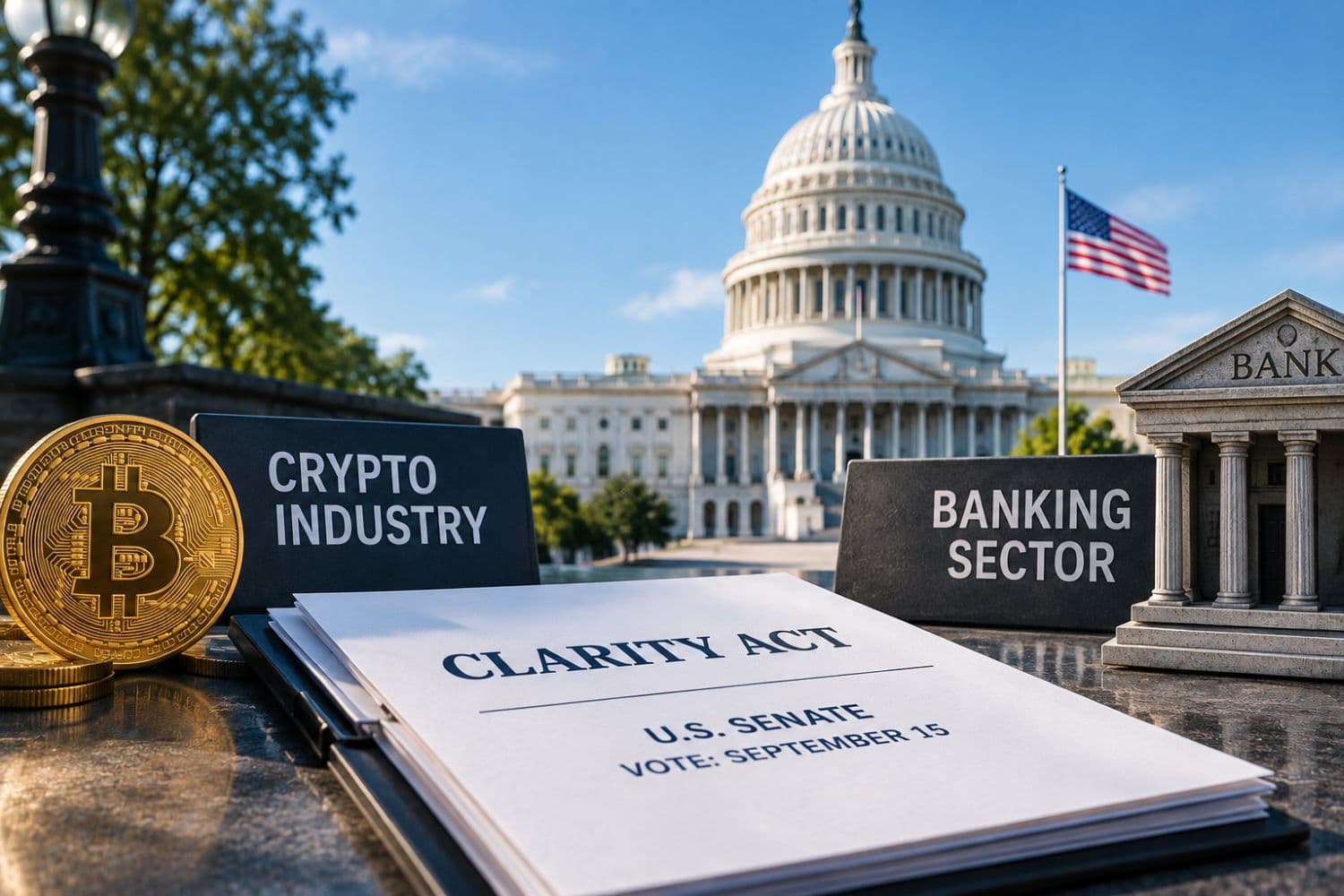
The outcome blocks the bill from advancing at this stage. It also represents a tactical victory for the banking sector, which spent months warning that stablecoin rewards could draw money away from traditional deposits and weaken banks’ ability to fund lending.
For the digital asset industry, the result showed how a comprehensive market-structure bill had become tied to a narrower but fundamental question: who will hold—and earn from—the digital dollars moving through the future financial system?
The CLARITY Act was designed to answer broader regulatory questions. It seeks to define how digital assets are treated under US law, clarify the respective responsibilities of the Securities and Exchange Commission and Commodity Futures Trading Commission, and establish rules for exchanges and other digital asset intermediaries.
The official bill text describes a framework governing the offer and sale of digital commodities and the roles of the two federal market regulators.
Yet stablecoin rewards gradually became one of the legislation’s most difficult negotiating points.
The GENIUS Act, enacted in 2025, established a federal framework for payment stablecoins and restricted issuers from paying interest or yield merely for holding them. The remaining dispute centered on whether exchanges, affiliated platforms and other service providers could offer rewards—and whether incentives connected to payments or platform activity should be treated differently from passive yield.
The crypto industry argued that activity-based rewards should remain possible and that extending the prohibition too broadly would limit competition and product innovation. Banks saw the distinction as a potential route around the existing restriction.
For banks, the debate was not simply about terminology. It concerned their traditional funding model.
Customer deposits provide banks with a relatively stable source of money that supports lending. If consumers can keep dollar-denominated value in stablecoins, use those assets for payments and receive a return, stablecoin balances begin to resemble an alternative to certain bank accounts.
Banking groups warned that this could pull deposits from the banking system, raise funding costs and reduce the credit available to households and businesses. The concern was particularly forceful among community banks, which have less access to alternative funding than the largest financial institutions.
The crypto industry countered that banks were using financial-stability arguments to protect themselves from competition. From that perspective, preventing platforms from sharing stablecoin-related revenue with users would preserve the banks’ advantage rather than protect the financial system.
This was not a last-minute disagreement. Reuters reported in March that the legislation had already stalled because banks opposed provisions allowing stablecoin issuers and crypto firms to offer yield-bearing products and other rewards.
The conflict later developed into a wider lobbying battle. Crypto groups campaigned for the legislation, while banking organizations took their concerns to senators in their home states. Both sides presented the dispute as a question of competition, financial stability and the future shape of dollar-based payments.
Banks alone did not defeat the procedural motion. The bill also faced strong opposition from Democrats demanding stricter ethics provisions governing public officials with crypto holdings or commercial interests.
Republican lawmakers released revised language before the vote. It would have required political officials with significant interests in crypto companies to divest those holdings or place them in blind trusts. It also expanded the enforcement role of state attorneys general.
Leading Democrats maintained that the protections did not go far enough, particularly in relation to President Donald Trump’s crypto interests and those of his family. Other concerns included illicit-finance safeguards and the extent to which federal authorities could intervene in enforcement actions brought by states.
These groups did not need to oppose the bill for the same reason. Under the Senate’s 60-vote cloture threshold, banking concerns, Republican hesitation and Democratic ethics objections could combine to prevent the legislation from advancing.
The political argument belonged largely to the Democrats, but the banking lobby won the immediate economic battle: the digital asset industry did not obtain market-structure legislation while preserving the stablecoin rewards model it wanted.
Tuesday’s vote was not a final vote on the substance of the CLARITY Act.
The Senate voted on “cloture on the motion to proceed.” In plain language, senators were deciding whether to limit procedural resistance and allow the chamber to begin considering the bill.
For most legislation, invoking cloture requires three-fifths of the Senate, normally 60 votes. A simple majority is not enough.
Even if cloture had been invoked, senators would still have needed to complete the motion to proceed, debate the legislation, consider amendments and later vote on final passage. Any Senate version that differed from the House legislation would also have required further work between the two chambers.
The accurate description is therefore that the CLARITY Act failed to advance, not that the Senate finally rejected or defeated the bill itself.
The outcome contrasts with the bipartisan support the legislation received earlier in Congress. The House of Representatives passed the CLARITY Act by 294–134 in July 2025.
The Senate Agriculture Committee, which oversees the CFTC, advanced related digital commodity legislation in January 2026. The Senate Banking Committee followed in May, advancing its version by 15–9, with two Democrats joining committee Republicans.
Those votes showed support for creating federal digital asset rules. They did not demonstrate agreement over the stablecoin economy that would operate alongside them—or provide the 60 senators needed on the floor.
The vote gives banks greater leverage over the next round of negotiations. Supporters of the CLARITY Act may now face a difficult choice between accepting stronger restrictions on stablecoin rewards or risking further delays to the wider market-structure framework.
Still, the banking sector’s victory is tactical rather than permanent. No new restriction on stablecoin rewards became law as a result of the vote, and the broader adoption of stablecoins continues. Banks are also developing their own tokenized deposits, payment products and digital asset services.
Senate leaders could revise the legislation and attempt another vote. But the approaching November midterm elections leave limited floor time for a complex bill with several unresolved political and commercial disputes. If Congress does not complete the legislation before its current term ends, lawmakers would generally need to restart the process in the next Congress.
Bitcoin traded near $75,900 during the vote and was down approximately 1.3% over the preceding hour, according to prices shown alongside the live proceedings. The decline was noticeable, but it did not resemble a disorderly repricing following an unexpected regulatory shock.
That reaction is consistent with the view that much of the disappointment was already reflected in the market. Before the vote, investors and analysts had increasingly questioned whether supporters could assemble 60 votes.
Market attention now turns to the Federal Reserve’s interest-rate decision, economic projections and Chair Jerome Powell’s comments. Those signals will shape expectations for liquidity, Treasury yields and the dollar—forces with a more immediate impact across the digital asset market.
The CLARITY Act was intended to determine the regulatory architecture of US digital assets. Its latest setback suggests that the more decisive contest may be over the economics underneath that architecture: will stablecoins complement the banking system, or be permitted to compete directly for its deposits?

Disclaimer of Warranty
The information provided in this article is for general informational purposes only. We make no warranties about the completeness, reliability, and accuracy of this information. Read full disclaimer

Editor's Picks

Why Zondacrypto’s Collapse Would Unfold Differently in the UAE

Walid Abou Zaki

Aug 28, 2026

8 min

The Missing Orchestration Layer Holding Back Institutional Digital Assets
Julian Sawyer
Aug 18, 2026
5 min

Beyond Crypto Access: How ARP Digital Is Building the UAE’s Digital Capital Infrastructure
Anna K.
Aug 17, 2026
8 min
Read More Articles

In the Same Space
U.S. House Unveils Crypto Tax Bill Ahead of Key Markup
News Desk
Sep 15, 2026
4 min

SEC Seeks to Allow Blockchain as Official Ledger for Tokenized Securities
News Desk
Sep 11, 2026
7 min
U.S. Crypto, Banks Escalate Lobbying Ahead of Clarity Act Vote
News Desk
Sep 10, 2026
2 min

CFTC Seeks Dismissal of CME Challenge to Kalshi Bitcoin Perpetuals
News Desk
Sep 3, 2026
4 min