Advertisement
Regulation & Policy
Share
The U.S. Senate's final CLARITY Act draft restricts deposit-like yield on payment stablecoins and grants Treasury new intervention powers if stablecoin growth triggers significant bank deposit flight.
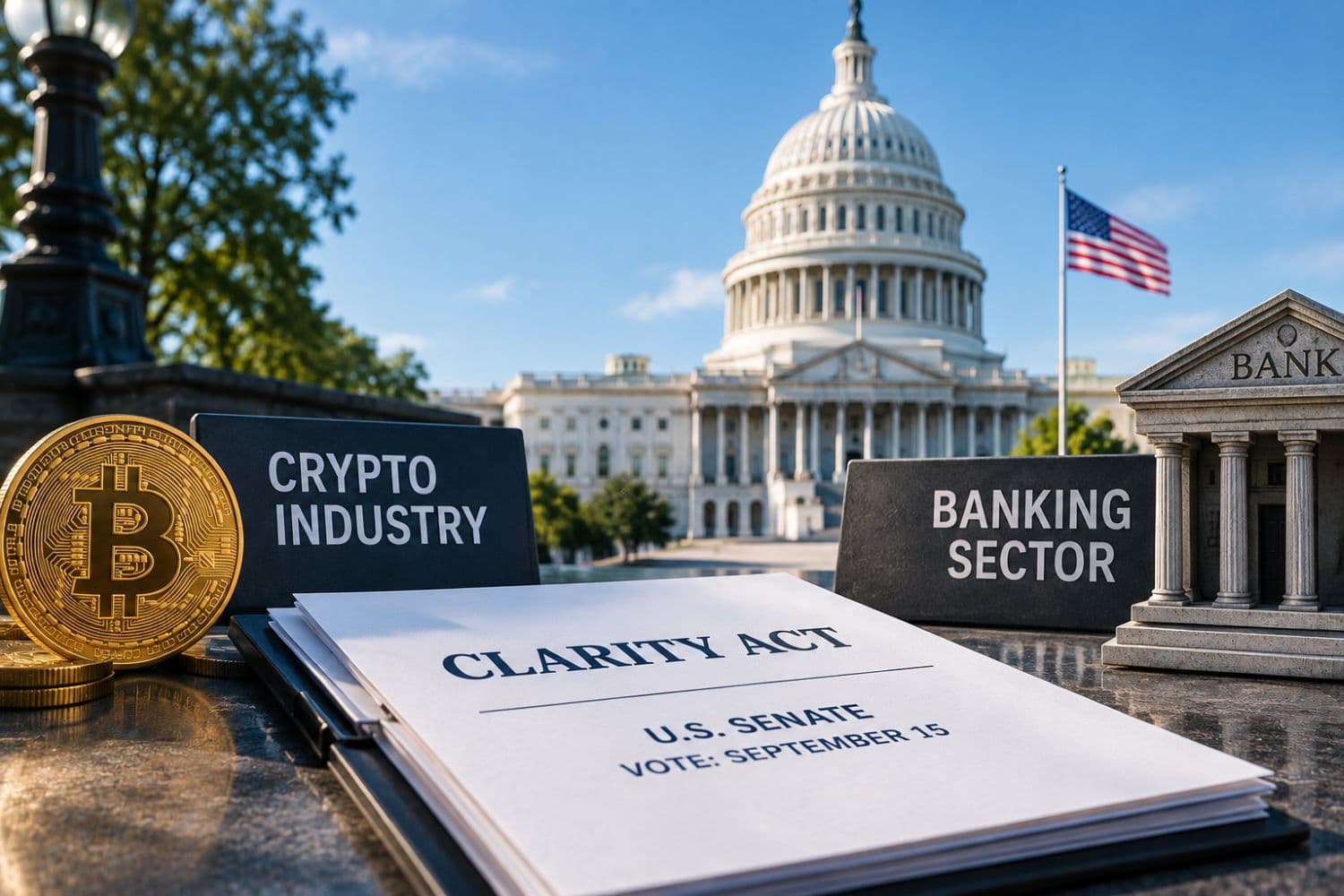
The U.S. Senate has released the final draft of the Digital Asset Market CLARITY Act ahead of a key procedural vote, with stablecoin rewards emerging as one of the bill’s most consequential compromises between the crypto industry and traditional banking sector.
Senate Banking Digital Assets Subcommittee Chair Cynthia Lummis, Senate Banking Committee Chairman Tim Scott and Senate Agriculture Committee Chairman John Boozman released the final text on September 14, saying it incorporates 126 substantive changes requested by Democrats following more than a year of bipartisan negotiations.
Among the most closely watched changes is Section 404, which addresses interest and yield on payment stablecoin balances. Rather than imposing a blanket ban on stablecoin rewards, the provision targets rewards that function economically like interest on bank deposits while preserving incentives linked to genuine payment activity.
Under Section 404, covered digital asset service providers and their affiliates would be prohibited from paying U.S. customers interest or yield simply for holding payment stablecoins or maintaining a stablecoin balance.
The provision also reaches programs that could effectively replicate deposit interest through rewards, loyalty points, promotions or similar incentives. At the same time, regulators would have authority to clarify which transaction-based or activity-based rewards remain permissible.
The distinction matters because the debate has moved beyond whether stablecoin issuers themselves should pay interest. The final language extends the restrictions to covered digital asset service providers and affiliates, putting pressure on the broader ecosystem of exchanges and platforms that can use rewards to attract stablecoin balances.
The bill also introduces restrictions on how payment stablecoins can be marketed. Providers would not be allowed to present them as bank deposits, investment products, government-backed products or FDIC-insured products, while disclosures would be required around compensation connected to holding or using stablecoins.
The more significant political compromise may be the additional authority given to the Treasury Secretary.
The final CLARITY Act gives Treasury new powers to respond if payment stablecoins contribute to significant deposit movement away from banks. Lummis, Scott and Boozman described the measure as a “circuit-breaker” intended to protect community banks and the farmers and small businesses that rely on them.
That provision addresses one of the banking industry's central concerns: that rapidly growing stablecoin balances and rewards could compete with bank deposits and potentially affect banks' ability to fund lending.
The approach therefore stops short of treating all stablecoin rewards as inherently prohibited. Instead, it establishes a baseline restriction on deposit-like yield while giving Treasury an additional intervention tool if concerns over deposit flight materialize.
The issue remains politically contested. Banking groups have continued to argue that the latest text does not go far enough to address the potential impact of stablecoin rewards on deposits, while supporters of the compromise argue that the restrictions are targeted rather than broad enough to undermine stablecoin payment use cases.
Stablecoin yield is only one part of the final package.
The September 14 draft also incorporates new ethics provisions, changes to law-enforcement and anti-money-laundering measures, consumer protections, affiliate-trading restrictions and revisions affecting software developers and state consumer-protection laws. It also includes changes to the Blockchain Regulatory Certainty Act designed to protect developers from money-transmission registration requirements while establishing a civil safe harbor.
The breadth of the changes reflects the political effort behind the latest version. The bill originated as a market-structure proposal but has expanded into a wider framework covering digital commodities, stablecoins, enforcement, consumer protection and political ethics.
The final text is expected to be offered as an amendment in the nature of a substitute if the Senate advances the legislation following Tuesday's vote.
For the stablecoin market, however, Section 404 could prove to be one of the provisions with the most immediate commercial consequences. It draws a clearer line between rewards for using a stablecoin as a payment instrument and rewards that make a stablecoin balance function more like an interest-bearing deposit.
The result is a compromise that leaves stablecoin-based payment incentives viable while putting the industry on notice that deposit-like yield will face tighter regulatory scrutiny — and that Treasury could gain additional authority if the banking system begins to feel the effects.

Disclaimer of Warranty
The information provided in this article is for general informational purposes only. We make no warranties about the completeness, reliability, and accuracy of this information. Read full disclaimer

Editor's Picks

Why Zondacrypto’s Collapse Would Unfold Differently in the UAE

Walid Abou Zaki

Aug 28, 2026

8 min

The Missing Orchestration Layer Holding Back Institutional Digital Assets
Julian Sawyer
Aug 18, 2026
5 min

Beyond Crypto Access: How ARP Digital Is Building the UAE’s Digital Capital Infrastructure
Anna K.
Aug 17, 2026
8 min
Read More Articles

In the Same Space

Kalshi's Bid for Non-Stop Stock Perpetuals Reignites CFTC-SEC Turf War
News Desk
Sep 11, 2026
8 min

Iran Turns to Crypto as Sanctions Bite, But USDT Has a Control Problem
Salma Naueihed
Sep 9, 2026
5 min

US and UK Launch Joint Effort to Tackle Crypto Investment Fraud
News Desk
Sep 4, 2026
5 min

CFTC Seeks Dismissal of CME Challenge to Kalshi Bitcoin Perpetuals
News Desk
Sep 3, 2026
4 min