
Advertisement
Regulation & Policy
Share
SN
Senior English Editor


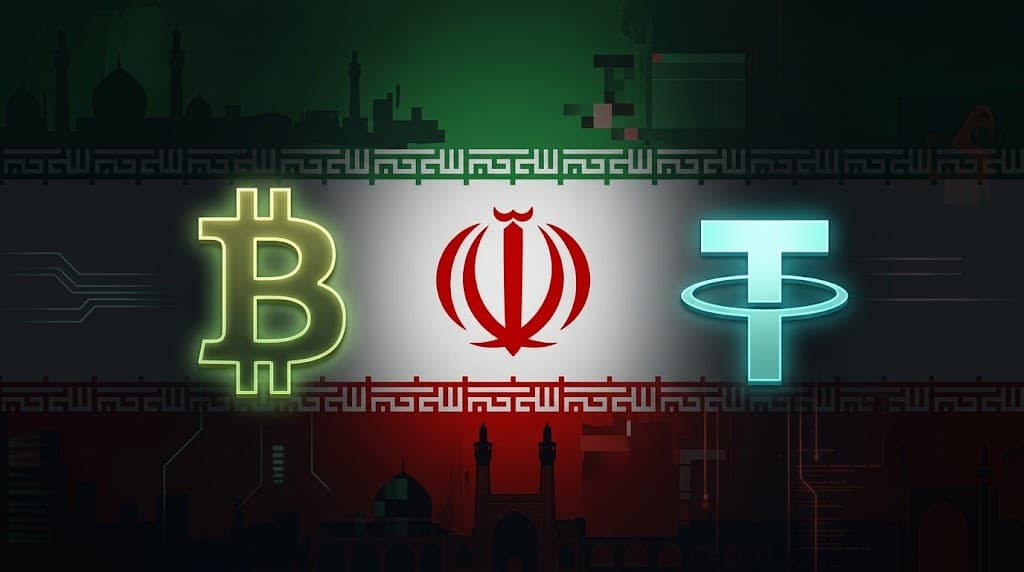
Iran moved roughly $10 billion in crypto in 2025 to circumvent U.S. sanctions, but Tether's ability to freeze USDT—demonstrated by the freezing of ~$475 million in Iran-linked central bank addresses—reveals a critical vulnerability in that strategy.
Iran is increasingly turning to cryptocurrencies to keep cross-border trade and financial activity moving as U.S. sanctions tighten, but its growing reliance on Tether’s USDT also exposes a weakness in the strategy: the dollar-pegged stablecoin can be frozen by its issuer.
Iran has historically used informal financial channels to work around restrictions on its access to the global banking system. Now, cryptocurrencies are becoming part of that infrastructure. Around $10 billion in crypto moved through Iran in 2025, according to the Financial Times, as traders and exporters increasingly use digital assets for cross-border transactions and to finance imports.
The development highlights both the utility of crypto under financial restrictions and the limits of that utility when the asset being used is a centrally issued stablecoin.
Iran's growing crypto activity comes as U.S. sanctions and broader economic pressure make conventional cross-border finance increasingly difficult.
The country's central bank has eased some foreign-exchange controls, allowing exporters to repatriate funds through informal channels, including crypto platforms. Traders can also use export revenues to finance imports directly rather than relying entirely on conventional banking channels.
Bitcoin and stablecoins offer an alternative route for moving value across borders without depending on correspondent banks in the same way as conventional dollar transfers.
For Iran, that makes crypto useful not necessarily because it replaces the global financial system, but because it can provide additional channels around parts of it.
That distinction is becoming increasingly important as Washington expands its focus beyond traditional banks and financial institutions.
The strongest example is USDT.
Unlike Bitcoin, USDT is issued and controlled by a centralized company, Tether. While transactions take place on public blockchains, Tether retains the ability to freeze tokens held at specific addresses.
That capability has already been used against Iranian-linked wallets.
In July, Tether froze roughly $131 million in USDT held across four wallets that U.S. authorities had identified as belonging to Iran's central bank. Chainalysis said the action brought the amount of USDT frozen from Iran-linked central bank addresses to almost $475 million.
That creates a fundamental distinction between using crypto and using a genuinely censorship-resistant asset.
Iran may be able to move USDT on-chain without going through a conventional bank, but that does not mean the resulting funds are beyond the reach of sanctions enforcement.
The blockchain can continue processing transactions while the underlying tokens can become inaccessible to their holders.
The U.S. government is also increasingly treating crypto infrastructure connected to Iran as part of the sanctions landscape.
In June, the U.S. Treasury's Office of Foreign Assets Control sanctioned Nobitex, Iran's largest digital asset exchange, along with three other Iranian exchanges, accusing them of facilitating sanctions evasion and illicit financial activity.
In August, Treasury went further by targeting two additional digital asset exchanges and a network of entities that it said were facilitating cryptocurrency activity for Tehran and the Islamic Revolutionary Guard Corps.
The pressure is unlikely to remain limited to exchanges.
U.S. Treasury Secretary Scott Bessent said on Sept. 2 that digital assets were among the areas the Trump administration was considering targeting as part of its campaign to increase economic pressure on Iran.
That puts exchanges, stablecoin issuers and other intermediaries in a difficult position: serving Iranian-linked customers can provide access to a market with substantial demand for alternative payment channels, but it can also create significant sanctions exposure.
Iran's experience demonstrates an important distinction in the debate over crypto and sanctions.
Blockchain networks can make it possible to transfer value without relying on the traditional correspondent banking system. That can be particularly valuable for a country largely cut off from conventional international finance.
But the financial assets moving across those networks are not necessarily equally resistant to intervention.
Bitcoin's decentralized structure makes it fundamentally different from a centrally issued stablecoin. USDT can move globally and around the clock, but its issuer remains capable of freezing particular balances.
For Iranian users, that means the usefulness of USDT depends not only on whether they can acquire and transfer the token, but also on whether the counterparties, wallets and infrastructure involved can continue operating without becoming sanctions targets.
Iran's growing use of crypto is therefore less a demonstration that sanctions no longer work than a test of how far digital assets can provide an alternative financial infrastructure.
There is evidence that crypto can help Iranian traders move value and facilitate commerce when conventional channels are constrained. But the same activity is attracting greater attention from U.S. authorities, while centralized stablecoins introduce their own points of control.
That leaves Iran with a complicated proposition: crypto can provide an additional route around traditional financial restrictions, but not every crypto asset provides the same degree of independence from the financial system it is meant to circumvent.
For USDT in particular, the contradiction is becoming harder to ignore. The token provides digital access to dollars outside traditional banking rails, while the issuer retains the ability to cut off access to those dollars when sanctions come into play.
As Washington increasingly brings digital assets into its sanctions strategy, Iran's crypto experiment may ultimately show not that sanctions can be bypassed indefinitely, but where the limits of that bypass actually lie.

Disclaimer of Warranty
The information provided in this article is for general informational purposes only. We make no warranties about the completeness, reliability, and accuracy of this information. Read full disclaimer

Editor's Picks
In the Same Space

South Korea Plans Forex Law Change to Cover Stablecoins

News Desk

Oct 23, 2026

3 min

Coinbase Ireland Fined €3.25M as Safeguarding Failures Draw Second Irish Penalty
News Desk
Oct 23, 2026
4 min

South Korea’s Digital Asset Bill Nears Final Talks as 2027 Crypto Tax Looms
News Desk
Oct 22, 2026
3 min

Robinhood Plans Dubai Launch in 2027 After DFSA Authorization
Walid Abou Zaki
Oct 22, 2026
4 min