Advertisement
Stablecoins & Payments
Share
SN
Senior English Editor


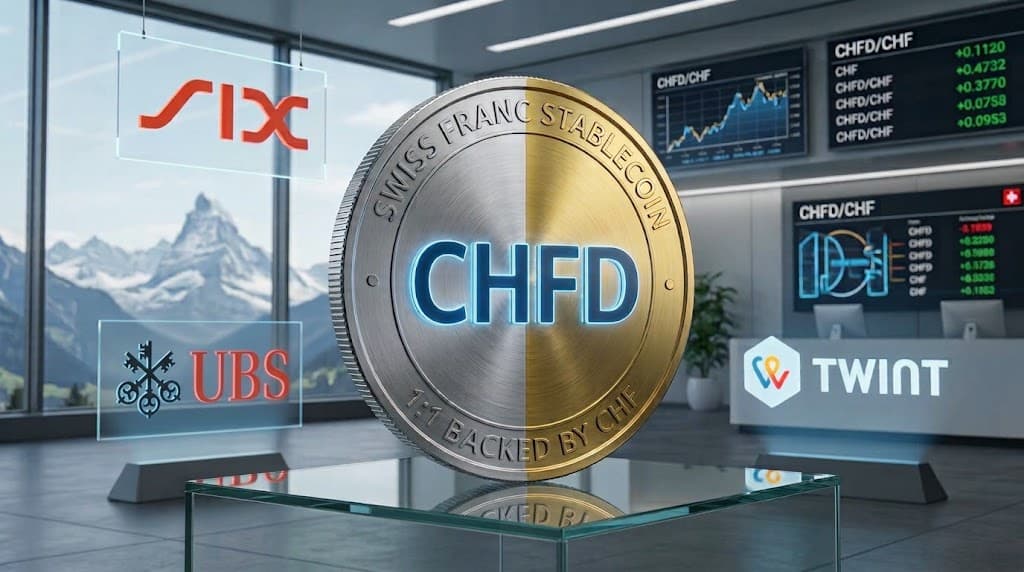
UBS, SIX, TWINT and six other Swiss financial institutions have begun live sandbox testing of CHFD, a 1:1 Swiss franc-pegged stablecoin, with the pilot running through end-2026 to evaluate payments, digital asset settlement and programmable transaction use cases.
UBS and a group of Swiss financial institutions have moved their Swiss franc stablecoin initiative into live testing, adding financial market infrastructure operator SIX and payments platform TWINT to the project.
The initiative is testing CHFD, a Swiss franc-pegged stablecoin designed to maintain a 1:1 value against the franc, in a controlled digital environment. According to UBS, CHFD has been technically live in the sandbox since the end of June, while the broader testing phase is expected to continue through the end of 2026.
The project brings together UBS, PostFinance, Sygnum, Raiffeisen, Zürcher Kantonalbank (ZKB), Banque Cantonale Vaudoise (BCV), SIX, TWINT and Swiss Stablecoin AG.
The initiative builds on the six-bank collaboration launched in April to examine potential applications for a Swiss franc stablecoin. Unlock Blockchain previously reported on the launch of the Swiss banks' Franc-pegged stablecoin testing initiative.
The sandbox is designed to test how a CHF-denominated stablecoin could be used under realistic conditions rather than to launch a commercial product.
UBS said the partners are examining automated transactions between financial institutions and the tokenized settlement of digital assets, alongside applications involving programmable payments.
The latter includes testing whether programmable payments could reduce fraud risks on online marketplaces, improve access to event tickets and make the distribution of public funds more efficient.
The testing environment operates with safeguards including a restricted group of participants and transaction limits. UBS said the initiative is open-ended, with the objective of identifying where a Swiss franc stablecoin could provide value and what technical, operational and regulatory requirements would need to be addressed before any potential future development.
The project therefore remains a pilot rather than a commercial launch. UBS has not announced a public launch date or confirmed that CHFD will eventually be introduced as a broadly available payment instrument.
The addition of SIX and TWINT broadens the initiative beyond its original group of banking participants.
SIX brings expertise in Switzerland's financial market infrastructure, while TWINT adds experience in domestic digital payments. Their participation gives the project access to infrastructure and payment perspectives alongside the banking institutions involved in the original initiative.
That combination could allow the sandbox to test applications extending beyond interbank settlement and institutional transactions.
The structure also reflects a wider shift in how financial institutions are approaching digital money. Rather than testing blockchain applications solely as back-end infrastructure, banks and market infrastructure providers are increasingly examining how tokenized money could interact with payment systems and programmable applications.
The Swiss project is part of a broader European and global move by banks to develop forms of digital money that can operate on blockchain infrastructure.
In Europe, the Qivalis initiative has brought together 37 banks to develop a euro-denominated stablecoin. Unlock Blockchain reported in May that the consortium had expanded to 37 members as European banks moved toward a shared euro stablecoin infrastructure.
The European effort has also moved into potential cross-border applications. Project Pangea, involving Qivalis alongside Korean banking and blockchain infrastructure participants, is testing how regulated euro and Korean won stablecoins could support near-instant foreign exchange settlement.
In the United States, banks are pursuing similar infrastructure strategies. Thirty-nine U.S. banking groups recently formed the BankChain Alliance to explore infrastructure for tokenized deposits, stablecoins and smart payments.
The Swiss initiative differs in its currency and institutional structure, but the underlying objective is similar: determining how regulated forms of digital money can operate across existing financial infrastructure while preserving the role of established financial institutions.
Switzerland has already tested blockchain-based representations of commercial bank money. In 2025, UBS, PostFinance and Sygnum participated in a pilot involving tokenized bank deposits on a public blockchain.
The new CHFD initiative explores a different form of digital money.
Tokenized deposits represent claims on individual commercial banks, while stablecoins are generally structured as transferable digital assets pegged to a fiat currency. The distinction matters because the two models can serve different purposes across payments, settlement and digital asset markets.
Unlock Blockchain previously examined this emerging competition between bank-issued tokenized deposits and stablecoins in its analysis of “Stablecoins vs. Tokenized Deposits: Who Will Control Digital Money?”
For Switzerland, the CHFD sandbox provides a way to test where a franc-denominated stablecoin could fit within that evolving digital money landscape.
The current phase is expected to run until the end of 2026. The participating institutions said the results will be used to assess potential applications as well as the technical, operational and regulatory requirements for any future development.

Disclaimer of Warranty
The information provided in this article is for general informational purposes only. We make no warranties about the completeness, reliability, and accuracy of this information. Read full disclaimer

Editor's Picks
In the Same Space

Bitcoin ETFs Reverse Outflows With $1B in Three-Day Inflows

News Desk

Oct 22, 2026

7 min

Switzerland Approves First Retail Spot Bitcoin ETF
News Desk
Oct 21, 2026
4 min

Qivalis Secures Dutch Approval for Euro Stablecoin
News Desk
Oct 15, 2026
3 min

Fuze Finance Targets US Market With New Modern Treasury Stablecoin Payment Deal
Anna K.
Oct 20, 2026
6 min