Advertisement
Institutional Adoption
Share
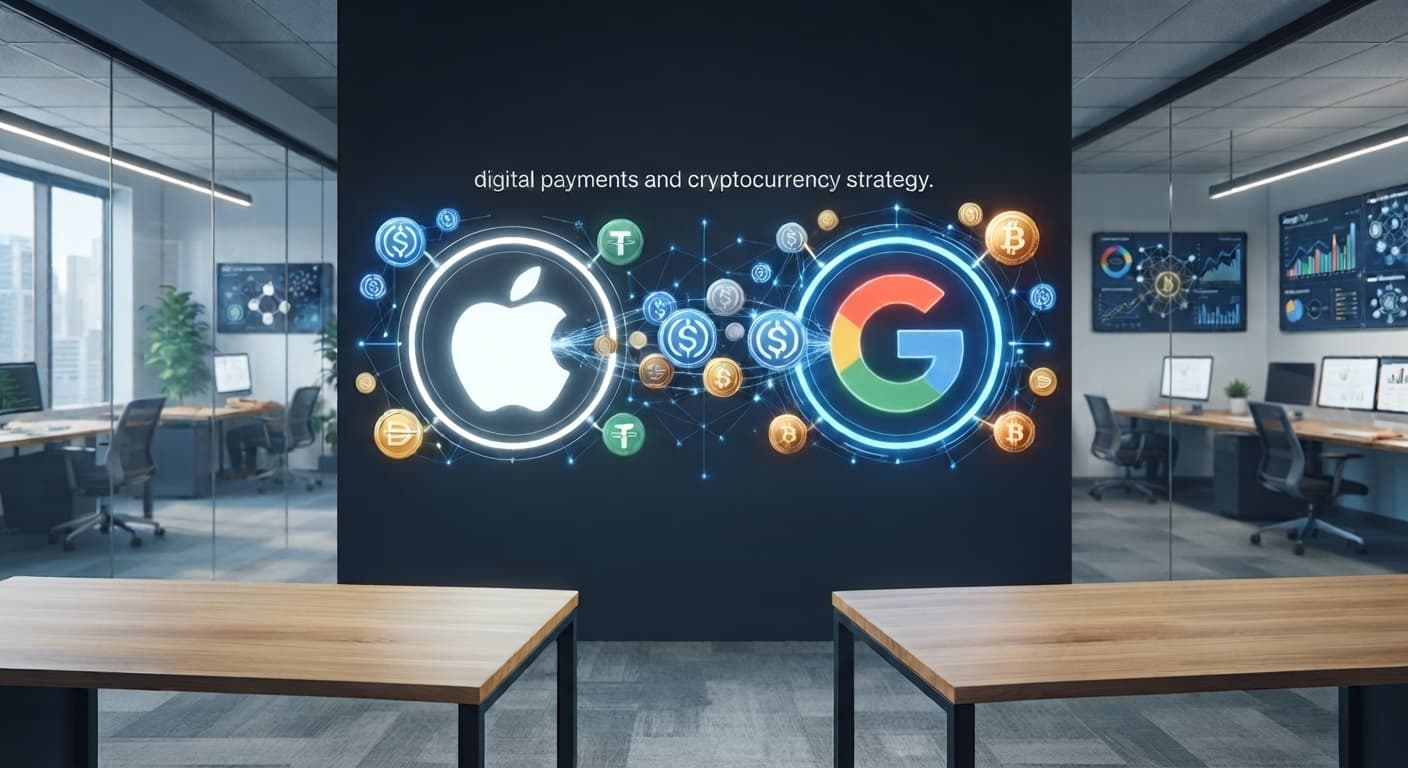
Apple and Google are recruiting for roles requiring stablecoin and blockchain expertise, signaling that both companies are building internal capabilities around tokenized finance and digital-asset infrastructure without announcing proprietary stablecoins.
Apple and Google are expanding their focus on digital-asset infrastructure, with both companies advertising roles that require expertise in stablecoins, blockchain technology and tokenized finance.
The positions point to different approaches. Apple is seeking a financial product strategy lead for Apple Pay in the United States, with knowledge of stablecoins and tokenized deposits among the preferred qualifications. Google, meanwhile, is hiring a Web3 principal architect in Hong Kong to work on blockchain infrastructure and digital-asset systems for institutional clients.
Neither company has announced a proprietary stablecoin through these job postings. Instead, the openings provide a glimpse into how both technology giants are building expertise around digital assets and their potential role in payments and financial infrastructure.
Apple's August 26 job posting seeks a financial product strategy lead for Apple Pay in the U.S., covering products associated with Apple Card and Apple Cash.
The team oversees consumer credit cards, peer-to-peer transfers, stored-value products and other financial services connected to Apple's payments ecosystem. The successful candidate will evaluate new product structures, business models and potential partnerships while contributing to Apple's longer-term financial product strategy.
The position requires at least six years of experience in areas including consulting, investment banking, corporate strategy, strategic finance or related planning roles. Apple also lists experience with consumer payment models, international payment systems and financial modeling among the core requirements.
Knowledge of stablecoins, tokenized deposits and blockchain technology appears among the preferred qualifications.
The role will involve working with product, business development and data science teams to assess potential products and partnerships across areas such as digital wallets, payments and e-commerce.
Apple lists a U.S. base salary range of $149,700 to $280,000, depending on qualifications, experience and location.
Importantly, the posting does not identify a specific blockchain-based or stablecoin product under development.
Apple's interest in digital-asset concepts comes while its existing financial services continue to operate through conventional payment infrastructure.
The company announced in January that JPMorgan Chase would become the new issuer of Apple Card, with the transition expected to take about 24 months. Mastercard will remain the card's payment network during the changeover.
Apple's public Apple Pay materials continue to focus on card payments, merchants, peer-to-peer transfers and digital wallets. The company has not announced its own stablecoin.
That makes the new role notable less as evidence of an imminent Apple digital currency and more as an indication that blockchain-based financial products have entered the company's strategic planning.
Google is taking a more technical approach with its new Web3 role.
The company is hiring a principal architect for Web3 in Hong Kong, with the position focused on digital-asset infrastructure and Google Cloud projects across the Asia-Pacific region.
The job requires up to 10 years of experience in systems engineering, distributed systems or cloud infrastructure, along with at least four years working with production Web3 systems, blockchain protocols or smart-contract platforms.
Google lists multi-party computation, hardware security modules, transaction-signing systems and confidential computing among the preferred areas of expertise.
The job description also specifically references the tokenization of real-world assets, stablecoin networks, tokenized deposits and digital-asset custody within regulated financial environments.
The architect will work with blockchain companies, institutional exchanges, custodians, financial institutions and decentralized applications. Responsibilities include helping customers design systems for blockchain verification, indexing, key management and enterprise security.
Regulatory compliance is also part of the role, including guidance on virtual-asset risk, security and compliance frameworks applicable to regional rules such as those overseen by the Hong Kong Monetary Authority and the Securities and Futures Commission.
The recruitment comes alongside Google's broader work on blockchain-based financial infrastructure.
Google Cloud's Global Ledger is described as a managed distributed-ledger service for financial institutions. Its API allows institutions to build payment services, tokenize assets and manage digital representations of commercial bank money.
Documentation updated in 2026 describes capabilities that allow authorized operators to mint, transfer and burn tokenized forms of value within defined permissions.
Google positions the service as infrastructure for banks and financial intermediaries building payment products and financial markets rather than as a Google-issued stablecoin.
The distinction is important: Google is developing the infrastructure and tools for financial institutions to work with tokenized assets without positioning itself as the issuer of the underlying financial products.
Google's digital-asset ambitions extend into machine-to-machine payments.
The company's Agent Payments Protocol (AP2) supports extensions for stablecoins and digital currencies. Google Cloud has also worked with Coinbase, the Ethereum Foundation, MetaMask and other partners on the A2A x402 extension, which is designed to facilitate crypto payments between AI agents.
The underlying concept is that autonomous software agents could eventually need to pay for APIs, computing resources and other digital services without relying on conventional banking accounts.
Google Cloud and the Solana Foundation have also worked on Pay.sh, which allows AI agents to pay for APIs and cloud computing resources using stablecoins on the Solana network.
These projects place stablecoins in a broader context for Google: not simply as digital versions of fiat currency, but as programmable payment instruments that could potentially support automated transactions between software systems.
Google's decision to recruit for the Web3 role in Hong Kong also comes against the backdrop of the city's developing stablecoin framework.
Hong Kong's stablecoin legislation took effect on August 1, 2025, establishing a licensing regime for issuers of fiat-referenced stablecoins. The Hong Kong Monetary Authority said in February 2026 that it was reviewing applications and expected only a limited number of licenses to be granted initially.
The framework covers issuers operating in Hong Kong, overseas issuers marketing Hong Kong dollar-referenced stablecoins and companies actively marketing regulated issuance services to the local public.
Requirements include reserve management, governance, risk controls and anti-money-laundering obligations.
The HKMA is also operating EnsembleTX, a platform designed to test real-world transactions involving tokenized assets and deposits.
That environment gives financial-technology companies and infrastructure providers an established regulatory setting in which to develop and test tokenized financial products.
Apple and Google are not alone in exploring the intersection between technology, payments and stablecoins.
Samsung has reportedly been considering stablecoin support for Samsung Wallet, although the company has not disclosed which assets or technical partners would be involved or provided a launch timeline.
The approaches remain different.
Apple's new role is centered on financial product strategy and payments, with stablecoins and tokenized deposits listed as areas of relevant expertise.
Google's Web3 position is more directly focused on technical infrastructure, institutional blockchain systems, tokenization, custody and regulated digital-asset applications.
Google's existing projects also give it a more visible blockchain footprint through initiatives such as Global Ledger, AP2 and more.
Neither company's latest recruitment activity amounts to an announcement of a proprietary stablecoin.
Instead, the openings suggest that stablecoins and tokenized assets are increasingly being treated as areas of expertise relevant to the future of payments and financial infrastructure.
The significance may ultimately lie less in whether Apple or Google issues a digital currency of its own and more in whether these companies become part of the infrastructure through which tokenized money and assets move.

Disclaimer of Warranty
The information provided in this article is for general informational purposes only. We make no warranties about the completeness, reliability, and accuracy of this information. Read full disclaimer

Editor's Picks
In the Same Space

Crypto Wealth Is Growing, but Traditional Wealth Infrastructure Is Not Ready

News Desk

Sep 10, 2026

4 min

Block Seeks U.S. Bank Charter for Bitcoin, Stablecoin Custody
News Desk
Sep 9, 2026
4 min

As U.S. Crypto Legislation Stalls, Circle Launches Its Own Financial Network
Walid Abou Zaki
Sep 16, 2026
9 min

UAE Leads 27 Markets as 69% Plan Digital Supply Chain Investment
News Desk
Sep 8, 2026
6 min