Advertisement
Insights
Share
AK
Senior English Editor


Kearney estimates $500 billion in GCC assets could be tokenized by 2030, with the UAE positioning itself as the primary hub after Coinbase selected Abu Dhabi Global Market as its international tokenization base. The central challenge is no longer regulatory permission but connecting issued tokens to real liquidity and institutional buyers.
Kearney estimated in January that close to $500 billion of GCC assets could be represented on blockchain by 2030, with private markets, the largest single category, at an estimated $154 billion.
The forecast is ambitious. However, the harder question is who will do the work of getting those assets there.
The UAE is making the strongest case to host that work. In August, Coinbase chose Abu Dhabi Global Market as its international tokenization hub, securing FSRA permission to arrange deals and provide custody for tokenized securities. A listed U.S. exchange could have put that work in Singapore, London or New York. It chose the UAE.
That decision says less about crypto-friendliness than it does about something rarer. The UAE is one of the few jurisdictions where every link in a tokenization chain now exists within its borders, from the regulator that approves the token to the bank that settles it. That is why the country has become a hub for real-world asset (RWA) tokenization, and why the next phase will be harder than the last.
Globally, tokenized real-world assets reached $38.6 billion in distributed value on September 28, 2026, according to RWA.xyz, excluding stablecoins. Forecasts for 2030 range from McKinsey’s base case of about $2 trillion to Ripple and BCG’s $9.4 trillion estimate. The wide gap reflects different definitions and assumptions, not certainty.
Kearney's Gulf forecast alone is roughly thirteen times the entire global on-chain market today.
Nonetheless, the UAE is not alone. Saudi Arabia completed its first tokenized title-deed transfer this year, and the Qatar Financial Centre is moving to enable real estate tokenization. The UAE's lead is real, but it is a lead, not a monopoly.
Tokenizing a real-world asset takes far more than minting a token. RWALabs.ae engaged with over 150 asset owners over the last 12 months, and the same concerns come up in almost every conversation:
Who will actually buy this, and where will the liquidity come from?
How deep are the markets, and which venue can list my RWA tokens?
Is this legal, and how should it be structured?
How much will it cost to launch and run?
The first question matters most, and asset owners are right to ask it.
A token can be created in ten minutes with a few lines of code, but that does not create a market, and it does not create liquidity. In fact, the data supports them.
Research finds that most RWA tokens have low trading volumes and long holding periods, while one study of tokenized property found that ownership changed hands roughly once a year. Liquidity has concentrated where natural buyers already existed, particularly in Treasuries and gold, while most tokenized real estate and private credit still wait for a second buyer. The UAE has solved the permission problem.
"The first thing every asset owner asks us is who is going to buy this. They're right to ask," said Anton Golub, Founding Member of RWALabs.ae and Head of Exchange GTM at Forte.
"You can mint a token in an afternoon, but nobody has ever bought one because the code was good. We support asset owners with finding the listing and trading venue before they issue anything."
The next challenge is connecting the regulatory and technology rails the UAE has built with the liquidity and investor base a token needs once it is issued.
A RWA tokenization advisor, sometimes called an orchestrator, sits between the underlying asset and the market it needs. The role is to sequence every stage, from asset and structuring through regulation, token design, technology, issuance and custody, to distribution and liquidity, so that the legal structure supports the token, the regulator sees a complete file, and the custody, banking and distribution partners are signed before issuance, not after.
"Tokenization is only as strong as the legal structure behind it and the investors who can trade it," saidIrina Heaver, UAE Crypto Lawyer, Founder of NeosLegal and Founding Member of RWALabs.ae. "Since 2018, we have seen STOs launched with no secondary venues to trade on, and opaque SPVs where the risk of the same asset being sold twice was too obvious to ignore. Investors remember that. What has changed in the UAE is that regulators now approve each structure individually, and that gives serious capital a reason to come back."
A token without a buyer is only a digital certificate. The value of tokenization is realized at the final stage - liquidity - and that stage must be designed from the start.
"Most projects treat distribution as the last step. However, it should be the first conversation," said Juliet Su, Founding Member of RWALabs.ae and Fund Partner at NewTribeCapital.
"The capital exists, from family offices in the Gulf to investors across Asia, but it has to be brought in through licensed channels, with a product the investors already understand. Nobody wires money into a token they can't explain to their own board."
This month puts the question on a global calendar. DTCC, the backbone of U.S. post-trade, is launching its tokenization service for Russell 1000 stocks, major ETFs, and Treasuries. Wall Street is tokenizing assets that are already liquid. The UAE is attempting the harder task of tokenizing assets that are not property, gold, private credit, and trade finance.
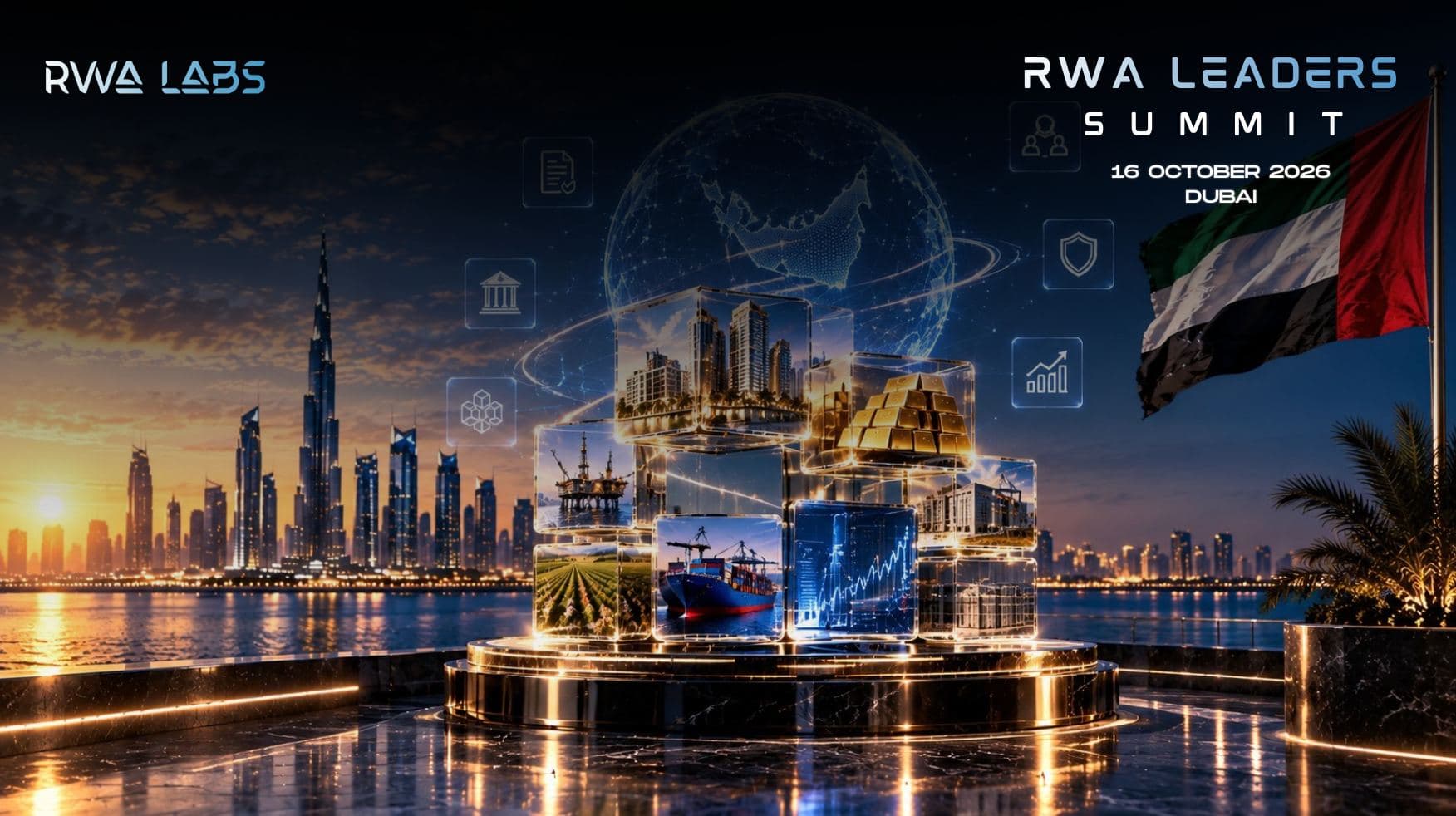
That work depends on the parties in the chain meeting in one room. The RWA Leaders Summit, co-hosted by RWALabs.ae and NeosLegal with support from the DMCC Crypto Centre, convenes on 16 October 2026 in Dubai. It brings together regulators, banks, asset owners, institutional investors, exchanges, custodians, stablecoin and payment providers, and tokenization infrastructure firms.
Attendance is by approved registration and is limited to C-level executives. Asset owners and institutions considering tokenization can apply here.
The UAE has built the infrastructure, but the next phase belongs to whoever can persuade asset owners to use it.

Disclaimer of Warranty
The information provided in this article is for general informational purposes only. We make no warranties about the completeness, reliability, and accuracy of this information. Read full disclaimer

Editor's Picks
When Assets Move—or Stop—Without Consent: The Limits of Crypto Wallet Control

Walid Abou Zaki

Sep 29, 2026

6 min

Where Do the Dollars Behind the UAE’s Crypto Economy Sit?
Anna K.
Sep 21, 2026
9 min

As U.S. Crypto Legislation Stalls, Circle Launches Its Own Financial Network
Walid Abou Zaki
Sep 16, 2026
9 min
Read More Articles

In the Same Space
ADGM Puts DLT Foundation Audits and Disclosure in Focus
Walid Abou Zaki
Sep 23, 2026
7 min
Stablecoins Solved the Transfer. Saleem Wants to Solve the Last Mile.
Ola Rajeh
Sep 21, 2026
8 min
VARA Approves Alya Marrakchi as Managing Director of GC Exchange FZE
Chantal Assi
Sep 21, 2026
4 min
UAE Stablecoin Market Expands as Digital Dirham Enters Next Phase
News Desk
Sep 18, 2026
7 min