Advertisement
Stablecoins & Payments
The ADGM-registered, pre-launch platform is borrowing an important lesson from M-Pesa: financial innovation does not always begin with a new device. Sometimes it begins by making better use of the one already in people’s hands.
Share
OR
Chief Commercial Officer


Saleem, an Abu Dhabi-based payment infrastructure company founded by Ramy Soliman and Faris Sibai, is building a pre-launch orchestration layer that routes stablecoin-based payments from institutional treasuries to recipients on basic handsets, including those without bank accounts or mobile data, targeting initial corridors from the Gulf into the Levant and Pakistan.
Stablecoins can move across a blockchain in seconds. Reaching the person they were intended to pay can still take days.
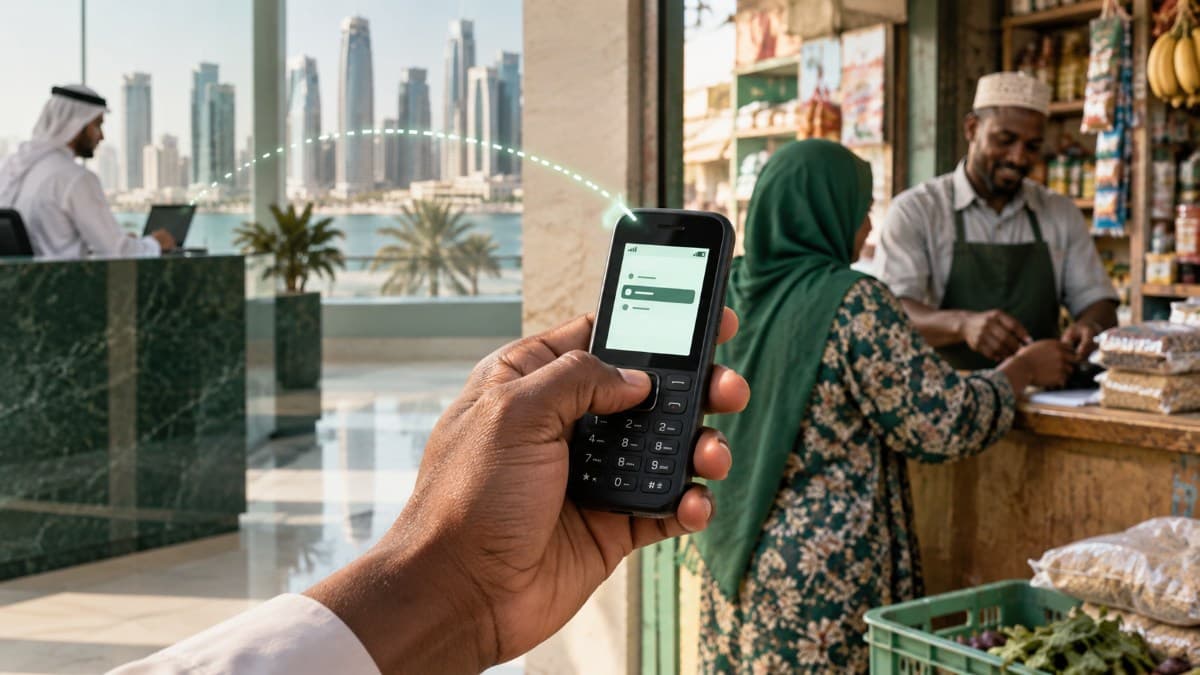
That contradiction sits at the center of Saleem, a new Abu Dhabi-based payment infrastructure company founded by Ramy Soliman and Faris Sibai. Saleem is building a rail through which an aid agency, government, employer, bank or corporate treasury could send value to a recipient using the phone already in their hand—even when that phone is a basic handset and the recipient has neither a bank account nor mobile data.
The proposition challenges one of the digital-asset industry’s most repeated claims. Stablecoins are regularly described as the clearest product-market fit for cross-border payments. Technically, much of that argument is justified: they can reduce settlement time, operate beyond banking hours and move value without passing through a long correspondent chain.
But settlement is not the same as delivery. A stablecoin arriving at an on-chain address is of little help to someone who cannot open a conventional wallet, manage private keys or convert the balance into something usable locally.
Saleem is betting that the next stage of stablecoin innovation will be determined not by how quickly a token crosses a network, but by what happens after it arrives.
The model inevitably recalls M-Pesa, though the two systems are structurally different.
When Safaricom and Vodafone launched M-Pesa in Kenya in 2007, its significance did not come from inventing the mobile phone or digitizing money for the first time. It came from combining the reach of an ordinary mobile handset with a trusted agent network that allowed customers to deposit, transfer and withdraw local currency.
M-Pesa met users where they already were. It did not wait for bank branches, smartphones or mobile applications to reach them. That distribution model helped it grow from a money-transfer service into infrastructure supporting payments, savings, credit and, more recently, access to investments. By early 2026, M-Pesa had approximately 35 million users in Kenya, according to Reuters.
Saleem is not attempting to reproduce M-Pesa on a blockchain. M-Pesa operates domestic mobile-money systems and controls a deeply established distribution network. Saleem is positioning itself as an institutional layer connecting different participants across borders: treasuries, regulated stablecoin and custody providers, local wallets, banks, telecom operators, exchange houses and merchants.
The similarity lies in the underlying principle. The user should not need the latest technology to benefit from financial innovation.
Under Saleem’s proposed model, an institution initiates and approves a payment run. A licensed partner receives the institution’s funds and, where required, converts them into regulated digital money. Saleem then validates the instructions, coordinates screening, chooses the route, records the payment and returns the reconciliation data.
On the receiving side, the value often lands in an operator or bank wallet the recipient already uses. Saleem is designed to sit above those existing wallets rather than require the recipient to open another one. Where no suitable wallet exists, the value can be held by a licensed custodian and made accessible through Saleem’s interfaces. The recipient can interact through USSD or SIM Toolkit on a basic handset, a KaiOS feature phone, an Android or iOS application, or a participating merchant.
The distinction is important: the basic phone does not hold the stablecoin or its private keys.
“The phone holds nothing; it only shows the balance under the person’s number,” Saleem told Unlock Blockchain. Under the target operating model, the funds and keys remain with a licensed custodian in the recipient’s country. If the handset is lost, the money remains with the custodian and access can be restored through the licensed partner after identity reverification.
This makes the phone an access mechanism rather than a self-custody device. It also shifts much of the regulatory and operational responsibility to the licensed institutions participating in each corridor.
Saleem does not plan to issue its own token. Nor does it intend, at launch, to hold customer money or private keys.
The company describes itself as the software and orchestration layer: checking instructions, coordinating sanctions and transaction screening, routing payments, maintaining a record of each step and producing reconciliation files that institutional payers can export into their own systems.
Cash-in, currency conversion, custody and cash-out would be undertaken by licensed partners under the rules of the relevant jurisdiction. Saleem has said it may pursue additional permissions, directly or through a group entity, as the operating model and corridor requirements mature. Initially, however, custody would remain with regulated partners.
That separation is central to the regulatory case Saleem is trying to build. The company operates through 5 Lanes Limited, which is registered in ADGM but is not licensed to conduct regulated financial activities. Saleem says a corridor will open only after the necessary partners, permissions, banking relationships and controls are in place at both ends.
Its initial corridors are being developed from the Gulf into the Levant and Pakistan. These are markets where remittance, payroll and assistance flows are significant, but where access, local liquidity, sanctions screening and regulatory differences make the final stage of delivery particularly difficult.
Saleem’s model is institution-funded. No Saleem fee would be deducted from the value delivered to the recipient; instead, the institution would pay separately through per-payment charges, software licenses and other infrastructure fees.
That does not mean every transaction will be free. The licensed partner may set an FX rate when currencies are converted. An exchange house or agent may impose a cash-out fee, and an existing third-party wallet may charge its own fee. A recipient who spends digitally at a participating merchant would avoid the cash-out cost.
These distinctions matter. Stablecoin network fees can be very low, but they represent only one component of a functioning payment corridor. The real cost also includes conversion, compliance, local distribution, liquidity and the physical availability of cash when recipients still need it.
Saleem says these costs will be disclosed in its pilot terms and included in the reported results. If a payment fails, the licensed partner remains responsible for the money handled under its license, while Saleem is responsible for the software layer. According to the company, a failed payment would not incur a Saleem charge, would be returned to the institution and would be recorded with the reason for failure.
Saleem has deliberately drawn a line between what has been built and what remains to be completed.
Six client-facing surfaces are currently demonstrable: USSD and SIM Toolkit, KaiOS, Android, iOS, an institutional desktop console and a merchant point-of-sale interface. However, they operate against mocked services. The production backend, connections with licensed partners, independent security testing and penetration testing remain pre-launch work. No customer funds currently move through the platform.
Saleem is part of the Stellar x CV Labs Accelerator, cohort 2026, and is beginning conversations around its first external funding round. The capital is intended to help move the product from a demonstrable environment into production and fund the first pilots with licensed partners on both sides.
The company says those pilots will be measured against practical outcomes: the cost of delivering each dollar, time to the recipient, successful execution, traceability, leakage and the range of handsets reached.
Those measurements are essential because the figures currently presented by Saleem describe the size and cost of the existing market—not results achieved by Saleem itself. The company has not yet processed a live customer payment.
The stablecoin industry has spent years improving issuance, reserves, blockchains, wallets and settlement. That infrastructure continues to mature, but technical settlement alone cannot complete a payment corridor.
M-Pesa’s history offers a useful reminder. Its breakthrough was not simply that money could be represented digitally. It was that digital value could be accessed through a familiar handset, supported by a distribution and cash network that people could actually use.
Saleem is approaching the same problem from a different direction. Instead of creating a closed domestic mobile-money system, it wants to connect regulated digital money moving across borders with the wallets, custodians, telecom networks, merchants and exchange houses operating locally.
That is an ambitious coordination problem. The technology may already be demonstrable, but the harder work will be securing trusted partners, regulatory approval, sufficient liquidity and reliable recipient access in every corridor.
If Saleem can assemble those pieces, it could help move stablecoins beyond the smartphone-owning users who already know how to access them. If it cannot, faster settlement will still stop before reaching the people who need it most.
Stablecoins may have solved much of the transfer. The last mile remains unfinished—and that is where Saleem believes the next innovation belongs.

Disclaimer of Warranty
The information provided in this article is for general informational purposes only. We make no warranties about the completeness, reliability, and accuracy of this information. Read full disclaimer

Editor's Picks
In the Same Space
USDU Expands UAE Reach With Crypto.com App Integration

News Desk

Sep 10, 2026

4 min

Where Do the Dollars Behind the UAE’s Crypto Economy Sit?
Anna K.
Sep 21, 2026
9 min
U.S. Bank Moves Its Stablecoin From Testing to Live Cross-Border Payment
News Desk
Sep 10, 2026
3 min
Visa Brings Onchain Credit to Stablecoin Card Financing
News Desk
Sep 9, 2026
3 min