Advertisement
Stablecoins & Payments
Share
The UAE's Central Bank now has five AED-backed stablecoin initiatives progressing within its ecosystem, four bank-linked and one non-bank, while advancing the next Digital Dirham phase and preparing a public consultation to refine its Payment Token Services Regulation.
The UAE's regulated stablecoin market is expanding, with five AED-backed initiatives now progressing within the Central Bank of the UAE's ecosystem, comprising four bank-linked initiatives and one non-bank participant, as the Central Bank prepares the next phase of the Digital Dirham and gets ready to revisit its existing stablecoin framework.
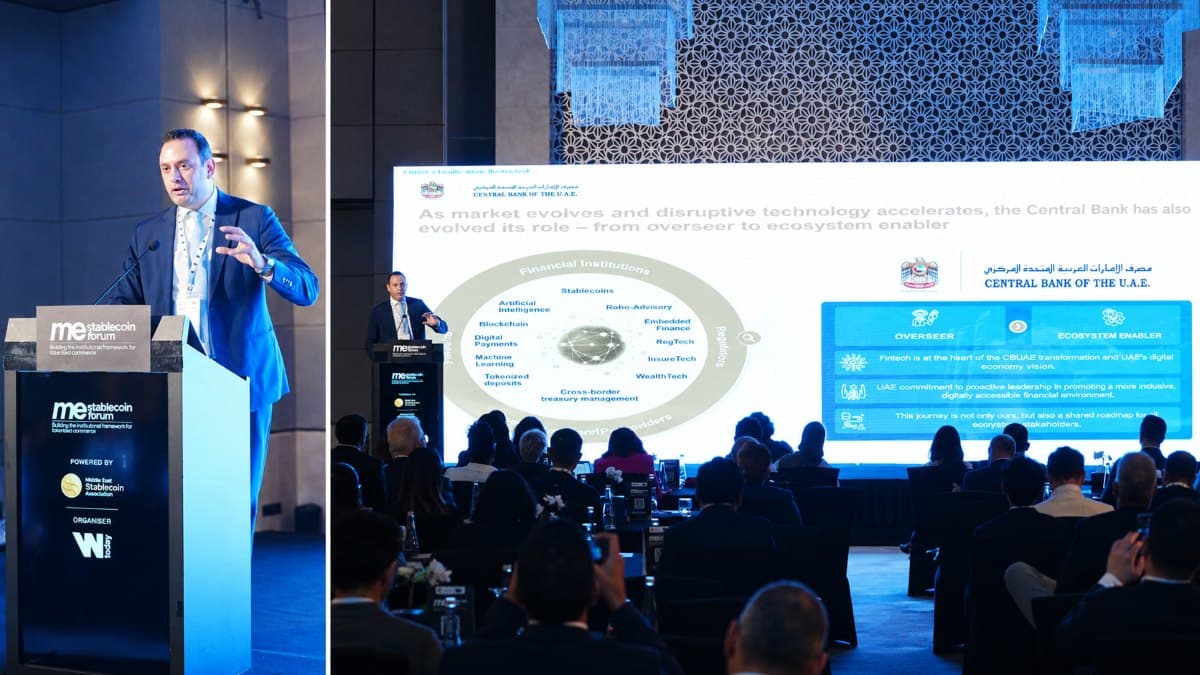
Paul Kayrouz, Chief FinTech Officer at the Central Bank of the UAE (CBUAE), outlined the developments during the MESC Forum 2026 in Dubai on September 17, offering one of the clearest updates yet on how the country's digital-money infrastructure is evolving.
The developments extend beyond the stablecoin market and the next stage of the Digital Dirham. Kayrouz's presentation pointed to a financial system in which sovereign digital money, privately issued AED stablecoins and existing financial infrastructure retain different roles while becoming increasingly connected.
"We're not a traditional regulator," Kayrouz told the audience. "We want to be the ecosystem leader."
Kayrouz said five Dirham stablecoin issuers are progressing within the CBUAE's ecosystem, with four described as banks and one as a non-bank participant.
The disclosure adds to a regulated AED stablecoin market that has been developing since the CBUAE's Payment Token Services Regulation took effect in 2024.
The regulation established requirements covering Payment Token Issuance, Conversion, Custody and Transfer, while distinguishing between Dirham Payment Tokens and registered Foreign Payment Tokens. It also sets restrictions around the use and promotion of certain foreign payment tokens in the UAE.
The market has since moved from licensing and approval toward practical payment activity.
RAKBANK, for example, announced in January that it had received in-principle approval for an AED-backed stablecoin.
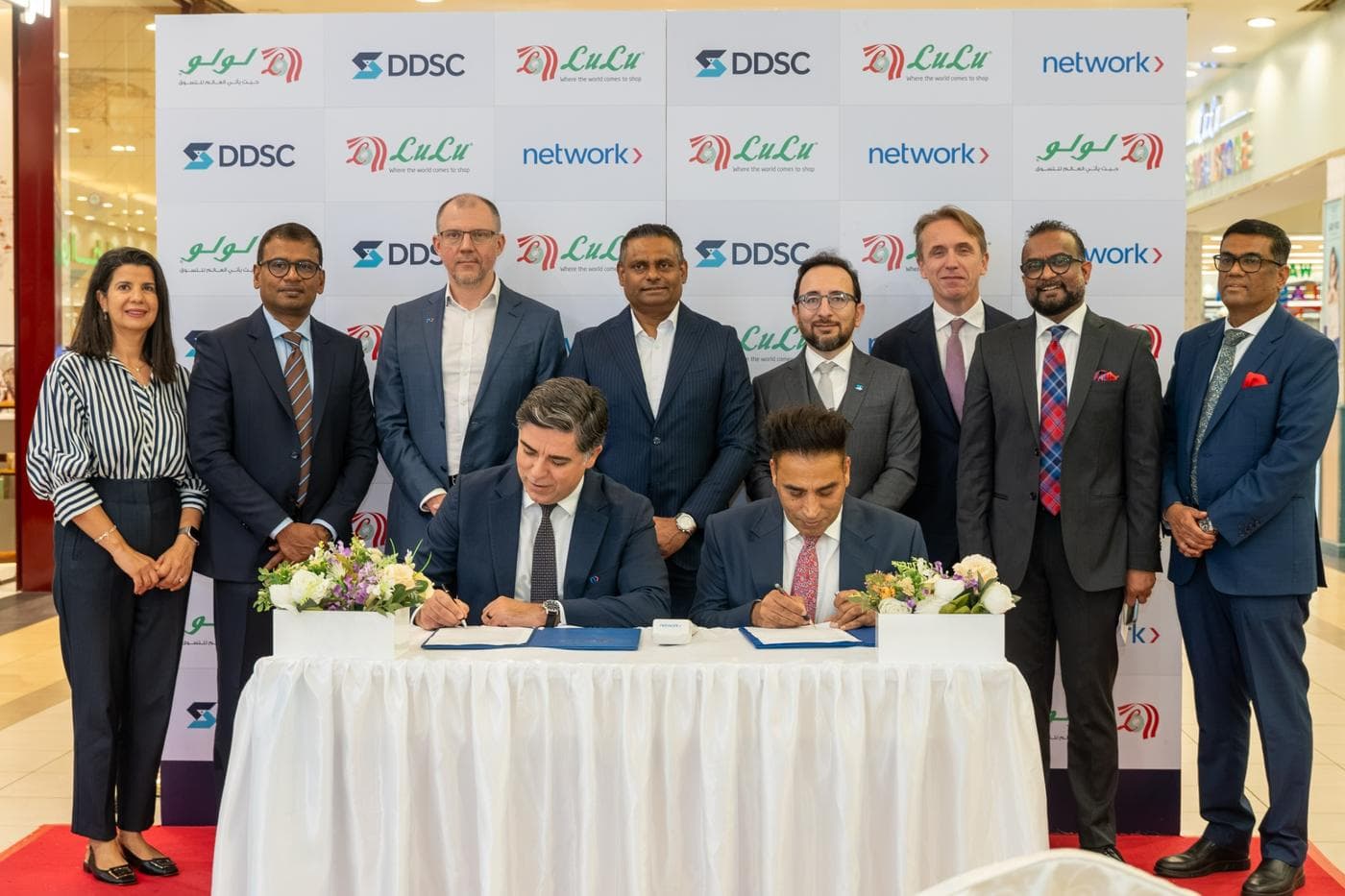
DDSC has progressed further into live activity. In September, Network International launched an in-store pilot allowing customers to make AED-backed stablecoin payments through selected point-of-sale terminals at Marks & Spencer in Dubai Festival City and LuLu Hypermarket in Abu Dhabi.
AE Coin and Zand AED are also part of the developing regulated AED stablecoin market.
The distinction between banks and non-bank participants is relevant to the regulatory structure. Under the Payment Token Services Regulation, banks cannot themselves act as Payment Token Issuers but can establish subsidiaries, affiliates or related entities to conduct the activity subject to the applicable requirements.
The result is an AED stablecoin ecosystem that is becoming broader while remaining closely connected to the regulated financial sector.
Alongside the stablecoin update, Kayrouz provided an update on the Digital Dirham.
The CBUAE is preparing the next phase of the central bank digital currency, with four initial use cases and four banks currently working with the Central Bank on the rollout.
A broader expansion involving banks and fintech companies is expected to follow.
The Digital Dirham program has already progressed through several stages of development. The CBUAE published a comprehensive progress report on the initiative in February 2026, outlining work toward issuing the digital currency.
The next phase is expected to bring the Digital Dirham into a wider range of practical applications.
Kayrouz described potential use cases spanning payments, digital wallets and tourism, alongside connections with other parts of the UAE's financial infrastructure.
Tourist onboarding is one area the CBUAE has previously highlighted. The model would allow visitors to fund a Digital Dirham wallet, convert currencies and use the digital currency while in the UAE.
The Central Bank is also looking at biometric payments, where consumers could authorize transactions using facial or palm recognition while accessing different underlying forms of payment.
These could include bank money, cards, AED stablecoins or a Digital Dirham wallet.
The objective is not to make every form of digital money interchangeable in terms of regulation or use. Instead, the CBUAE is developing infrastructure that can allow different regulated forms of money to operate alongside existing payment systems.
The regulatory framework governing stablecoins is also set for further review.
Kayrouz said the CBUAE will “very soon” launch a public consultation seeking feedback from market participants on provisions of the existing framework that may need enhancement.
The Payment Token Services Regulation introduced the UAE's licensing and registration framework for payment-token activities, including rules governing Dirham Payment Tokens and registered Foreign Payment Tokens.
The consultation comes as the regulated stablecoin market has gained practical experience since the framework was introduced.
Projects have moved through different stages of approval and licensing, while stablecoins are beginning to be tested in areas including payments, treasury activity, digital-asset settlement and tokenized financial infrastructure.
Kayrouz acknowledged that some elements of the existing framework may not always appear entirely clear to market participants, while noting that flexibility was part of the original approach given the speed of market development.
The CBUAE's regulatory-development process provides for public consultations on proposed regulatory changes, allowing market participants to provide feedback before new or amended rules are introduced.
The upcoming consultation therefore provides an opportunity for the Central Bank to assess how the existing framework is functioning as the market moves from regulatory design toward implementation.
Kayrouz described the Digital Dirham and regulated Dirham stablecoins as two different forms of digital money.
The Digital Dirham is sovereign digital currency issued by the Central Bank, while AED stablecoins are privately issued payment tokens operating within the CBUAE's regulatory framework.
Foreign Payment Tokens occupy another category under the regulation.
USDU, for example, falls within the foreign-currency payment-token framework rather than the category of Dirham Payment Tokens. The regulatory framework places specific limits on the use of Foreign Payment Tokens as a means of payment in the UAE, including their use in defined virtual-asset and virtual-asset-derivative transactions.
The distinction allows different forms of digital money to develop for different applications while remaining within defined regulatory boundaries.
The CBUAE is developing the surrounding infrastructure at the same time.
Open Finance is being rolled out across banks, while national eKYC and KYB infrastructure is being developed to support digital onboarding and compliance.
Biometric payments and digital wallets are also part of the broader technology agenda.
The Central Bank's approach increasingly links these initiatives rather than treating them as separate projects.
The strategy also extends into cross-border payments through Jisr, the UAE's multi-CBDC infrastructure for international settlement.
Kayrouz said more than 23 countries have signed up to participate, naming China, India, Brazil, Türkiye and Kazakhstan among them.
The UAE has already demonstrated direct digital-currency settlement with China, while Jisr is intended to expand the country's connectivity with international payment and settlement networks.
The cross-border focus adds another dimension to the development of AED-denominated digital money.
Kayrouz also highlighted corporate treasury, micropayments and decentralized finance as areas where stablecoin use cases are being explored, including through the CBUAE's Innovation Hub.
The UAE's digital-money agenda is therefore developing across several connected areas: sovereign digital currency, regulated stablecoins, digital payments, financial-market infrastructure and cross-border settlement.
The immediate focus is now on putting those systems into wider use while continuing to refine the regulatory framework around them.
With five AED stablecoin initiatives progressing, the Digital Dirham moving toward its next phase and a public consultation on stablecoin rules approaching, the CBUAE is entering a new stage of its digital-money strategy — one increasingly focused on implementation across the wider financial system.

Disclaimer of Warranty
The information provided in this article is for general informational purposes only. We make no warranties about the completeness, reliability, and accuracy of this information. Read full disclaimer

Editor's Picks

As U.S. Crypto Legislation Stalls, Circle Launches Its Own Financial Network

Walid Abou Zaki

Sep 16, 2026

9 min

Stablecoin Yield Fight Helps Derail CLARITY Act in Senate
Walid Abou Zaki
Sep 15, 2026
8 min
Why Zondacrypto’s Collapse Would Unfold Differently in the UAE
Walid Abou Zaki
Aug 28, 2026
8 min
Read More Articles

In the Same Space
Deutsche Bank Moves Into Institutional Crypto Custody With Bitcoin, Ether and Stablecoins
News Desk
Sep 17, 2026
4 min

U.S. Bank Moves Its Stablecoin From Testing to Live Cross-Border Payment
News Desk
Sep 10, 2026
3 min

Visa Brings Onchain Credit to Stablecoin Card Financing
News Desk
Sep 9, 2026
3 min
A Swiss Franc Play in Europe’s Bank-Led Stablecoin Race
Salma Naueihed
Sep 9, 2026
5 min