
Advertisement
Infrastructure & Scaling
Share
SN
Senior English Editor


AI is creating a second market for Bitcoin mining infrastructure, as power access, grid connectivity and site quality gain value beyond Bitcoin production, reshaping how mining companies are assessed by investors.
AI is giving Bitcoin miners a new benchmark for the value of their power, sites and computing infrastructure.
For years, Bitcoin mining companies were valued largely through the economics of Bitcoin production: how much power they could secure, how efficiently they could convert it into hashrate and how much Bitcoin that capacity could generate.
AI is beginning to disrupt that framework.
Not because artificial intelligence is replacing Bitcoin mining, but because it is creating an alternative market for infrastructure miners accumulated during the industry's expansion.
That changes the question investors can ask about a mining company.
It is no longer only how much Bitcoin can this site produce?
It is also:
What is the highest-value use of the infrastructure connected to it?
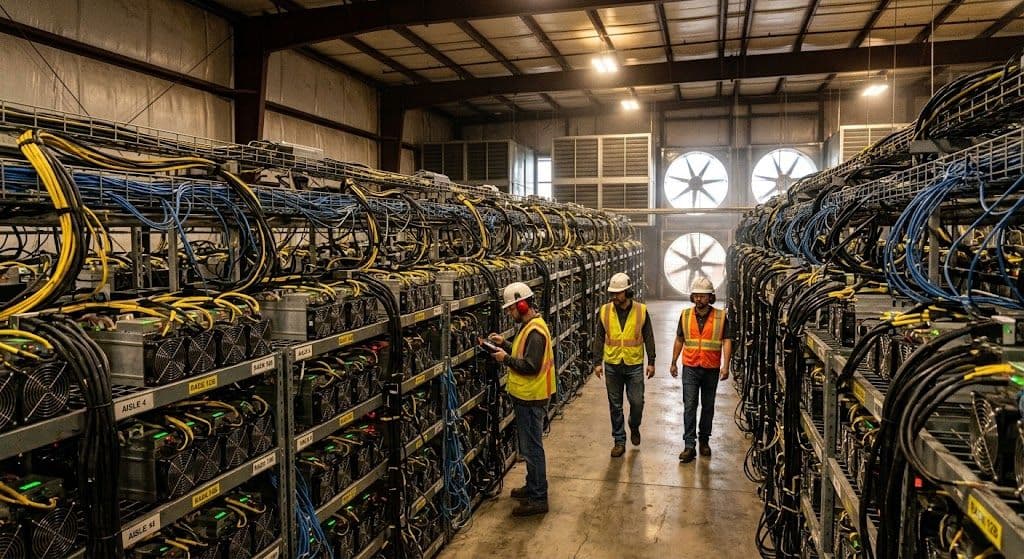
A Bitcoin mining facility may look like a specialized crypto asset, but its underlying components are broader: secured electricity, grid connectivity, land, substations, buildings, cooling systems, networking and the ability to deploy computing capacity at scale.
Bitcoin was the original customer for that infrastructure.
The infrastructure itself, however, was never inherently tied to Bitcoin.
Keel Infrastructure, formerly Bitfarms, illustrates how that distinction is becoming more important. The company has shut down its U.S. Bitcoin-mining operations as it shifts toward high-performance computing and AI infrastructure, with a pipeline of up to 2.2 gigawatts of energized, secured and expansion power capacity.
The move is more significant than a single miner changing its business strategy.
It shows what happens when the market begins to value the underlying infrastructure independently of the activity it was originally built to support.
A mining company may increasingly be valued not only as a producer of Bitcoin, but as an owner of power-backed computing infrastructure with multiple potential uses.
The attraction of mining sites to AI companies starts with something both industries require in enormous quantities: electricity.
AI data centers face growing power demands, while securing new grid capacity can take years. Existing sites with substantial power allocations and established grid connections can therefore have value beyond their original purpose.
Bitcoin miners spent years securing precisely those resources.
Riot Platforms' recently disclosed agreement with Anthropic provides one of the clearest examples. The 20-year deal covers 191 megawatts of computing capacity at Riot's Rockdale, Texas campus and is expected to generate $9.1 billion in revenue, with extensions potentially taking the value to $16.1 billion.
But the more important development is not any individual contract.
It is the emergence of a second market for infrastructure originally built around Bitcoin.
That gives miners a new benchmark. If an AI operator can generate more economic value from a site's power and infrastructure than Bitcoin mining can, the opportunity cost of continuing to mine becomes harder to ignore.
The AI opportunity should not be overstated.
A large power connection does not automatically make a site suitable for AI workloads. AI data centers can require sophisticated cooling, high-density electrical systems, advanced networking and significant reliability.
Converting a mining facility can therefore require substantial capital, engineering and time.
The distinction is important:
Having power is not the same as having an AI-ready infrastructure asset.
This is why the quality of a mining company's physical footprint may matter more than simply its total megawatt capacity.
Grid access, location, permitting, connectivity, expansion potential and the ability to support different workloads can determine whether a mining site has genuine optionality or simply excess power.
AI is not automatically a better use of mining infrastructure.
Bitcoin mining has a characteristic many conventional data-center workloads do not: flexibility.
Mining operations can be curtailed when electricity prices rise and restarted when economics improve. AI workloads generally require far greater availability and performance consistency.
The trade-off is therefore not simply Bitcoin versus AI.
It is flexibility versus contracted capacity, protocol-driven revenue versus enterprise revenue, and variable upside versus potentially more predictable infrastructure cash flows.
That makes optionality increasingly valuable.
The most strategically valuable mining companies may not be those that abandon Bitcoin the fastest.
They may be those with the ability to choose.
A site that can support Bitcoin mining today and potentially another high-density computing workload tomorrow has something more valuable than a single revenue stream: optionality.
Keel represents one end of that spectrum, moving its business away from Bitcoin and toward HPC and AI. Riot represents another, retaining its mining operations while monetizing part of its infrastructure through long-term data-center agreements.
The difference matters.
It suggests there is no single template for the industry's evolution. Some miners may become dedicated AI infrastructure operators. Others may maintain Bitcoin mining alongside data-center businesses. The common factor is that their physical assets can increasingly serve more than one computing market.
AI is giving Bitcoin mining an external benchmark that the industry previously lacked.
Mining economics have traditionally been assessed against Bitcoin's price, network difficulty, block rewards, energy costs and hardware efficiency.
Now miners can increasingly ask:
What would another computing business pay for the same infrastructure?
The answer will depend on conversion costs, contract terms, utilization, customer concentration and the economics of both businesses.
But the comparison itself matters.
It creates a market-based test for the opportunity cost of using scarce infrastructure for Bitcoin mining.
That could eventually change what investors look for.
Hashrate and energy efficiency will remain fundamental. But alongside them, investors may increasingly consider power access, grid connectivity, site quality, expansion potential and the ability to support alternative workloads.
The result is a broader valuation framework in which the infrastructure supporting Bitcoin production can be assessed independently of the Bitcoin it produces.
The AI boom is not necessarily taking Bitcoin mining's infrastructure away.
It is giving that infrastructure a second market.
The strongest companies may not ultimately be those that choose Bitcoin or AI. They may be those that have built infrastructure capable of serving both—and can shift toward whichever use creates the greatest value.
For years, miners competed to secure cheap power so they could produce more Bitcoin.
The next phase may be about something broader:
controlling power and infrastructure that multiple digital economies want.
Bitcoin may have been the original customer.
AI is forcing the market to ask whether it will remain the most valuable one.

Disclaimer of Warranty
The information provided in this article is for general informational purposes only. We make no warranties about the completeness, reliability, and accuracy of this information. Read full disclaimer

Editor's Picks
In the Same Space

JPMorgan Predicts Bitcoin Rally Against Gold Amid Shifting ETF Strategies

News Desk

Sep 18, 2026

3 min
Deutsche Bank Moves Into Institutional Crypto Custody With Bitcoin, Ether and Stablecoins
News Desk
Sep 17, 2026
4 min

KelpDAO Files Suit Against LayerZero Over 2026’s Largest Exploit
News Desk
Sep 25, 2026
6 min

CFTC Updates Tokenized Asset and Blockchain Rules as Crypto Bill Stalls
News Desk
Sep 25, 2026
5 min