Advertisement
Tokenization Infrastructure
Share
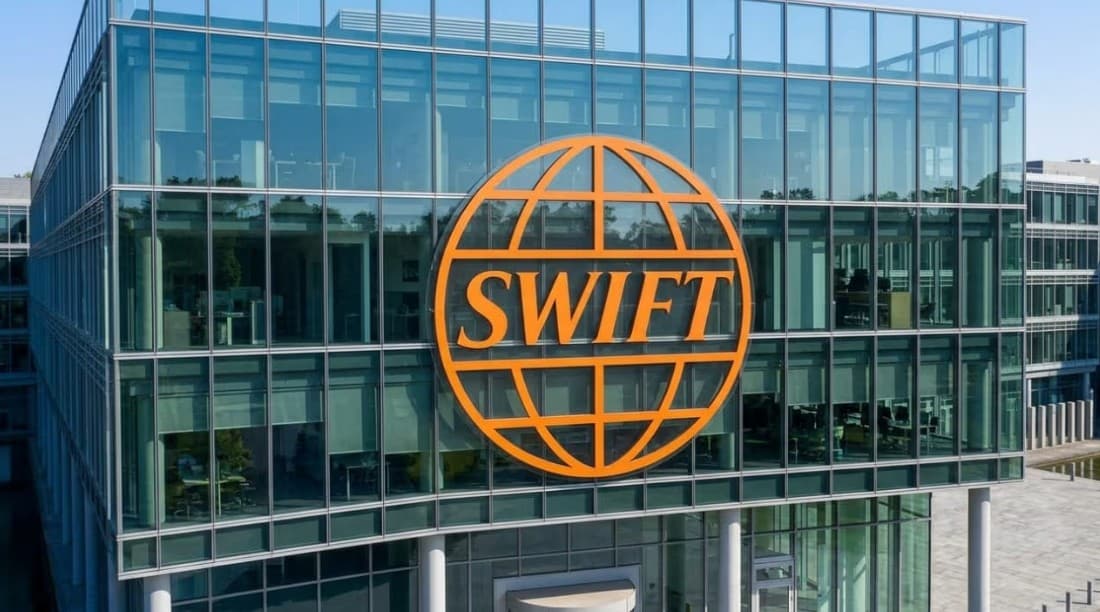
Swift has launched the first production use case of its blockchain-based shared ledger, with 17 banks across six continents—including UAE's FAB and Mashreq—piloting 24/7 cross-border payments via tokenized deposits. The rollout marks a concrete shift from experimentation to live regulated banking operations on distributed ledger infrastructure.
Swift has taken a significant step in the evolution of digital finance by launching the first production use case of its blockchain-based shared ledger, enabling banks to pilot 24/7 cross-border payments using tokenized deposits.
Seventeen financial institutions across six continents—including First Abu Dhabi Bank (FAB) and Mashreq from the UAE—are preparing to conduct live transactions on the platform, marking one of the clearest signs yet that blockchain infrastructure is moving beyond experimentation and into regulated banking operations.
Unlike many blockchain initiatives that focus on cryptocurrencies or public networks, Swift's ledger is designed to coordinate bank-issued tokenized deposits across participating institutions while relying on existing payment and settlement infrastructure. The approach allows banks to offer real-time cross-border money movement without replacing the compliance, risk management and settlement systems underpinning today's financial markets.
The launch represents the first commercial implementation of the blockchain-based ledger Swift unveiled last year and reflects growing industry efforts to modernize cross-border payments through tokenized money rather than entirely new payment networks.
For decades, Swift has served as the global messaging network connecting financial institutions across more than 200 markets.
The introduction of a blockchain-based orchestration layer signals a broader evolution in its role.
Rather than replacing existing payment rails, Swift is positioning its infrastructure as a coordination layer capable of connecting tokenized deposits issued by different banks while allowing final settlement to continue through established financial systems.
The model reflects an increasingly common approach across the banking sector: integrating distributed ledger technology into regulated financial infrastructure instead of building parallel blockchain ecosystems.
According to Swift, participating banks will be able to support continuous cross-border payments—including overnight and weekend transactions—while improving liquidity management and client experience.
Swift's initiative adds further momentum to one of the fastest-growing segments of institutional digital finance: tokenized deposits.
Unlike stablecoins, which are generally issued by private companies, tokenized deposits represent commercial bank liabilities recorded on distributed ledger infrastructure and remain within the regulated banking system.
They are increasingly viewed as a bridge between traditional banking and blockchain-based financial markets because they combine programmable functionality with existing banking regulation.
The launch also complements broader industry initiatives exploring tokenized money for wholesale financial markets, including projects led by the Bank for International Settlements (BIS) and central banks around the world.
Rather than competing with existing payment systems, tokenized deposits are increasingly being positioned as an extension of current banking infrastructure.
The participation of First Abu Dhabi Bank (FAB) and Mashreq highlights the UAE's continued involvement in shaping next-generation payment infrastructure.
Both institutions have been active participants in digital asset and tokenization initiatives, reflecting the country's broader strategy to position itself as a hub for regulated financial innovation.
Their inclusion alongside global banks such as HSBC, Citi, BNP Paribas, UBS, Standard Chartered, DBS, ANZ, BNY Mellon and Wells Fargo underscores the increasingly international nature of tokenized banking infrastructure.
For the UAE, participation reinforces its role not only as a regulatory hub for virtual assets but also as an active contributor to the modernization of cross-border financial markets.
Swift's production rollout reflects a broader shift taking place across global finance.
The conversation is no longer centered on whether banks should adopt blockchain technology.
Instead, financial institutions are increasingly focused on how distributed ledger technology can improve liquidity management, settlement efficiency and interoperability while remaining compatible with existing regulatory frameworks.
The launch also demonstrates that blockchain adoption within banking is increasingly taking place through familiar institutions rather than replacing them.
As tokenized deposits, digital securities and programmable payments continue to mature, the next phase of digital finance is likely to be defined less by cryptocurrencies alone and more by the integration of blockchain infrastructure into mainstream financial systems.
Swift's latest initiative suggests that transition has already begun.

Disclaimer of Warranty
The information provided in this article is for general informational purposes only. We make no warranties about the completeness, reliability, and accuracy of this information. Read full disclaimer

Editor's Picks

When Assets Move—or Stop—Without Consent: The Limits of Crypto Wallet Control

Walid Abou Zaki

Sep 29, 2026

6 min

Where Do the Dollars Behind the UAE’s Crypto Economy Sit?
Anna K.
Sep 21, 2026
9 min

As U.S. Crypto Legislation Stalls, Circle Launches Its Own Financial Network
Walid Abou Zaki
Sep 16, 2026
9 min
Read More Articles

In the Same Space

Mashreq and Citi Complete Live Tokenized Payment on Swift’s Blockchain Ledger
News Desk
Sep 30, 2026
3 min

Kraken Parent Payward Takes Institutional Settlement 24/7
News Desk
Oct 5, 2026
6 min

Citi and Coinbase Put Stablecoins Behind Corporate Payments
News Desk
Sep 29, 2026
5 min

Tether Takes Self-Custody to Africa and the GCC With Shiga
News Desk
Sep 29, 2026
4 min