Advertisement
Tokenization Infrastructure
Share
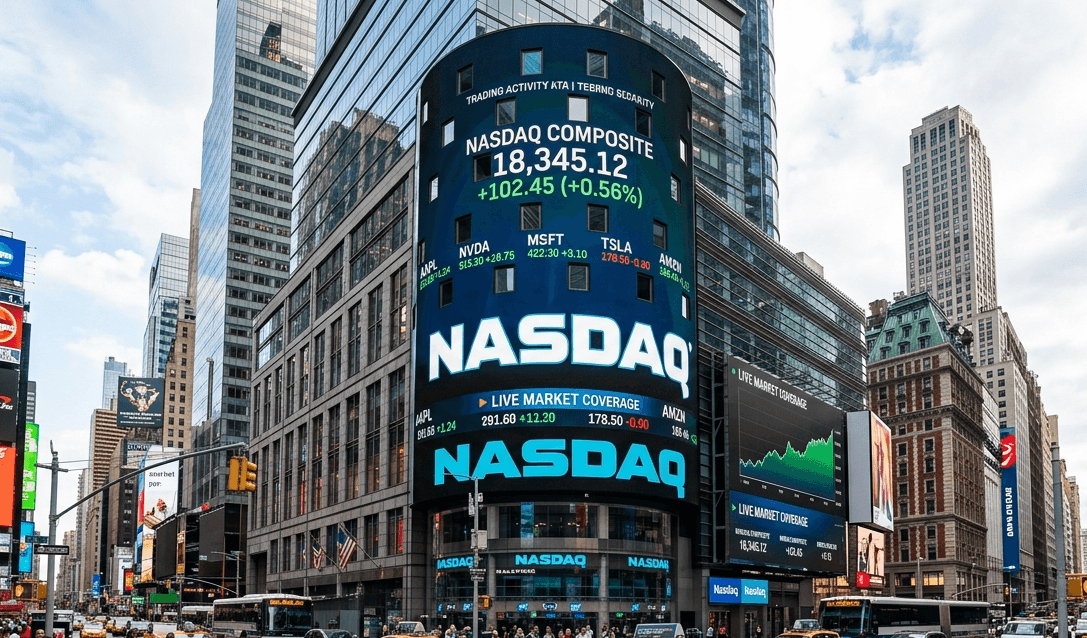
Nasdaq is embedding live market data and tokenized equities into blockchain infrastructure, with Ostium becoming the first on-chain exchange to use its real-time pricing for equity perpetual futures in May 2026.
Nasdaq is taking a major step beyond simply supporting blockchain innovation. The exchange operator is now integrating its proprietary market data directly into blockchain infrastructure, allowing on-chain platforms to access the same real-time pricing information used across traditional financial markets.
This development marks a significant shift in how blockchain-based trading platforms interact with regulated market data, narrowing the gap between decentralized finance and conventional capital markets.
In May 2026, decentralized trading platform Ostium became the first on-chain exchange to launch equity perpetual futures tied to individual U.S. stocks using Nasdaq's live market data.
Previously, most blockchain derivatives platforms depended on third-party oracle providers or delayed price feeds to estimate stock prices. Direct access to Nasdaq’s data significantly improves pricing accuracy while reducing reliance on intermediary data sources.
The new products enable traders to gain exposure to U.S. equities through perpetual futures, derivatives that have no expiration date or physical settlement requirement. While perpetual contracts have traditionally focused on cryptocurrencies, Ostium has expanded the model to include individual U.S. stocks using official exchange data.
Nasdaq's blockchain strategy extends beyond market data.
Earlier in March 2026, the exchange announced a partnership with Kraken to develop a framework for issuing, trading, and distributing tokenized versions of Nasdaq-listed stocks and exchange-traded funds (ETFs) worldwide.
The initiative seeks to combine blockchain efficiency with the protections of traditional financial markets by preserving shareholder rights, corporate governance standards, and regulatory compliance while enabling more efficient settlement through blockchain technology.
Also in March 2026, the U.S. Securities and Exchange Commission (SEC) approved Nasdaq's proposal to trade tokenized equities alongside conventional shares on the same order book.
This means tokenized and traditional securities follow identical execution priorities, fee structures, market surveillance, and pricing mechanisms, eliminating the need for a separate trading environment.
The approval followed Nasdaq's regulatory filing submitted in September 2025, transforming its tokenized securities framework from a proposal into an operational market structure.
Nasdaq's interest in blockchain technology is not new.
The company first entered the space in 2015 through a partnership with Chain, focusing on blockchain-based issuance of private market shares. While that initiative remained limited to private markets, the company's latest strategy targets publicly traded securities with regulatory approval, live trading infrastructure, and direct market data integration.
Rather than building a standalone blockchain exchange, Nasdaq is embedding tokenized assets into its existing financial infrastructure, allowing both traditional and tokenized securities to operate under the same regulatory and operational framework.
The expansion of tokenized equities could reshape how investors access financial markets.
For retail participants, blockchain-based trading opens the possibility of around-the-clock global access, reducing dependence on traditional market hours and geographic limitations.
Institutional investors could also benefit from automated processes such as dividend payments, proxy voting, and other corporate actions executed through smart contracts. At the same time, settlement cycles could be reduced from the conventional T+1 framework to near-instant finality, improving capital efficiency and reducing operational costs.
Nasdaq's latest initiatives suggest that blockchain is no longer being treated as an experimental technology, but as an extension of regulated financial infrastructure. By integrating real-time exchange data, tokenized securities, and blockchain settlement into its existing ecosystem, Nasdaq is reducing the distinction between traditional and digital markets rather than replacing one with the other.
This approach could become a blueprint for other global exchanges seeking to modernize market infrastructure without compromising regulatory standards. If adopted more broadly, the convergence of tokenization and regulated trading venues may accelerate institutional adoption of digital assets while establishing blockchain as a foundational layer for next-generation capital markets.

Disclaimer of Warranty
The information provided in this article is for general informational purposes only. We make no warranties about the completeness, reliability, and accuracy of this information. Read full disclaimer

Editor's Picks
In the Same Space
Canada’s Big Six Banks Explore Tokenized Deposit System

News Desk

Sep 23, 2026

5 min

Hong Kong Prepares 24/7 CBDC Settlement System for Tokenized Deposits
News Desk
Sep 18, 2026
3 min

Solana Begins Testing Alpenglow Upgrade Targeting 150ms Finality
News Desk
Sep 23, 2026
3 min

Saudi Arabia Exits China-Linked mBridge CBDC Project
News Desk
Sep 22, 2026
4 min