
Advertisement
Regulation & Policy
Harish Parameswaran of Comera Pay and Akshata Namjoshi of KARM discuss why the next phase of regulated digital finance will depend on product design, tokenization, governance, and trust.
Share
WA
CEO & Editor-in-Chief


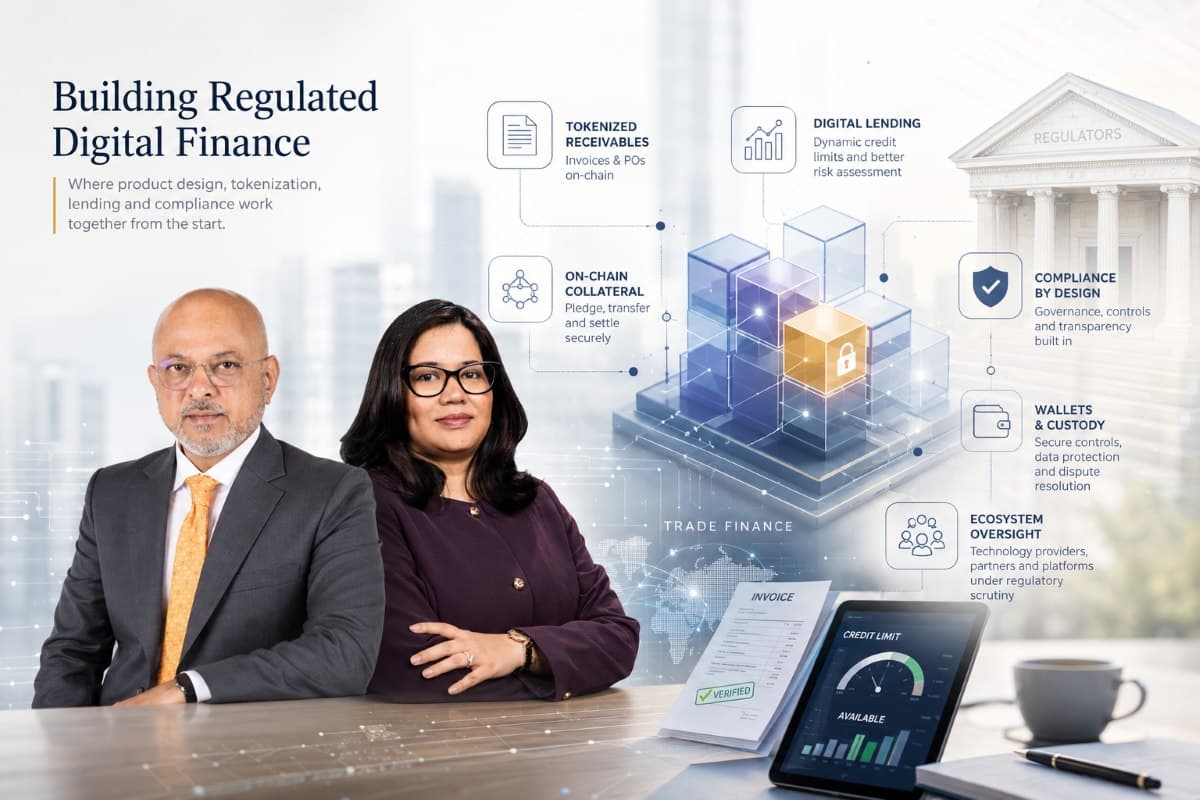
Harish Parameswaran of Comera Pay and Akshata Namjoshi of KARM argue that regulated digital finance starts at product design, where compliance, tokenized trade finance, digital lending, and embedded finance must be built together, not added later.
For years, fintech was defined by speed. Faster onboarding, faster payments, faster lending, and faster product launches became the language of digital finance. But as the sector moves deeper into lending, embedded finance, blockchain infrastructure, and digital assets, speed alone is no longer enough.
The next phase of the market may be shaped by a harder question: can the product itself survive regulatory scrutiny?
That idea sits at the center of a joint conversation with Harish Parameswaran, VP – Comera Pay, and Akshata Namjoshi, Equity Partner at KARM. Their answers show why the Comera Pay regulated digital finance story is not simply about launching digital products under a license. It is about how financial products are designed, governed, risk-managed, and trusted from the beginning.
For Comera Pay, the starting point is a gap between traditional financial institutions and the expectations of digitally connected consumers and SMEs. Many remain underserved because of slow processes, rigid underwriting, or limited access to credit products that reflect their real financial behavior.
Comera Pay’s response to that gap is a digital-first financial ecosystem built around accessibility, speed, transparency, and a regulated framework. But the important point is not speed alone. Parameswaran’s answers repeatedly connect digital access with governance, customer protection, responsible underwriting, and compliance-by-design.
This is where KARM’sview sharpens the story. Namjoshi argues that in financial services, the product itself is the regulatory analysis. A small design decision can change the entire regulatory character of a business: who holds customer funds, who controls a wallet, who takes credit risk, how funds move, whether a balance is repayable, or whether a token represents value.
That is a powerful idea for digital finance and digital assets. A wallet is not just a feature. A token is not just a technical tool. A lending model is not just a user journey. Each one can carry licensing, governance, capital, compliance, custody, and customer protection consequences.
The strongest digital asset thread in the discussion is tokenization.
Comera Pay points to the tokenization of invoices, purchase orders, and receivables as a practical use case. By turning these assets into digital tokens on a blockchain, they can become verifiable, transferable, and pledgeable as collateral in real time. In practical terms, this could support an on-chain supply-chain finance model where credit is linked more directly to verified commercial activity.
This matters because it moves tokenization away from abstract market narratives and into the mechanics of lending. Tokenized receivables can potentially help lenders assess trade performance more dynamically, using on-chain transaction history such as payment velocity, buyer diversity, and dispute rates instead of relying only on annual financials.
It could also change how credit limits work. Comera Pay points to the possibility of event-driven credit facilities, where limits expand when new purchase orders are tokenized and verified. That is a more useful digital asset conversation for financial institutions than speculation alone: blockchain as a layer for collateral, credit data, verification, and fraud reduction.
The fraud angle is also important. In trade finance, duplicate financing remains a major risk. If a tokenized asset can only be pledged once on-chain, the technology can reduce the risk of the same invoice or receivable being financed more than once. Tokenization may also allow lenders to take fractional interests in pools of receivables, lowering minimum lending thresholds and widening access to finance.
The opportunity is clear, but KARM’s answers make it equally clear that blockchain does not become financial infrastructure simply because assets are placed on-chain.
For tokenization to work in regulated finance, governance must cover custody, settlement finality, asset representation, operational resilience, cybersecurity, and legal enforceability. These are not technical footnotes. They decide whether a tokenized asset can be trusted, whether a transaction is final, whether customer assets are protected, and whether the product can withstand regulatory review.
This is where many digital asset models face their real test. It is not enough to say an asset is tokenized. The market still needs to know who verifies the asset, who controls it, what legal rights the token represents, how disputes are handled, and what happens if an operational failure occurs.
That also explains why KARM sees regulatory readiness as more than obtaining a license. Regulators are increasingly looking at the full ecosystem around a product, including technology providers, program managers, embedded finance partners, tokenization platforms, and outsourcing partners. In other words, the regulatory perimeter is moving closer to the actual operating model.
The same logic applies to lending. Digital platforms, alternative data, embedded finance, and AI-led decisioning can make credit more personalized and accessible. But Comera Pay stresses that richer data should not lead to irresponsible credit expansion.
Responsible underwriting remains central. Lending decisions still need to balance customer needs, affordability, repayment capacity, and long-term financial wellbeing. Alternative data may support inclusion, but it should not simply become a tool to raise approval rates.
KARM identifies underdeveloped underwriting methodologies as a common weakness in digital lending and finance company applications. Applicants may present a strong commercial story but fail to show how affordability assessments, credit decision engines, portfolio monitoring, collections, complaints handling, provisioning, concentration risk, and AI controls will work in practice.
That is why the next phase of digital lending will not be judged only by speed or conversion. It will be judged by whether the operating model is defensible.
Trust Is More Than a License
For customers, regulated digital finance cannot only mean that a company is licensed. Licensing is the foundation, but trust is built through the full customer journey.
Comera Pay defines trust through transparency, data protection, security, product understanding, reliability, customer support, dispute resolution, and protection from fraud and financial crime. In digital finance, where customers may never visit a branch, the product experience itself becomes the trust layer.
That point matters even more in digital assets. Customers are not only trusting an app. They are trusting how their assets are represented, how transactions settle, how wallets are controlled, how data is used, and how failures or disputes are handled.
The Comera Pay–KARM relationship reflects this wider shift: legal and regulatory input is no longer a final step before launch, but part of how regulated financial products are designed from the beginning.
Looking ahead, embedded finance, AI-driven risk assessment, digital identity, eKYC, real-time cross-border payments, settlement infrastructure, and tokenization are likely to become more normal parts of financial services. But other areas, including DeFi and certain digital asset use cases, still need more maturity before broad adoption. Clearer regulation, stronger governance, better interoperability, and stronger consumer protection remain essential.
The next phase of digital finance will not belong to companies that move fast and fix compliance later. It will belong to those that understand that product design, legal structure, governance, digital asset architecture, and customer outcomes are not separate conversations.
They are the same conversation.
And increasingly, in digital finance, the product is the regulation.

Disclaimer of Warranty
The information provided in this article is for general informational purposes only. We make no warranties about the completeness, reliability, and accuracy of this information. Read full disclaimer

Editor's Picks

When Assets Move—or Stop—Without Consent: The Limits of Crypto Wallet Control

Walid Abou Zaki

Sep 29, 2026

6 min

Where Do the Dollars Behind the UAE’s Crypto Economy Sit?
Anna K.
Sep 21, 2026
9 min

As U.S. Crypto Legislation Stalls, Circle Launches Its Own Financial Network
Walid Abou Zaki
Sep 16, 2026
9 min
Read More Articles

In the Same Space

Rakbank Islamic Explains Shari’ah Framework Behind Bitcoin Service
Salma Naueihed
Sep 30, 2026
4 min

EEMEA SMEs Turn to Crypto and Stablecoins as Digital Adoption Accelerates
News Desk
Sep 28, 2026
5 min
FinCEN Withdraws Proposed Rules on Crypto Mixers and Self-Hosted Wallets
News Desk
Oct 6, 2026
5 min
Circle Urges EU to Revise MiCA as Only 3 of Top 30 Stablecoins Comply
News Desk
Oct 2, 2026
3 min