Advertisement
Regulation & Policy
Share
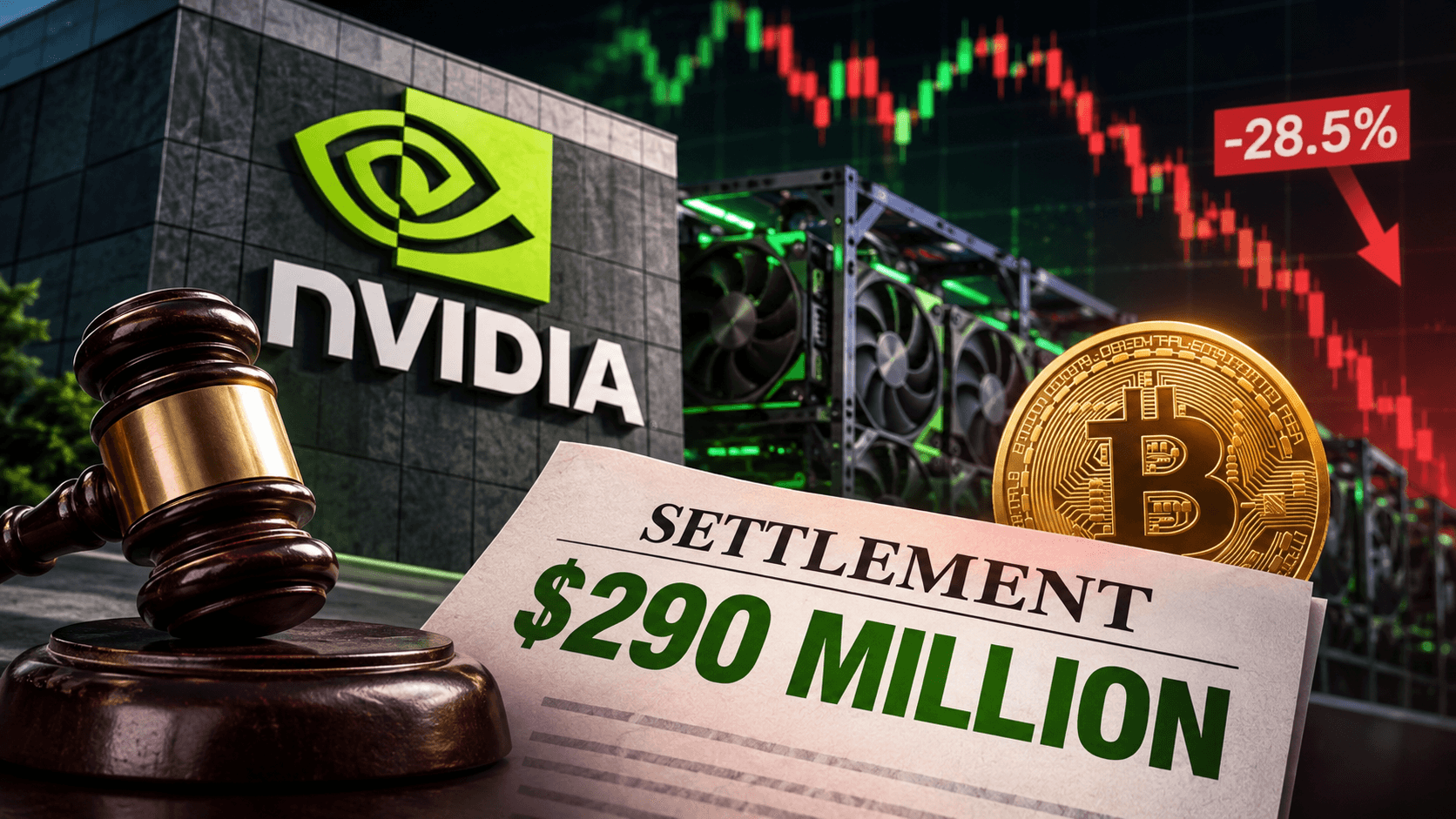
Nvidia has agreed to a $290 million class-action settlement over allegations that it misled investors about cryptocurrency mining's contribution to gaming revenue during 2017–2018, with the company's insurers expected to cover most of the payout. The case, which survived dismissal and an appellate revival over seven years, also follows a separate $5.5 million SEC settlement on the same disclosure issue.
Nvidia has agreed to pay $290 million to settle a long-running class-action securities lawsuit accusing the chipmaker of misleading investors about the role cryptocurrency mining played in its gaming revenue during 2017 and 2018.
The proposed settlement, which still requires court approval, would resolve claims that Nvidia and its CEO, Jensen Huang, understated how much demand from crypto miners contributed to gaming graphics card sales. Investors also alleged that the company failed to adequately disclose the risks of a potential downturn in mining activity, particularly as Ethereum mining began to lose momentum.
According to the plaintiffs, the disclosures contributed to a sharp decline in Nvidia's share price in November 2018. The stock fell 28.5% over two trading sessions as investors reacted to the extent of the company's exposure to weakening cryptocurrency-related demand.
Nvidia said its insurers would cover most of the $290 million settlement. Lawyers representing the plaintiffs are seeking up to $62 million in legal fees from the total amount.
The proposed agreement was filed on November 24 in the US District Court for the Northern District of California, potentially bringing an end to a legal dispute that has lasted nearly seven years.
The case was initially dismissed in 2021, but the Ninth Circuit Court of Appeals revived it in 2023. It was subsequently granted class-action status earlier this year, allowing the claims to proceed on behalf of a broader group of investors.
The settlement follows a separate agreement between Nvidia and the US Securities and Exchange Commission. In that case, the company agreed to pay $5.5 million over disclosures concerning the impact of cryptocurrency mining on its gaming business.
The lawsuit centers on the cryptocurrency mining boom of 2017 and 2018, when demand for graphics processing units surged. Nvidia's GPUs were widely used to mine digital assets, particularly Ethereum, helping drive sales and boost revenue in its gaming division.
That demand proved vulnerable to changes in cryptocurrency market conditions. As digital asset prices declined and mining became less profitable, purchases of graphics cards weakened sharply. The downturn exposed the extent to which Nvidia's gaming business had benefited from mining-related demand and raised questions about the durability of its revenue growth.
The case highlights a broader challenge for technology companies whose sales depend on volatile markets. Demand from fast-growing sectors can provide a significant revenue boost, but companies may face abrupt reversals when market conditions change. For investors, the central issue is whether those risks are clearly reflected in corporate disclosures.
The settlement comes amid a separate period of uncertainty surrounding Nvidia's leadership and CEO Jensen Huang.
Huang reportedly resigned on November 12 amid allegations involving relationships outside his marriage, including claims concerning Alice Huang, who was alleged to have links to Chinese intelligence. Reuters was unable to independently verify the claims about Alice Huang's alleged intelligence connections. The reports raised questions about corporate governance and national security, as well as uncertainty surrounding the leadership of a company closely associated with the artificial intelligence boom.
On November 23, Nvidia's board reinstated Huang, 11 days after his resignation. The decision followed consultations with US officials, with the government reportedly indicating that it had found no evidence that his return posed a national security risk.
The announcement triggered a sharp market rally. Nvidia shares climbed 31.5% during Monday's session, adding approximately $950 billion to the company's market capitalization. The Nasdaq Composite also gained around 6.5%, supported by a broader recovery in technology and AI-related stocks.
The rebound was short-lived, however. Nvidia shares fell 5.9% in the following session as investors reassessed leadership and governance concerns, alongside broader pressure on technology stocks and questions about elevated valuations across the AI sector.
Huang's return also coincided with a brief rally in the cryptocurrency market. Bitcoin rose approximately 5% following the announcement, but surrendered its gains later that day.
Other major cryptocurrencies and technology stocks also advanced during the broader improvement in risk appetite. The movement reflected the close relationship between investor sentiment toward technology companies and demand for other risk-sensitive assets, including digital currencies.
However, the temporary reaction does not establish a direct or lasting link between Nvidia's leadership developments and cryptocurrency prices. Digital asset markets remain influenced by a wider range of factors, including liquidity, monetary policy, investment flows and regulatory developments.
The $290 million agreement brings renewed attention to the relationship between the cryptocurrency industry and semiconductor manufacturers. Nvidia's experience during the 2017–2018 mining boom showed how crypto-related demand can shift from a major source of growth to a business risk when market conditions deteriorate.
The separate controversy surrounding Huang also underscores how leadership uncertainty and investor confidence can affect the valuation of major technology companies, particularly those at the center of the AI boom.
While the brief Bitcoin rally following Huang's reinstatement did not establish a sustained market impact, it highlighted how sentiment across technology stocks and digital assets can move together. The Nvidia case, meanwhile, serves as a reminder that companies benefiting from volatile industry cycles face scrutiny not only over their performance, but also over how clearly they communicate the risks behind it.

Disclaimer of Warranty
The information provided in this article is for general informational purposes only. We make no warranties about the completeness, reliability, and accuracy of this information. Read full disclaimer

Editor's Picks
In the Same Space

Kraken's Krak Unveils Bitcoin Cashback Credit Cards With USDC-Backed Option

News Desk

Nov 25, 2026

5 min

Backpack CFTC Approval Advances Global Derivatives Plans
Walid Abou Zaki
Nov 17, 2026
4 min

South Korea Draft Law Reopens ICOs and Puts Banks at the Center of Stablecoin Issuance
News Desk
Nov 25, 2026
6 min

US Seeks Court Order to Recover $1.1 Billion in USDC Linked to Binance Hack
News Desk
Nov 24, 2026
6 min