Advertisement
Institutional Adoption
When a single swap loses 99.9% of its value to infrastructure absence- not fraud, not hacks- the problem isn’t the trader. It’s the market layer that doesn’t exist yet.
Share

RM
Founder & CEO • Stratalink® Labs Ltd


Last month, a trader executed a $50 million swap and received $36,000 in return.
No exploit. No rug pull. No smart contract vulnerability. Pure infrastructure failure.
The mechanics are stark: $50 million USDT routed through a thin AAVE liquidity pool via CoW Protocol on SushiSwap. A 99% slippage warning appeared on screen. The trader clicked through. MEV bots extracted $9.9 million in the same block. Block builder Titan collected $34 million in priority fees. Final output: $36,000 worth of AAVE tokens.
The industry’s response has largely settled into two narratives: human error and the inherent risks of permissionless systems. However, both miss the point entirely.
This wasn’t a failure of attention. It was a failure of infrastructure, the kind of infrastructure that institutional markets have considered baseline for decades, and that digital asset markets still don’t have.
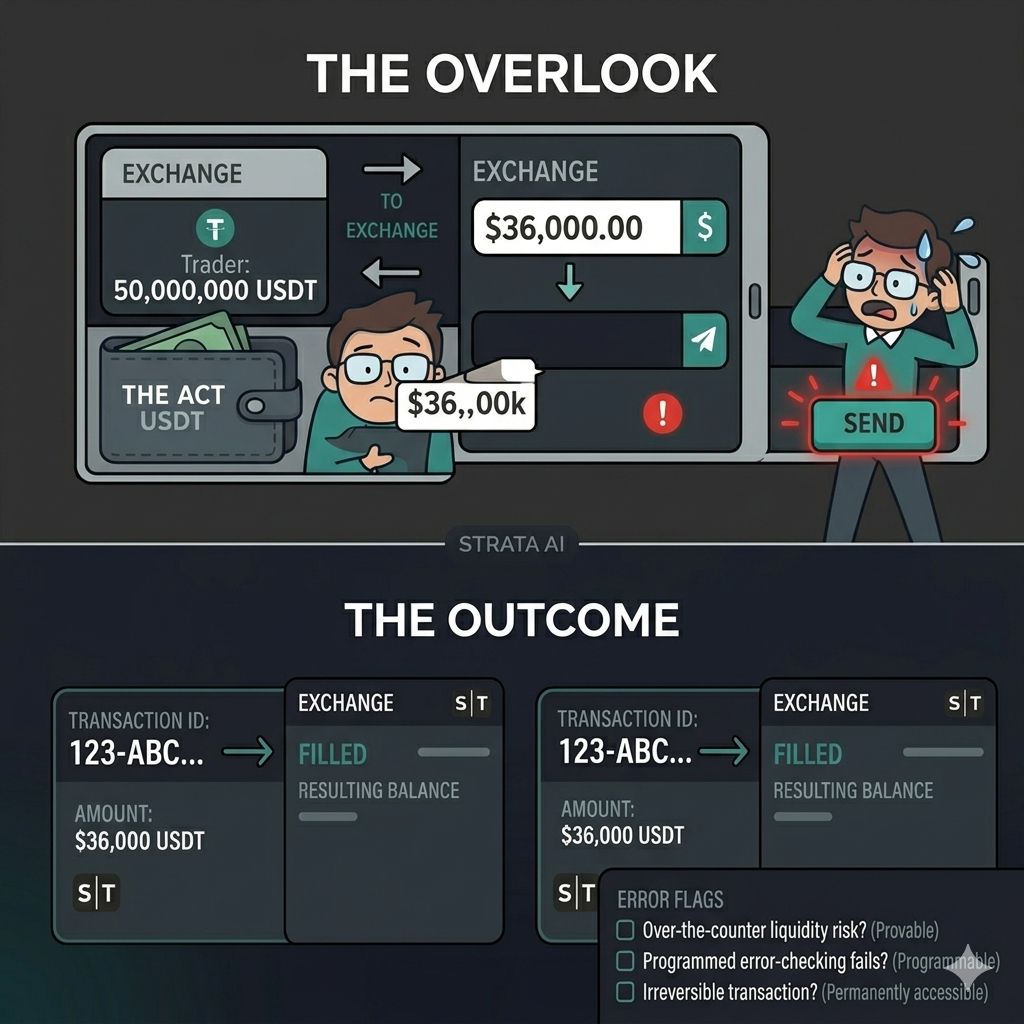
The slippage warning fired. The interface functioned as designed. In the narrowest technical sense, the system “worked.”
But there is a fundamental difference between displaying information and verifying liquidity, and conflating the two is the structural flaw keeping institutional capital out of digital asset markets.
What the trader saw: a warning message.
What the trader needed: cryptographic proof.
Specifically, three things were absent at the point of execution: independently attested proof of what the pool could actually absorb at that order size, not a theoretical liquidity figure pulled from an API; cross-venue execution risk scoring that would have immediately surfaced the catastrophic cost of this routing decision relative to available alternatives; and consolidated orderbook intelligence making it mathematically unambiguous that no single venue had the depth to handle a $50 million market order without obliterating price.
A warning you can click through is not verification. It’s a liability waiver.
The MEV bots that extracted $9.9 million weren’t lucky. They were operating with information the trader didn’t have: real-time certainty about pool depth, routing dynamics, and the arbitrage opportunity the trade would create. That information asymmetry isn’t inherent to permissionless systems. It’s the direct result of missing market infrastructure.
I spent 27 years in institutional finance - Goldman Sachs, Deutsche Bank, leading MiFID II research unbundling across Europe. What happened in European equities after MiFID II is the exact precedent for what digital asset markets need now.
Before MiFID II, venues published liquidity data that nobody independently verified. “Best execution” was a regulatory principle without supporting infrastructure. The gap between what venues claimed about their liquidity and what existed was structural and systematically exploited by participants with better information.
MiFID II forced the build. Consolidated tape requirements mandated a single, verified view of liquidity across all venues. Pre- and post-trade transparency obligations made execution quality independently auditable. Systematic Internaliser frameworks brought dark liquidity into the verification layer. Execution quality reporting standards made it impossible to route institutional orders without documented evidence of best execution.
The result: a market where institutional capital could commit at scale, not because gatekeepers were trustworthy, but because liquidity data became independently verifiable.
Digital asset markets are at the same inflection point, just earlier in the cycle.
Venues publish orderbook data. Liquidity figures circulate. But cryptographic proof that those figures are accurate, consistent, and manipulation-resistant does not exist at institutional scale. The $50 million swap didn’t happen because a trader ignored a warning. It happened because the verification layer that would have made that warning unignorable and mathematically unbypassable hasn’t been built yet.
That’s the infrastructure gap. And it’s the reason institutional capital remains on the sidelines despite years of progress on custody, regulation, and market maturation.
Institutional capital hasn’t stayed cautious about digital asset markets because of custody risk, although custody matters. It’s not primarily about regulatory uncertainty, although that matters too.
It’s about the absence of baseline pre-trade verification infrastructure that institutional execution desks regard as non-negotiable—infrastructure that answers, with evidence rather than estimation: What will this trade actually cost, and can this venue actually absorb it?
Every prime brokerage desk, every systematic trading operation, every institutional asset manager in traditional markets has access to pre-trade analytics that answer this question before a single order is routed. That infrastructure is so embedded in TradFi workflows that its absence in digital asset markets isn’t always immediately visible to participants who’ve only operated in one environment.
To participants who’ve operated in both, it’s the most glaring gap in the stack.
The $50 million incident made that gap visible to everyone, catastrophically, expensively, publicly visible.
And here’s what matters: the markets that solve this first will capture institutional flow. This isn’t about features. It’s about baseline infrastructure that makes institutional-scale execution possible. The competitive advantage goes to the venues and protocols that can provide cryptographic proof of liquidity depth before capital is committed.
That’s not a nice-to-have. It’s table stakes for institutional participation.
The narrative emerging from this incident, that permissionless finance has no safety nets, and this is simply the cost of decentralization, needs to be challenged directly.
Permissionless and verifiable are independent properties.
A market can be fully permissionless in its access architecture and completely verified in its liquidity data. The absence of gatekeepers does not require the absence of proof.
Stratalink® is not building a safety net. Safety nets are centralized, paternalistic, and antithetical to the design principles of digital asset markets.
A proof layer is none of those things. It’s infrastructure that makes information independently verifiable, available to every participant equally, manipulable by none.
The trader who lost $50 million didn’t need a gatekeeper to stop them. They needed the same quality of pre-trade evidence that an institutional desk in London or New York has as a matter of course before routing an order of that size.
That evidence layer is what Stratalink® provides. And its absence from digital asset markets is not an argument against decentralization. It’s an argument for building the verification infrastructure that makes decentralized markets safe for institutional scale.
Digital asset market infrastructure has matured significantly. Custody solutions are institutional grade. Regulatory frameworks are developing across major jurisdictions. On-chain settlement is demonstrably more efficient than legacy post-trade architecture.
The remaining gap, the gap this incident exposed with brutal clarity, is at the pre-trade layer.
Verified liquidity. Attested depth. Proof-backed execution quality data available before capital is committed.
That’s where the critical build happens next. That’s what Stratalink® is delivering, liquidity verification infrastructure that meets the evidentiary standards institutional capital requires, built for the architecture digital asset markets run on.
The $50 million lesson has been paid.
The question now is whether the market builds the infrastructure to ensure it doesn’t have to be paid again.

Disclaimer of Warranty
The information provided in this article is for general informational purposes only. We make no warranties about the completeness, reliability, and accuracy of this information. Read full disclaimer

Editor's Picks

As U.S. Crypto Legislation Stalls, Circle Launches Its Own Financial Network

Walid Abou Zaki

Sep 16, 2026

9 min

Stablecoin Yield Fight Helps Derail CLARITY Act in Senate
Walid Abou Zaki
Sep 15, 2026
8 min

Why Zondacrypto’s Collapse Would Unfold Differently in the UAE
Walid Abou Zaki
Aug 28, 2026
8 min
Read More Articles

In the Same Space

UAE Leads 27 Markets as 69% Plan Digital Supply Chain Investment
News Desk
Sep 8, 2026
6 min

X Bridges Social Media and Crypto Trading With New Cashtags
News Desk
Sep 16, 2026
5 min

UAE's Fuze Finance Expands Into Switzerland With Regulated Crypto Infrastructure and Institutional Push
Anna K.
Sep 8, 2026
4 min

UK Pledges $676M and 500 Officers in Money Laundering Crackdown
News Desk
Sep 16, 2026
3 min