
Advertisement
Markets
Share

SN
Senior English Editor


Bitcoin’s market narrative is increasingly being shaped by a convergence of institutional adoption, macroeconomic uncertainty, and ETF-driven capital flows. While recent headlines point to renewed inflows and resilient prices, the deeper structural shift appears to be unfolding more gradually than markets often assume.
Together, institutional positioning, macro-sensitive price action, and Bitcoin’s growing role as an inflation hedge point to a single theme: a gradual institutional absorption cycle rather than a rapid re-rating event.
Bitcoin had recently traded near the $77,000 level before slipping toward $75,000 right after the Federal Reserve announced it would hold interest rates steady for a third straight meeting. The pullback reinforced how sensitive Bitcoin remains to liquidity expectations and macro policy signals, even during periods of strong ETF participation.
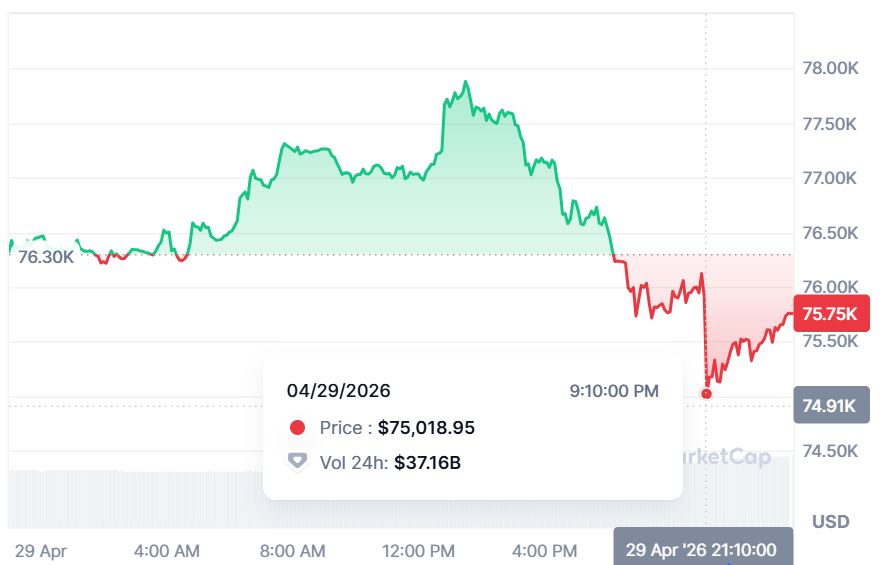
The Fed kept its benchmark rate unchanged at 3.50% to 3.75%, citing elevated inflation and geopolitical uncertainty. The decision was more hawkish than a simple pause suggested, with multiple dissents and increased internal division over the future policy path.
That reaction matters. Bitcoin’s recent strength does not necessarily reflect fully completed institutional allocation. Instead, it increasingly reflects anticipation of future inflows through ETF channels, combined with hopes that monetary conditions may ease later in the year.
Markets appear to be pricing Bitcoin not only on present demand, but on expected structural demand that has yet to fully materialize.
Adam Back, CEO of Blockstream, recently said in an interview with CoinDesk that institutional demand through spot Bitcoin ETFs is real, but the pace of deployment remains slower than many market participants expect.
Back noted that while major asset managers such as BlackRock have publicly discussed portfolio allocations in the 2% to 4% range, many wealth managers and institutional allocators have not yet fully implemented exposure. He characterized this as structural inertia inside traditional finance rather than a lack of interest.
That thesis is supported by recent ETF flow data. U.S. spot Bitcoin ETFs have seen renewed inflows in recent sessions after a volatile start to the year marked by notable outflows earlier in 2026. The recent rebound suggests institutional demand is improving, but in an incremental and cyclical pattern rather than a single synchronized wave.
In this framing, ETFs are not an immediate demand shock. They are a long-duration capital funnel.
Alongside institutional flow dynamics, macro investors continue to reinforce Bitcoin’s role as a hedge against systemic financial risk.
In an interview with Invest Like the Best podcast, Paul Tudor Jones has reiterated that Bitcoin remains one of the strongest inflation hedges available in modern markets because of its fixed supply structure and independence from sovereign monetary expansion.
In that framework, Bitcoin is increasingly discussed alongside concerns around persistent inflation, fiscal expansion, and long-term currency debasement risks. This moves Bitcoin beyond the category of a speculative digital asset and closer to that of a strategic macro instrument used for diversification during periods of uncertainty.
The Federal Reserve’s latest hold decision may reinforce that narrative. If inflation remains sticky while rates stay restrictive, investors may continue seeking scarce assets outside the traditional fiat system.
Viewed together, these developments form a coherent structural transition rather than isolated market events.
Institutional infrastructure is now largely in place. ETFs have removed access barriers. Bitcoin is increasingly part of traditional portfolio discussions. Macro conditions continue to support interest in alternative stores of value.
However, the defining characteristic of the current cycle is timing.
Institutional capital is not absent, but slow-moving. ETF access has opened the door, but internal allocation processes at large institutions still take time. As a result, capital is entering the system gradually rather than in one coordinated surge.
This creates a market where Bitcoin is increasingly being revalued in anticipation of future institutional demand rather than on fully realized inflows.
Price action remains forward-looking. Adoption remains delayed. And that gap may define Bitcoin’s next phase.

Disclaimer of Warranty
The information provided in this article is for general informational purposes only. We make no warranties about the completeness, reliability, and accuracy of this information. Read full disclaimer

Editor's Picks
In the Same Space

Alpaca Moves Closer to UAE Market Entry with Preliminary ADGM Approval

News Desk

Oct 26, 2026

3 min

Robinhood Plans Dubai Launch in 2027 After DFSA Authorization
Walid Abou Zaki
Oct 22, 2026
4 min

Standard Chartered Signs Deal to Acquire Zodia Custody
News Desk
Oct 21, 2026
3 min

JPMorgan Takes JPM Coin to Ethereum in Major Push to Bring Bank Deposits Onchain
News Desk
Oct 19, 2026
5 min