Advertisement
Policy & Industry
Share
Russia's State Duma is set to hold final readings on its cryptocurrency regulation bill this week, while South Korea's Bank of Korea prepares a nine-bank real-world CBDC pilot for September — two distinct but parallel moves toward institutionalizing digital assets.
Two major economies are taking different paths toward digital asset adoption this week, with Russia moving closer to comprehensive cryptocurrency regulation while South Korea prepares to expand real-world testing of its central bank digital currency (CBDC).
The developments highlight how governments continue to pursue distinct strategies for integrating digital assets into their financial systems, with Russia focusing on legalizing cryptocurrency activity and South Korea accelerating the development of blockchain-based sovereign money.
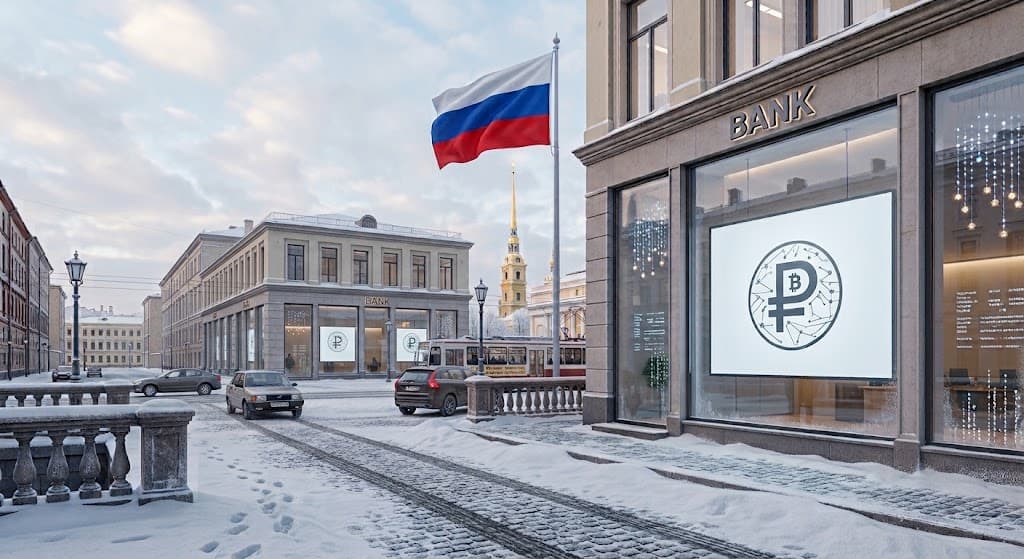
Russia's State Duma is expected to hold the second and third readings of its long-awaited cryptocurrency regulation bill on Tuesday, bringing the legislation one step closer to becoming law.
According to Anatoly Aksakov, chairman of the State Duma Committee on Financial Markets, lawmakers will consider draft law "On Digital Currency and Digital Rights," which aims to establish a comprehensive legal framework governing cryptocurrency transactions and cross-border payments.
If approved, the legislation would introduce investment limits based on investor classification.
Under the proposal, non-qualified investors would be allowed to purchase up to 300,000 rubles (approximately $3,800) worth of cryptocurrencies annually through a single intermediary and transfer up to 100,000 rubles abroad. Qualified investors would receive significantly higher limits, with annual purchase caps of 3 million rubles and cross-border transfer limits of 1 million rubles.
The legislation is also designed to facilitate the use of digital assets in international trade, allowing companies involved in importing goods into Russia to settle transactions using cryptocurrencies under a defined legal framework.
Should the bill receive final approval, its main provisions are expected to enter into force on September 1.
While Russia focuses on regulating cryptocurrencies, South Korea is advancing its central bank digital currency initiative.
The Bank of Korea (BOK) is scheduled to launch the second phase of its CBDC pilot in September, introducing real-world transaction testing involving nine domestic banks.
According to local reports, the central bank will provide the underlying institutional CBDC infrastructure, while participating financial institutions will issue and manage deposit tokens that customers can use for transactions.
The expanded pilot will include major lenders such as KB Kookmin Bank, Shinhan Bank, Hana Bank, Woori Bank, Gyeongnam Bank, and iM Bank.
Bank of Korea officials said the next phase is intended to establish the foundation for eventual commercialization, with the broader objective of enabling digital won transactions regardless of time or location.
South Korea's CBDC initiative comes as commercial banks are simultaneously preparing for a potential future in which private-sector stablecoins coexist with central bank-issued digital money.
Hana Bank has reportedly begun developing infrastructure capable of supporting a won-backed stablecoin, including systems for issuance, redemption, settlement, digital wallets, and anti-money laundering compliance. Although the bank has not committed to launching a stablecoin, the preparations reflect growing expectations that legislation governing the sector will emerge in the coming years.
Meanwhile, the South Korean government continues expanding its broader digital asset strategy. Authorities recently announced plans to revise the country's decades-old national asset law to formally recognize cryptocurrencies as national assets, reinforcing Seoul's commitment to integrating blockchain technology into public finance.
The latest developments illustrate the contrasting priorities shaping digital asset policy worldwide.
Russia is seeking to provide legal certainty for cryptocurrency investors and businesses, particularly in the area of cross-border commerce, while South Korea is focusing on modernizing its payment infrastructure through central bank digital currency technology.
Although their approaches differ, both initiatives reflect a broader global trend toward integrating blockchain-based financial systems into national economies, whether through regulated cryptocurrencies, CBDCs, or a combination of both.

Disclaimer of Warranty
The information provided in this article is for general informational purposes only. We make no warranties about the completeness, reliability, and accuracy of this information. Read full disclaimer

Editor's Picks
In the Same Space

Sberbank Wins Russia Approval to Trade Bitcoin and Crypto

News Desk

Oct 15, 2026

4 min

Bitcoin Reclaims $83,000 Amid Global Tech Sell-Off
News Desk
Oct 13, 2026
6 min

South Korea Moves to Block 27 Crypto Sites, Including KuCoin and MEXC
News Desk
Oct 13, 2026
3 min

UAE and Morocco Deepen Financial Ties With Payment and CBDC Agreements
News Desk
Oct 9, 2026
5 min