Advertisement
Stablecoins & Payments
Share
The Central Bank of the UAE and Bank Al-Maghrib have signed two MoUs covering banking supervision, instant payment system linkage, Islamic finance coordination, and CBDC exploration, aiming to deepen financial integration between the UAE and Morocco.
The Central Bank of the United Arab Emirates (CBUAE) and Bank Al-Maghrib, Morocco’s central bank, have entered into two Memoranda of Understanding (MoUs) to strengthen financial cooperation, improve payment connectivity, and coordinate banking oversight. The agreements establish a framework for closer collaboration between the two countries, covering instant payments, central bank digital currencies (CBDCs), Islamic finance, and the regulation of digital assets.
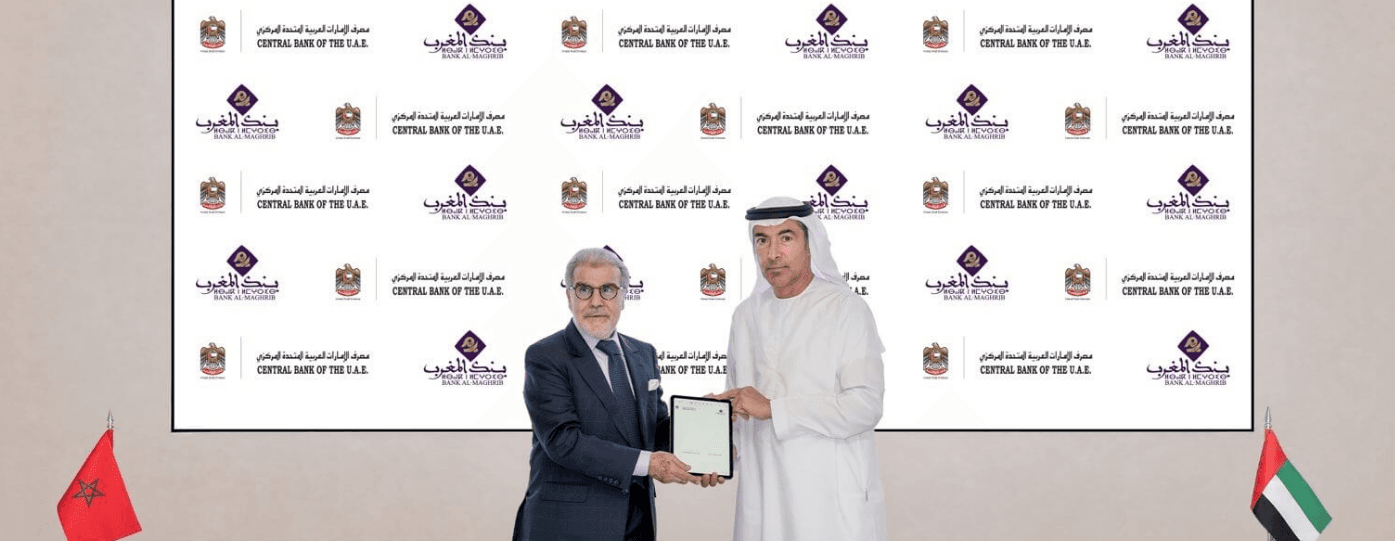
The agreements were signed at the CBUAE headquarters in Abu Dhabi by Khaled Mohamed Balama, Governor of the CBUAE, and Abdellatif Jouahri, Governor of Bank Al-Maghrib. The partnership seeks to modernise financial infrastructure while bringing supervisory approaches closer together, creating opportunities to facilitate cross-border transactions and reinforce economic ties between the UAE and Morocco.
The first MoU establishes a framework for cooperation between the two central banks on banking supervision and regulatory practices. Under the agreement, both institutions will exchange information and expertise concerning the oversight, regulation, and financial soundness of banks and other financial institutions operating in their respective markets.
The partnership also addresses Shariah governance, with the two regulators exploring ways to improve coordination between their respective frameworks. This cooperation could support the development of Islamic financing solutions for cross-border trade and infrastructure projects, potentially expanding financing opportunities for businesses and investors in both countries.
By coordinating supervisory practices and sharing regulatory knowledge, the central banks aim to strengthen oversight while supporting the development of financial products that meet Islamic finance requirements.
The second MoU focuses on improving the technical links between the UAE and Morocco’s payment infrastructures. The central banks will examine opportunities to connect their instant payment systems and domestic card-switching networks, with the objective of making payments between the two countries more accessible and efficient.
The initiative also includes exploring the mutual acceptance of domestic payment cards and improving the settlement of cross-border transactions. If implemented, these measures could reduce friction in payments between the two markets and support commercial activity, tourism, and other financial interactions.
In addition, the agreement covers cooperation on retail and wholesale central bank digital currencies. Both institutions intend to explore potential applications for CBDCs in cross-border payments, alongside exchanging expertise on the regulatory treatment of virtual assets, including stablecoins and other crypto-assets.
Consumer protection will remain a key consideration as the two countries examine approaches to supervising these emerging financial instruments.
Commenting on the agreements, Khaled Mohamed Balama, Governor of the CBUAE, said the partnership reflects the UAE’s commitment to expanding banking and financial relations with Morocco in support of their shared interests.
Balama highlighted the importance of exchanging supervisory expertise, advancing Islamic finance solutions, and identifying opportunities to connect payment systems. He also noted that these efforts are intended to improve the efficiency and innovation of the financial sector while supporting stronger trade and economic relations between the two countries.
The CBUAE is responsible for monetary policy, banking supervision, and maintaining financial stability in the UAE. It has also played an active role in developing the country’s digital financial infrastructure and establishing regulatory frameworks for emerging financial activities.
Bank Al-Maghrib serves as Morocco’s central bank, overseeing monetary policy, issuing the Moroccan dirham, managing foreign exchange reserves, and supervising credit institutions. It also plays a central role in the development and regulation of Morocco’s national payment infrastructure, including the integration of participatory banking, the country’s framework for Islamic finance.
The two MoUs create a formal basis for closer cooperation between financial regulators in the Gulf and North Africa. Rather than focusing exclusively on traditional banking relationships, the agreements extend to payment technology, digital currencies, and the evolving regulatory landscape for digital assets.
The significance of these agreements lies in their combination of regulatory coordination and payment infrastructure development. Connecting instant payment systems and domestic card networks could make cross-border transactions more convenient, but the broader impact will depend on the technical implementation, settlement arrangements, and regulatory standards adopted by both countries.
The inclusion of CBDCs and virtual-asset regulation also indicates that cooperation is extending beyond conventional banking into the next phase of financial infrastructure. However, exploring CBDC applications does not mean either country has committed to deploying a digital currency for cross-border payments under these agreements. The immediate priority is to establish a framework for collaboration and assess potential use cases.
For the wider MENA region, the partnership could provide a model for connecting national payment systems without requiring countries to adopt identical financial regulations. If the two central banks translate the agreements into operational links and compatible supervisory practices, the initiative could help reduce cross-border payment friction, support bilateral trade, and establish a foundation for broader regional financial interoperability.

Disclaimer of Warranty
The information provided in this article is for general informational purposes only. We make no warranties about the completeness, reliability, and accuracy of this information. Read full disclaimer

Editor's Picks
In the Same Space

UAE Tokenized Deposits Are Moving Faster Than Stablecoins

Walid Abou Zaki

Oct 6, 2026

10 min

MiCA Stablecoin Rules Face a Reality Check as Circle Calls for Change
Walid Abou Zaki
Oct 5, 2026
11 min

Swiss National Bank Warns of Stablecoin Risks to Monetary Policy and Interest Rates
News Desk
Oct 1, 2026
3 min

U.S. Weighs Global Stablecoin Push as Issuers Near $200B in Treasury Holdings
News Desk
Sep 28, 2026
3 min