
Advertisement
Exchanges & Trading
Share
SN
Senior English Editor


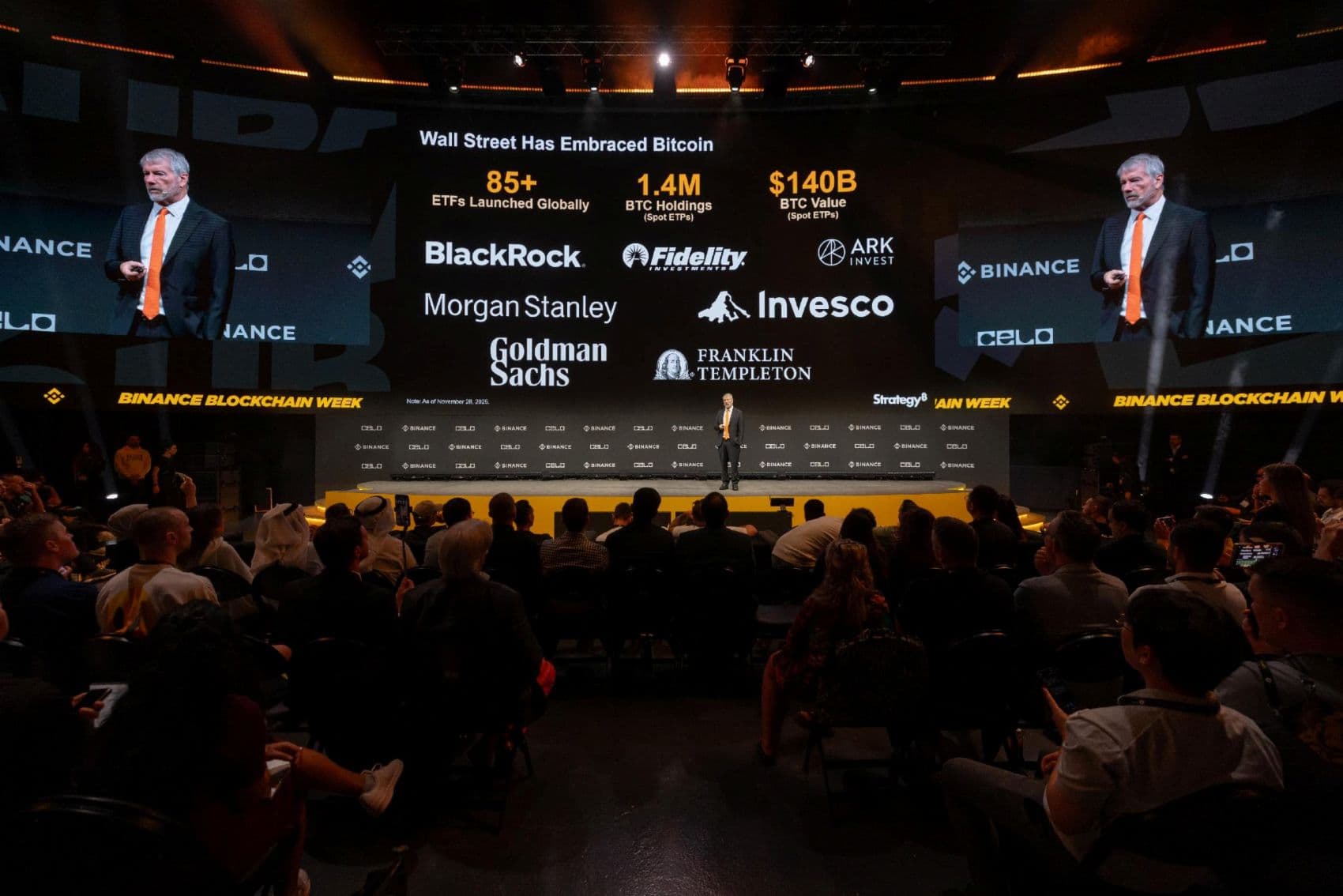
Michael Saylor, CEO of Strategy and the world’s largest corporate holder of Bitcoin, used the main stage in Dubai this week to deliver a clear message to crypto investors: don’t let market volatility shake long-term conviction.
Speaking to a packed audience of founders, policymakers, and traders, Saylor framed Bitcoin’s price swings as a sign of strength rather than weakness. Drawing parallels to the skepticism that once surrounded electricity, automobiles, and aviation, he argued that early resistance is a common feature of disruptive technologies.
“Volatility is not a flaw — it’s proof of relevance,” Saylor told attendees. “This is the most powerful, vibrant financial innovation in capital markets today. Don’t run away from the fire — run toward the fire.”
Saylor framed the current market phase as not merely cyclical but foundational — a moment where weak structures are being exposed.
“This isn’t just a correction. It’s an unmasking — a revelation of how much of the ecosystem was built on borrowed conviction and liquidity without discipline,” he told the audience.
“Bitcoin didn’t fail. Bitcoin exposed the failures around it — failures in risk management, human psychology, and protocols that were never designed to survive a storm.”
He stressed that downturns are intrinsic to dynamic markets — necessary resets that clear fragile assumptions and allow resilient infrastructure to emerge:
“Bitcoin doesn’t create chaos — it reveals it. Cycles like this are structural, mathematical, and built into free markets. Storms test systems, and they show you what’s real and what never was.”
For Saylor, the current volatility represents a learning opportunity rather than a warning sign.
“Understanding this moment requires education, not emotion,” he added, calling Bitcoin’s transparent blockchain structure “a definitive on-chain mechanism for long-term growth.”
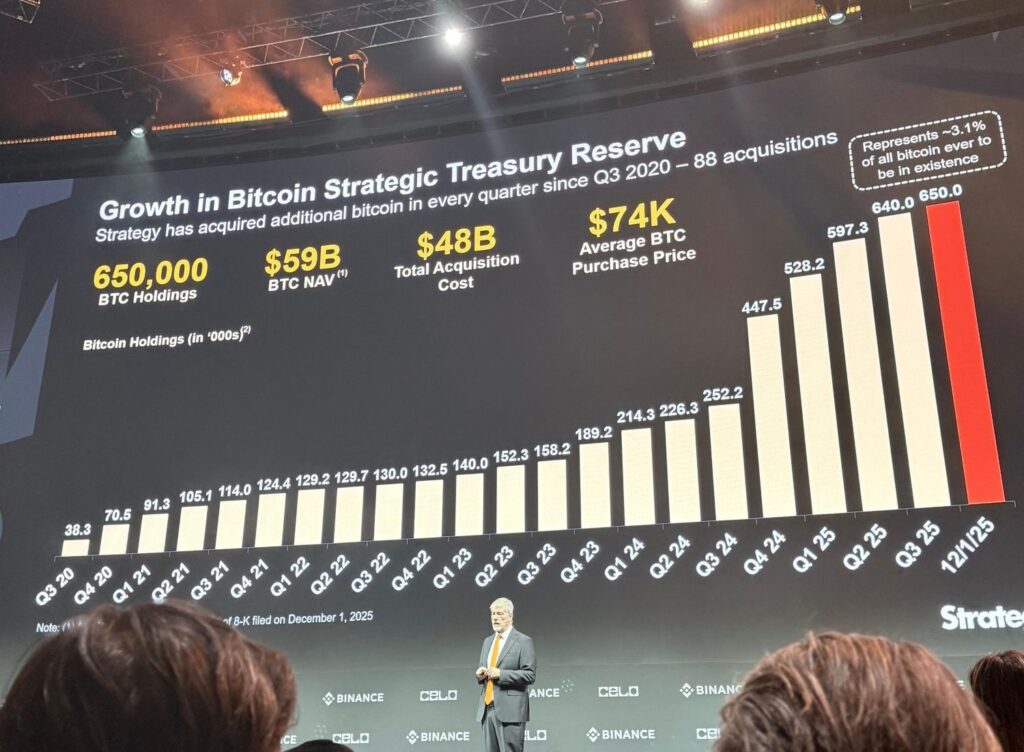
Strategy continues to exemplify that conviction. The company operates as a digital-asset treasury vehicle, accumulating Bitcoin to provide investors with direct capital exposure to the asset class. It currently holds about 650,000 BTC, equivalent to roughly 3.1% of the world’s total Bitcoin supply — amassed over five years and valued at approximately $56 billion at today’s prices.
The company’s stock has declined by about 37% this year, as investor appetite cooled amid concerns over its capital-raising strategy, which includes equity issuance, convertible debt, and preferred-share offerings.
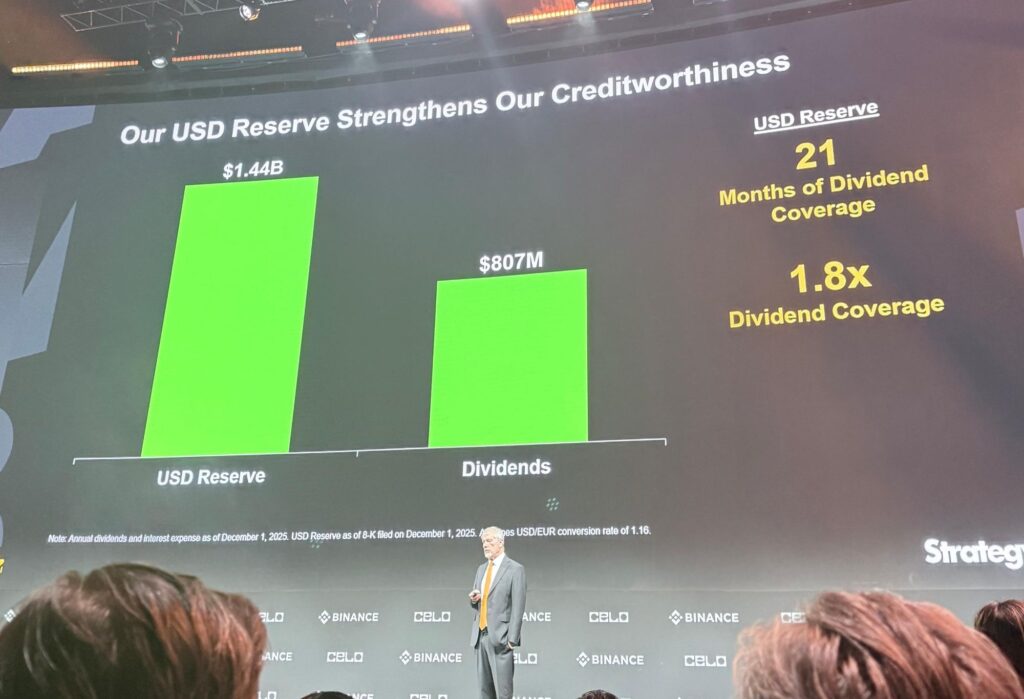
Nevertheless, Strategy recently secured $1.44 billion in additional dollar reserves through a stock sale. Saylor said this buffer ensures the firm can meet ongoing dividend payments and debt obligations without selling Bitcoin for nearly two years.
“This reserve gives us about 21 months of dividends even if capital markets close completely,” he explained. “If markets become irrational, we can still operate without liquidating crypto assets.”
Saylor outlined the firm’s capital management formula clearly: Strategy issues new equity when shares trade above the underlying value of its Bitcoin holdings — creating shareholder upside — and sells derivatives or Bitcoin only when equity prices fall beneath its net asset value.
With around $60 billion in Bitcoin reserves against $8 billion in debt, Strategy operates at what Saylor described as a “fairly low leverage ratio.”
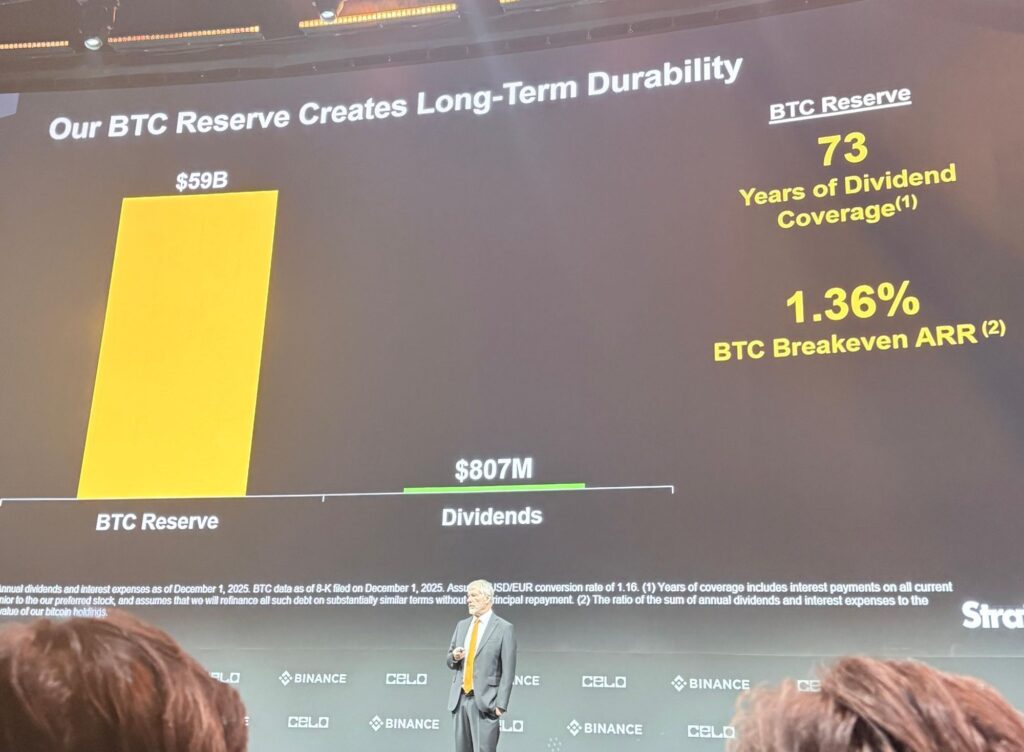
The company currently distributes roughly $807 million per year in dividends, equating to more than seven decades of payout capacity.
“For us to pay dividends indefinitely and grow shareholder value, Bitcoin only needs to rise about 1.36% per year,” Saylor said.
By comparison, he argued, traditional money markets generate returns around 3% annually, while Bitcoin-based investment strategies have historically produced approximately 47% per year.
“If your hurdle rate is the S&P’s 14% return benchmark, capital parked in money markets is destroying value,” he said. “Capital positioned in Bitcoin is creating it.”
Saylor pointed to dramatic shifts in institutional posture toward crypto over the past year. Major banks that once rejected Bitcoin-backed lending have reversed course.
“I couldn’t get a loan against Bitcoin from any major bank,” he noted. “Today, eight of the top ten US banks are active in crypto lending — all flipped in the last six months.”
Institutional expansion continues as well. More than 60 publicly traded companies now hold significant cryptocurrency reserves, compared to Strategy being alone in earlier years. Additionally, the approval of spot Bitcoin ETFs earlier this year has spurred growth to 85 Bitcoin exchange-traded funds worldwide, further legitimizing access to digital assets among mainstream investors.
Predicting further transformation, Saylor said digital credit would extend across global financial systems, modernizing banking and capital markets.
“The winners will be investors, the digital economy, and Bitcoin holders,” he said. “The losers will be bureaucratic institutions that want to hold your money and pay you nothing.”
As he concluded his address, Saylor framed the present cycle as a generational inflection point:
“Every generation faces a moment that tests its courage,” he said.
“Those moments don’t destroy the future — they create it. They force people to rebuild. And if you’re here tonight, you’re standing in one of those moments.”
Saylor’s speech underscored a larger theme emerging from Binance Blockchain Week Dubai — that the crypto conversation is moving away from short-term price cycles toward long-term capital structure and institutional adoption.
Bitcoin’s current correction may dominate headlines, but beneath the surface, adoption metrics, regulatory acceptance, and balance-sheet experimentation continue to expand.
The presence of global CEOs, policymakers, and financial leaders on Dubai’s stages reflects how the industry’s center of gravity is shifting. Crypto is increasingly discussed not as a speculative alternative but as evolving financial infrastructure.
Volatility remains part of the journey — but in Dubai this week, the message was clear: digital assets are no longer fighting for relevance. They are negotiating permanence.

Disclaimer of Warranty
The information provided in this article is for general informational purposes only. We make no warranties about the completeness, reliability, and accuracy of this information. Read full disclaimer

Editor's Picks
In the Same Space

BitMEX Shutdown Signals Crypto’s Shift From Leverage to Institutional Markets

News Desk

Jul 23, 2026

3 min

Triple-A Secures VARA In-Principle Approval for Broker-Dealer Services in Dubai
Anna K.
Jul 15, 2026
4 min

Kalshi Takes 24/7 Trading Battle Beyond Crypto With Perpetual Metals Futures Bid
News Desk
Jul 22, 2026
4 min

Grayscale Expands Crypto ETF Push With First U.S. Worldcoin Fund
News Desk
Jul 21, 2026
2 min