Advertisement
Research & Analysis
Share
AK
Senior English Editor


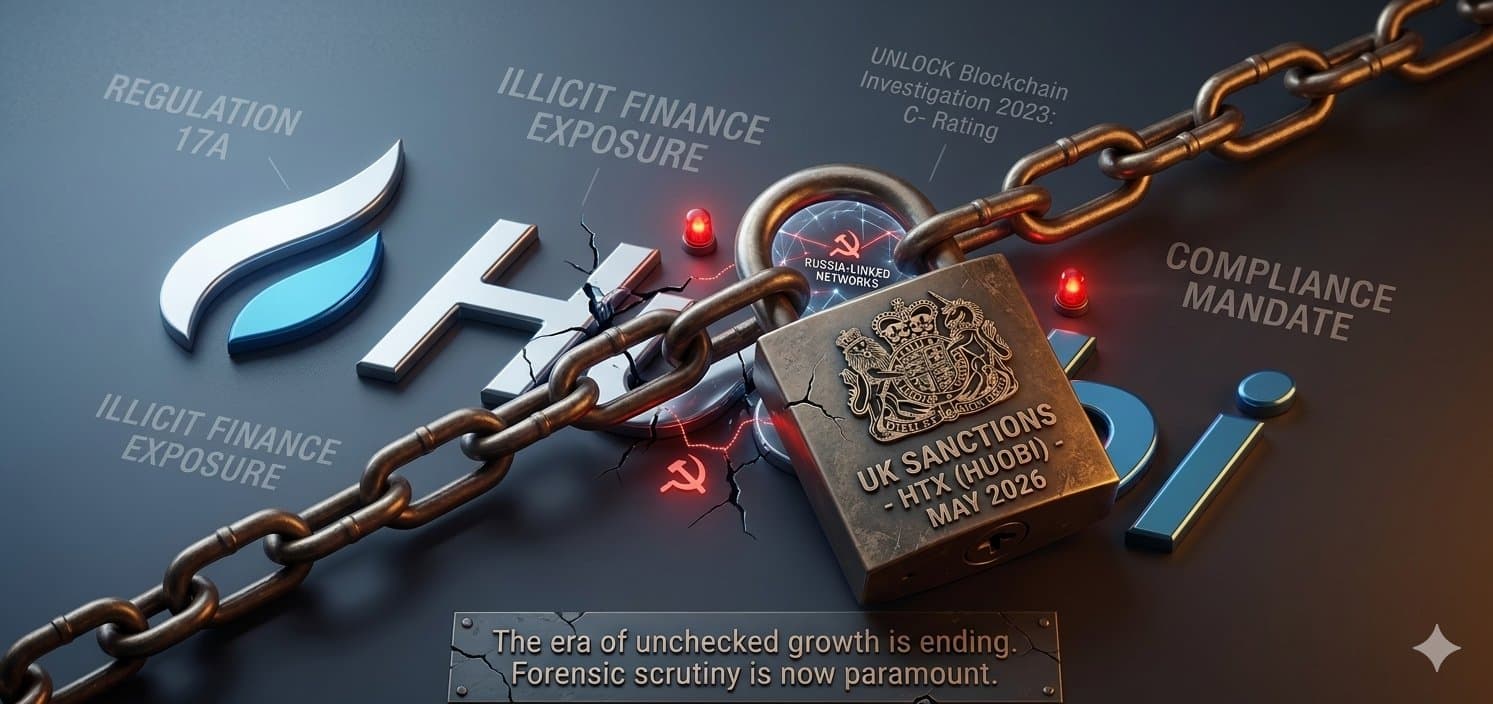
More than three years after UNLOCK Blockchain published an extensive compliance investigation into cryptocurrency exchange HTX, formerly known as Huobi, British authorities have now sanctioned the platform as part of a sweeping crackdown targeting Russia-linked financial and crypto networks.
The latest sanctions package, announced by the United Kingdom in May 2026, represents one of the most aggressive regulatory actions yet directed at crypto infrastructure allegedly connected to sanctions evasion and illicit financial activity.
Among the entities targeted was HTX, one of the world’s largest cryptocurrency exchanges by trading volume.
The development has brought renewed attention to an investigation published by UNLOCK Blockchain in March 2023 in collaboration with blockchain forensic and compliance firm VAF Compliance.
At the time, the report examined Bitcoin wallet clusters associated with Huobi using blockchain analytics, transaction tracing tools, sanctions screening databases, and open-source intelligence techniques.
The investigation was conducted during a period when many exchanges were still prioritizing growth and trading activity over compliance infrastructure, while global crypto regulation remained fragmented and inconsistent across jurisdictions.
As mentioned above, the original analysis focused specifically on Bitcoin wallet clusters linked to Huobi between 2013 and 2023.
Using blockchain forensic software and transaction flow analysis, VAF Compliance researchers identified direct and indirect exposure to multiple high-risk categories, including sanctioned entities, darknet marketplaces, and wallets associated with terrorist financing and child exploitation investigations.
The report assigned the exchange a compliance rating of C-, citing significant risk exposure tied to transaction flows involving high-risk counterparties.
According to the findings, more than 21,000 Bitcoins had direct exposure to sanctions-related addresses, while additional transfers were linked to darknet markets and to wallets associated with terrorist-financing investigations.
One of the most concerning findings involved transfers connected to addresses sanctioned by the US Office of Foreign Assets Control (OFAC). The report noted that some transactions continued to occur even after specific wallet addresses had already been added to sanctions lists.
The researchers at the time argued that the transaction patterns raised serious questions about the effectiveness of wallet-screening procedures, sanctions monitoring, and ongoing due diligence processes within centralized exchanges.
The investigation also highlighted a broader industry issue: the risk exposure associated with exchange wallet infrastructure does not remain isolated to the platform itself. Instead, exposure can extend to users interacting with those wallets, potentially impacting onboarding processes, institutional risk scoring, and relationships with regulated financial institutions.
Moreover, the report warned that insufficient anti-money laundering controls could eventually expose exchanges to regulatory penalties, reputational damage, and restrictions across multiple jurisdictions.
The United Kingdom’s latest sanctions package significantly raises the regulatory stakes for crypto exchanges operating globally.
For the first time, UK authorities applied Regulation 17A of the Russia (Sanctions) Regulations to cryptocurrency exchanges, placing designated digital asset platforms under restrictions similar to those imposed on sanctioned banks.
Under the new framework, UK financial institutions and virtual asset service providers are prohibited from maintaining correspondent relationships or processing payments connected to designated exchanges.
The measures also extend beyond direct counterparties. According to blockchain analytics firm Elliptic, firms may now be required to trace transaction paths and identify indirect exposure involving sanctioned entities throughout the payment chain.
HTX was specifically identified by British authorities as being suspected of facilitating services connected to Russia-linked financial infrastructure and sanctions evasion networks.
The sanctions package additionally targeted several crypto-related firms, payment networks, and offshore financial entities allegedly involved in supporting Russian financial activity.
The overlap between the 2023 UNLOCK Blockchain investigation and the latest UK sanctions highlights how dramatically the role of compliance has evolved across the digital asset industry in just a few years.
What was once viewed primarily as a technical or operational concern has increasingly become a central issue for regulators, institutional investors, banks, and governments.
In recent years, authorities across the United States, Europe, the Middle East, and Asia have intensified scrutiny around sanctions screening, anti-money laundering procedures, wallet attribution, transaction monitoring, and blockchain forensic capabilities.
With traditional financial institutions continuing to enter the digital asset sector, compliance expectations increasingly resemble those applied to the banking system itself.
The HTX case also reflects a broader transformation in how crypto exchanges are evaluated globally. Trading volumes and product offerings alone are no longer enough. Regulators and institutional counterparties are placing growing emphasis on the sophistication of compliance systems, transaction tracing capabilities, and the ability to identify illicit financial exposure in real time.
The sanctions against HTX arrive at a time when governments worldwide are tightening oversight of crypto infrastructure linked to geopolitical risk, sanctions circumvention, and cross-border illicit finance.
For the broader digital asset sector, the situation reinforces a larger reality: compliance failures that may once have been dismissed as isolated operational weaknesses are increasingly being treated as systemic financial risks.
It also highlights the growing importance of blockchain forensic intelligence and transaction analytics in shaping modern crypto regulation.
The renewed pressure surrounding HTX ultimately highlights one of the biggest shifts happening inside the crypto industry today: the era where exchanges could prioritize growth while treating compliance as secondary is rapidly coming to an end.
As regulators, banks, and governments tighten oversight of digital asset infrastructure, blockchain forensic analysis is emerging as one of the most powerful tools shaping the future of financial enforcement.
What UNLOCK Blockchain highlighted in 2023 was not simply an isolated compliance concern, but an early glimpse into the structural pressures now redefining the global crypto industry.

Disclaimer of Warranty
The information provided in this article is for general informational purposes only. We make no warranties about the completeness, reliability, and accuracy of this information. Read full disclaimer

Editor's Picks
In the Same Space

Who Gets the $5B Bitcoin Fortune? UK Ruling Complicates Victims’ Fight

News Desk

Oct 13, 2026

6 min

UK Names Six Banks to Lead First Digital Government Bond
News Desk
Oct 7, 2026
3 min

Russia’s Digital Ruble Reaches the Payroll for the First Time Ever
News Desk
Oct 5, 2026
2 min
“One Financial System”: What OKX’s New Investors Are Backing
Walid Abou Zaki
Oct 8, 2026
6 min