
Advertisement
Markets
Share
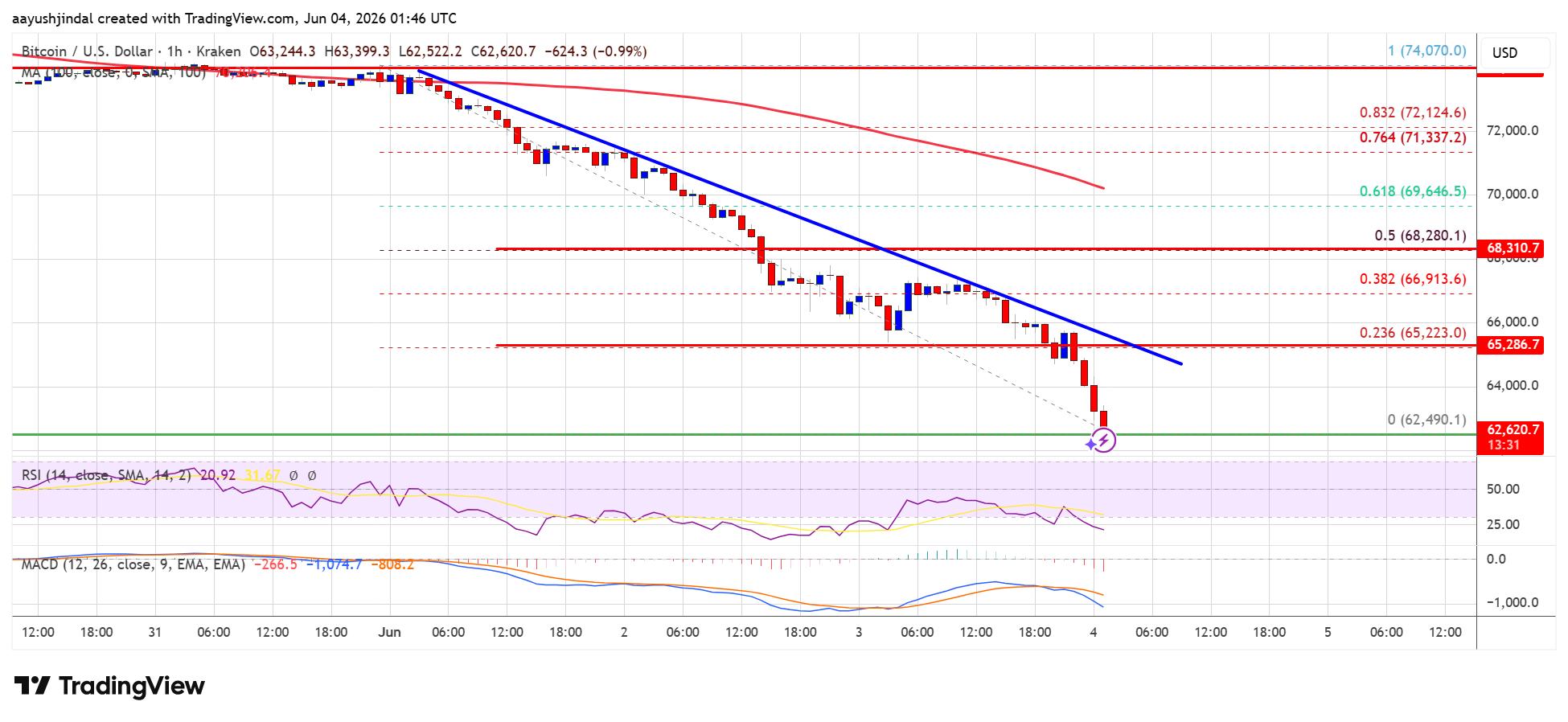
Bitcoin has entered a pronounced corrective phase, falling from around $82,400 to below $66,000 within a week and briefly testing levels near $62,000, marking one of its steepest short-term declines of the current cycle.
The selloff has triggered cascading liquidations across derivatives markets, wiping out more than $2.4 billion in leveraged positions within 48 hours, with long traders accounting for the overwhelming majority of losses.
While the immediate move has been described as technically driven, analysts say the broader decline reflects a convergence of structural outflows, profit-taking by long-term holders, and shifting institutional demand.
A growing number of market analysts now point to persistent outflows from U.S. spot Bitcoin exchange-traded funds as the central force behind the downturn.
According to market estimates cited by Citi analysts, ETF flows account for roughly 45% of weekly Bitcoin price variation, making them one of the most influential demand indicators in the current cycle.
Recent data shows billions of dollars exiting spot Bitcoin ETFs over a short period, with multi-day outflow streaks accelerating downward pressure on prices. One of the largest funds, BlackRock iShares Bitcoin Trust (IBIT), reportedly saw consecutive days of redemptions in May, contributing to broader institutional selling pressure.
Despite this, some market participants initially linked the selloff to a minor Bitcoin disposal by Strategy, which sold a small portion of its holdings. However, analysts at Citigroup argue the transaction is statistically insignificant relative to broader ETF-driven flows.
“ETF flows remain the primary driver of Bitcoin’s price action,” analysts noted, emphasizing that structural demand shifts matter more than isolated corporate transactions.
A key development in this downturn is the behavior of high-conviction Bitcoin holders.
According to market research cited by Compass Point, long-term holders—defined as wallets inactive for at least 155 days—have recently shifted from accumulation to distribution. In the past few sessions alone, they have reportedly sold billions worth of Bitcoin.
Notably, a significant share of recent selling has come from investors who entered the market at prices above $90,000, suggesting capitulation among late-cycle buyers.
This shift is often associated with late-stage corrections, where previously resilient cohorts begin reducing exposure after sustained drawdowns.
Analysts argue that this pattern may indicate the market is moving into a later phase of its current correction cycle rather than the early stages of a broader structural breakdown.
Beyond spot demand dynamics, derivatives markets have played a major role in accelerating the downturn.
As Bitcoin broke below key support levels near $68,000 and $65,000, leveraged long positions were rapidly unwound, intensifying downward momentum. In total, billions of dollars in positions were liquidated across centralized exchanges within a short window.
Technical indicators suggest Bitcoin briefly fell below key short-term moving averages, with momentum indicators entering deeply oversold territory during intraday trading.
Market structure analysts note that such liquidation cascades often exaggerate price moves beyond what fundamentals alone would justify.
Additional factors have contributed to market unease, including large block transactions in private liquidity pools and ongoing wallet movements linked to the defunct Mt. Gox estate, which continue to fuel speculation about potential future supply overhang.
Meanwhile, the broader macro divergence has become more visible: equities continue to hit record highs while Bitcoin has lagged, prompting renewed debate over whether the asset is functioning as a risk-on technology proxy or a macro hedge.
Bitcoin is now trading around $64,000, with analysts watching whether the $62,000–$60,000 zone can hold as structural support.
Resistance is seen near $65,000, with a broader recovery requiring a sustained move back above the $68,000 area. Momentum indicators have entered oversold territory, though analysts caution that such conditions can persist during liquidation-driven selloffs.
Despite current weakness, some analysts continue to point to regulatory developments as a medium-term stabilizing factor.
The proposed CLARITY Act has entered legislative discussion in the United States, though expectations for near-term passage have weakened.
Still, market strategists suggest that any progress on crypto market structure regulation could restore institutional confidence and revive inflows into digital asset products.
Interestingly, the broader crypto market has not fully mirrored Bitcoin’s downside momentum.
Ethereum and Solana both posted modest losses, while select mid-cap tokens even outperformed during parts of the selloff—an unusual pattern during Bitcoin-led downturns.
This divergence has prompted speculation that capital rotation may be underway, potentially setting the stage for selective outperformance if Bitcoin stabilizes.
Market participants remain divided.
On one side, ETF outflows, long-term holder capitulation, and liquidation cascades suggest continued fragility in near-term price action. On the other, oversold technical conditions and improving macro liquidity expectations point to a possible stabilization phase.
For now, Bitcoin’s trajectory appears increasingly dependent on whether institutional ETF flows stabilize—or continue to act as a sustained source of net selling pressure.

Disclaimer of Warranty
The information provided in this article is for general informational purposes only. We make no warranties about the completeness, reliability, and accuracy of this information. Read full disclaimer

Editor's Picks
In the Same Space

Schwab Enables Crypto Transfers After Completing Bitcoin and Ether Trading Launch

News Desk

Oct 16, 2026

4 min

Sberbank Wins Russia Approval to Trade Bitcoin and Crypto
News Desk
Oct 15, 2026
4 min

Coinbase Outlines Bitcoin’s Path Toward Quantum-Resistant Security
News Desk
Oct 14, 2026
5 min

Who Gets the $5B Bitcoin Fortune? UK Ruling Complicates Victims’ Fight
News Desk
Oct 13, 2026
6 min