Advertisement
Markets
Share
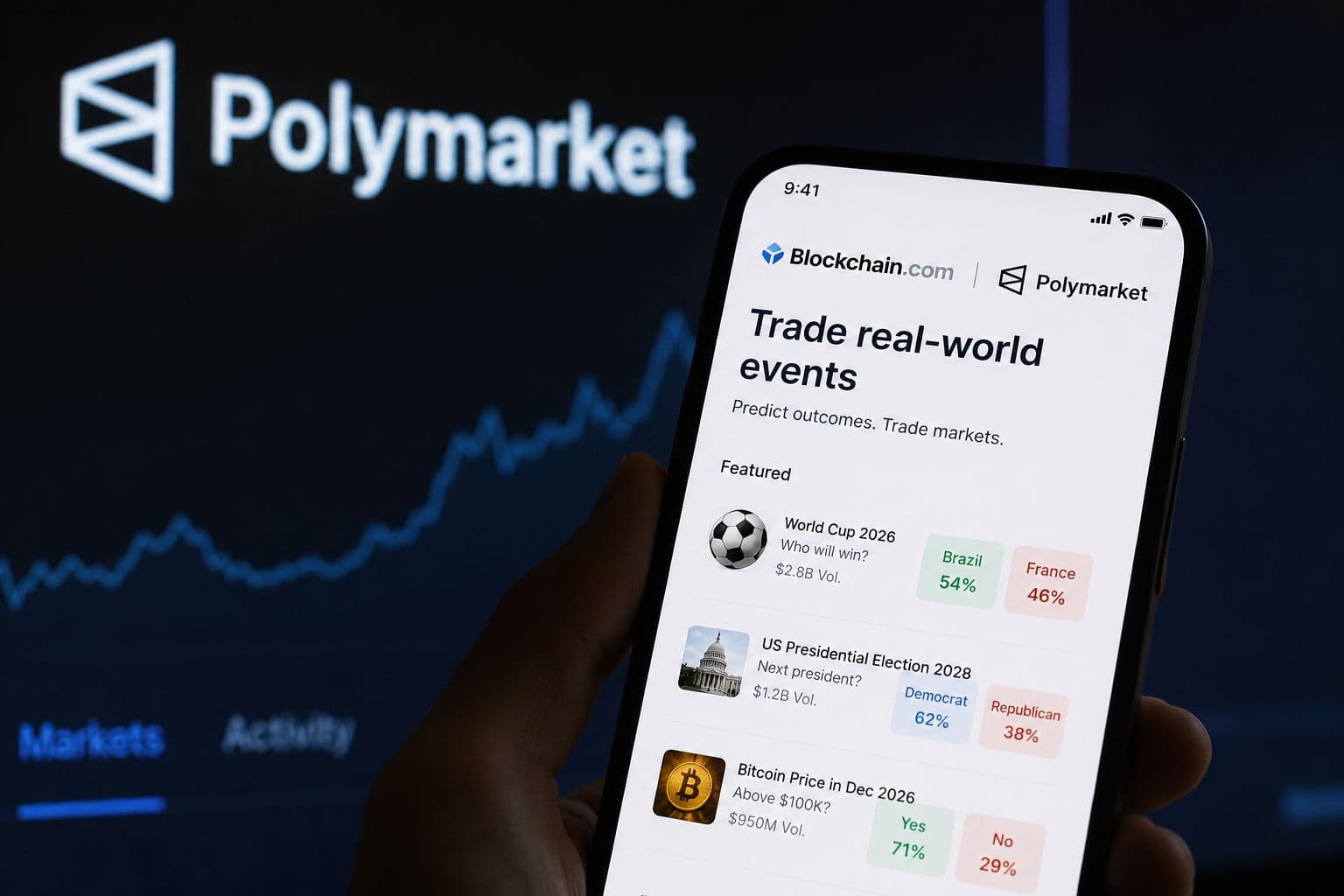
Blockchain.com has integrated Polymarket directly into its brokerage app, exposing prediction markets to 43 million verified users as the 2026 FIFA World Cup drives over $4.2 billion in football-related trading volume on the platform.
The 2026 FIFA World Cup is proving to be more than football's biggest global stage. It is becoming one of the strongest demonstrations yet that prediction markets are emerging as a new frontier for crypto platforms seeking to expand beyond traditional digital asset trading.
The latest sign came as Blockchain.com announced a partnership with Polymarket, integrating the prediction market platform directly into its brokerage app. The move allows eligible users to trade on real-world events without transferring funds to a separate platform, exposing prediction markets to Blockchain.com's 43 million verified users.
The announcement coincides with record activity surrounding the World Cup. According to Polymarket, football-related prediction markets have generated more than $4.2 billion in trading volume during the current tournament cycle and over $5 billion over the past year, making sport one of the platform's fastest-growing categories.
Rather than representing a temporary World Cup trend, the developments suggest prediction markets are becoming an increasingly important component of the digital asset ecosystem.
Prediction markets have historically operated as niche crypto applications where users speculate on election outcomes, economic events or sporting results.
That model is beginning to change.
By integrating Polymarket directly into its brokerage platform, Blockchain.com is positioning prediction markets alongside spot crypto trading within the same user account. Instead of requiring customers to move assets to a separate application, event contracts become another trading product available through an existing digital asset platform.
For Polymarket, the partnership significantly expands distribution. For Blockchain.com, it broadens the platform's offering beyond cryptocurrency trading at a time when exchanges are increasingly competing on product diversity rather than trading fees alone.
The strategy reflects a broader shift across the industry as exchanges evolve into multi-asset financial platforms.
Prediction markets are joining a growing list of products being integrated into crypto trading ecosystems.
Coinbase recently expanded its "everything exchange" strategy by introducing prediction markets powered by Kalshi alongside equities, derivatives, payments and digital assets. Robinhood has similarly increased its focus on event contracts, while crypto-native platforms continue exploring new ways to combine financial products within a single trading environment.
These developments illustrate how exchanges are increasingly competing to become comprehensive financial platforms rather than venues dedicated solely to cryptocurrency trading.
Prediction markets fit naturally into that strategy by increasing user engagement, generating trading activity around real-world events and creating new revenue opportunities without requiring entirely new customer bases.
The World Cup provides an ideal environment for prediction markets.
Unlike elections, which occur periodically, major sporting events generate continuous global engagement, frequent trading opportunities and rapidly changing market sentiment over several weeks.
The Argentina–England semifinal has reportedly become the most actively traded football market in crypto prediction market history, illustrating how global sporting events can rapidly create deep liquidity around non-financial outcomes.
The tournament has also renewed attention on blockchain-based fan engagement. Argentina's fan token ($ARG) and the Chiliz ecosystem have experienced increased trading activity during the competition, while FIFA continues expanding its digital asset strategy through partnerships including Krakenas an official crypto exchange supporter and FIFA Collect, its digital collectibles platform built on Avalanche.
Together, these developments demonstrate how major sporting events are becoming testing grounds for multiple blockchain-based products, from prediction markets and fan tokens to digital collectibles.
The Blockchain.com–Polymarket partnership reflects a broader transformation taking place across the digital asset industry.
The first generation of crypto exchanges competed primarily on access to digital assets. Later competition focused on derivatives, staking, custody and institutional services.
Increasingly, the next area of competition appears to be financial products linked to real-world events.
As prediction markets become integrated directly into mainstream crypto platforms, they are evolving from niche decentralized applications into another category of digital financial infrastructure.
For crypto platforms, the objective is no longer simply facilitating digital asset trading. It is building ecosystems where users can trade cryptocurrencies, tokenized assets, derivatives and event-based contracts through a single regulated interface.
The World Cup may eventually be remembered not only as a global sporting event, but also as the moment prediction markets demonstrated they were ready to become part of mainstream crypto finance.

Disclaimer of Warranty
The information provided in this article is for general informational purposes only. We make no warranties about the completeness, reliability, and accuracy of this information. Read full disclaimer

Editor's Picks
In the Same Space

US Government Transfers 12,267 BTC Worth $1 Billion in Latest Bitcoin Move

News Desk

Oct 9, 2026

5 min

Citi Raises 12-Month Bitcoin Target to $113,000 as Institutional ETF Demand Returns
News Desk
Oct 1, 2026
4 min
Russia Opens Regulated Crypto Market as Sberbank, VTB Enter First Registries
News Desk
Oct 7, 2026
4 min

Coinbase Completes Deribit Integration, Expanding Global Crypto Derivatives Access
News Desk
Oct 7, 2026
3 min