
Advertisement
Markets
Share

SN
Senior English Editor


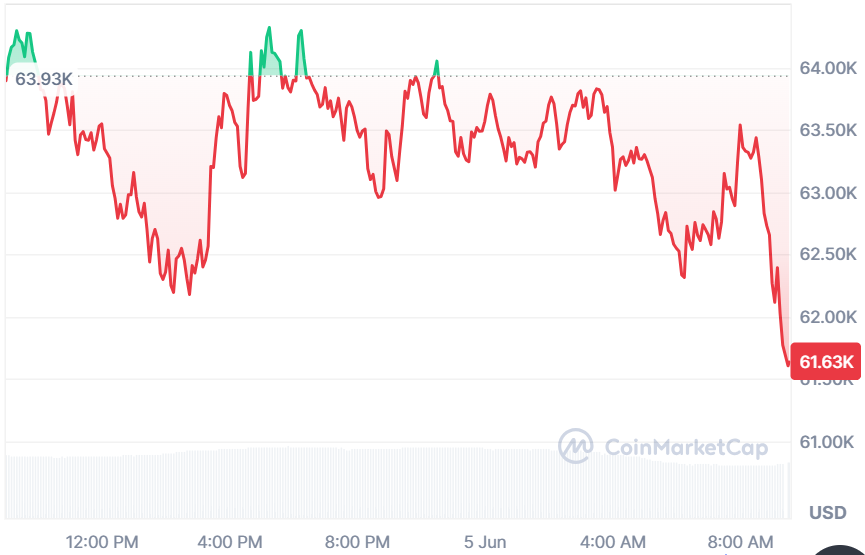
Bitcoin fell to a low of $61,606 on Friday morning, extending a weekly decline of 16% as a broader risk-off shift tied to the fading artificial intelligence trade rippled across global markets.
The move marks one of Bitcoin’s sharpest weekly drawdowns in months and comes as multiple macro and structural factors converge, including weakening equity momentum, persistent ETF outflows, and renewed questions over crypto’s dominant narrative.
The selloff was initially triggered outside crypto markets. A weaker-than-expected outlook from Broadcom on AI-chip demand on Wednesday disrupted a months-long rally in semiconductor stocks that had been a central driver of global risk appetite through 2026.
The reaction quickly spread across equities. According to TradingView data, within 24 hours, Nasdaq 100 futures fell 1.13%, South Korea’s KOSPI dropped 5.54%, and MSCI’s Asia-Pacific index declined 1.6%, reflecting a broad pullback in AI-linked trades that had led global markets this year.
As those positions unwound, crypto assets followed.
Ether fell to $1,647, extending weekly losses to more than 17%, while Solana fell to $64.9, down 20.8% over seven days, according to CoinMarketCap data. Hyperliquid’s HYPE token, one of the few outperformers earlier in the week, dropped 14.3% within 24 hours, erasing its relative strength.
The synchronized move suggested that capital rotating out of high-momentum AI and tech exposures is now spilling into digital assets.
Behind the price action, Bitcoin is also facing sustained pressure from institutional flows.
U.S. spot Bitcoin ETFs have recorded 13 consecutive sessions of net outflows, totaling roughly $4.4 billion since mid-May. Assets under management across these funds have fallen sharply from recent highs, signaling a notable slowdown in institutional demand that had supported the market through 2024 and 2025.
The weakness in flows has coincided with a rare Bitcoin sale by Strategy, which sold 32 BTC earlier this week to fund dividend obligations on preferred shares. Although small relative to its overall holdings, the move contributed to a shift in sentiment among traders who had long viewed the company as a consistent accumulator.
The combination of ETF outflows and reduced corporate buying has effectively removed two key sources of structural demand.
The price decline accelerated as leveraged positions unwound across derivatives markets.
As Bitcoin broke lower, long liquidations surged, forcing automatic selling and intensifying the downward move. According to market data, hundreds of millions of dollars in leveraged positions were flushed out in a 24-hour period, amplifying volatility during an already fragile market phase.
This liquidation cycle reinforced a familiar pattern in crypto markets: when momentum weakens, forced deleveraging often accelerates the trend rather than stabilizing it.
Beyond flows and technicals, Bitcoin is also contending with a broader narrative shift.
For much of the past year, Bitcoin has struggled to maintain a consistent macro identity. It has not behaved reliably as a “digital gold” hedge during geopolitical stress, nor as a high-beta proxy for technology equities during equity rallies.
Instead, capital has increasingly rotated toward AI infrastructure plays and semiconductor stocks, where returns have been more immediate and concentrated. Companies tied to chip production and AI infrastructure have significantly outperformed digital assets this year, drawing incremental speculative capital away from crypto markets.
This divergence has left Bitcoin more exposed during periods of risk rotation, particularly when new catalysts fail to emerge.
Market attention now shifts to upcoming U.S. labor market data, with investors watching Friday’s nonfarm payrolls report as a potential pivot point for risk sentiment.
A weaker-than-expected print could revive expectations for Federal Reserve rate cuts, potentially easing real yields and supporting risk assets, including crypto. A stronger reading would likely reinforce the current risk-off tone.
In parallel, traders are also watching ETF flow dynamics and whether large institutional holders, including Strategy, re-enter the market as buyers after this week’s turbulence.
Some analysts argue that Bitcoin’s broader cyclical structure remains intact, suggesting the market may still be operating within its typical multi-year pattern of expansion and contraction. Others caution that if current flow trends persist, downside pressure could extend further into the year.
For now, Bitcoin remains at the center of a global rotation in risk appetite—one increasingly shaped by AI-driven equity narratives rather than digital asset momentum.

Disclaimer of Warranty
The information provided in this article is for general informational purposes only. We make no warranties about the completeness, reliability, and accuracy of this information. Read full disclaimer

Editor's Picks
In the Same Space

FTX’s ‘Reckless’ Bitcoin-Mining Assets Find a Second Life in the AI Boom

News Desk

Oct 12, 2026

8 min

Schwab Enables Crypto Transfers After Completing Bitcoin and Ether Trading Launch
News Desk
Oct 16, 2026
4 min

Sberbank Wins Russia Approval to Trade Bitcoin and Crypto
News Desk
Oct 15, 2026
4 min

Coinbase Outlines Bitcoin’s Path Toward Quantum-Resistant Security
News Desk
Oct 14, 2026
5 min