Advertisement
Exchanges & Trading
Share
Major football tournaments generate headlines that extend beyond the pitch. Reports about tourism, airline bookings, sponsorship spending, retail demand, and consumer sentiment can all attract the attention of market participants.
However, attention alone does not make an event a reliable trading signal.
For Saudi traders interested in exploring World Cup-related market ideas, an IQ Option demo account can provide an environment in which a hypothesis can be examined using virtual funds before any real-money decision is considered.
The objective is not to predict a match result or assume that a national team’s performance will move a particular market. It is to determine whether a football-related development can be connected to measurable company or economic data.
Saudi readers should independently verify the platform’s current regional availability, applicable account conditions, supported assets, payment and withdrawal arrangements, and regulatory information through official sources. A demo account may help users understand how a platform works and test an analytical process, but it does not replace this due diligence.
A football story becomes relevant to financial markets only when it can be connected to a measurable economic or business channel.
A practical framework is:
Event → economic or company channel → relevant asset → confirming evidence
Consider reports of strong hotel demand in a World Cup host city. The headline itself is not a reason to open a position.
The possible economic channel would be higher tourism and hospitality revenue. A relevant asset might be the shares of a listed hotel operator with meaningful exposure to the host cities. The hypothesis would then require evidence such as occupancy rates, booking data, revenue per available room, or updated company guidance.
The same framework can be applied to aviation, advertising, retail, payments, and other sectors that may experience tournament-related activity.
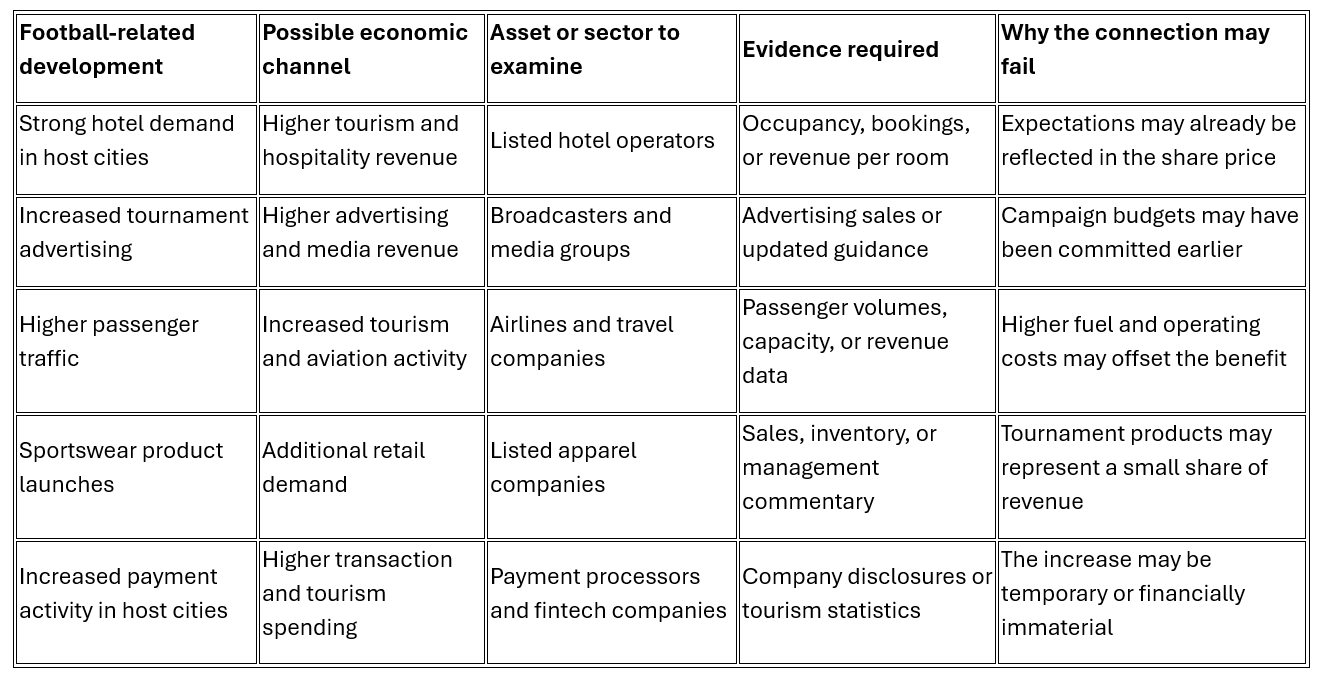
As explained in the platform’s guide to how major football events can affect trading, the strongest approach is to trace a story through factors such as attention, sentiment, liquidity, and company exposure rather than treating the tournament itself as a signal.
A headline should therefore generate a research question, not an automatic position.
When an idea does not identify a clear business channel, relevant asset, measurable variable, and date for verification, it is not yet ready to be tested.
Using a demo account should not be interpreted as confirmation that every platform service, account type, or financial instrument is available under the same conditions in every jurisdiction.
Saudi readers should consult official sources to verify the platform’s current availability and applicable terms before making any real-money decision.
They should also check the platform’s asset list to determine whether the company, sector, currency, commodity, or other instrument connected to the hypothesis is available.
This matters because a plausible economic idea may not translate into a suitable market test if the related instrument is unavailable, has limited liquidity, or is offered under conditions the user does not fully understand.
Before testing a position, beginners should also understand concepts such as spreads, margin, leverage, and liquidity.
A spread is the difference between the quoted buying and selling prices. Margin is the capital required to support a leveraged position. Liquidity refers to how easily an asset can be bought or sold without causing a significant change in its price.
These factors can affect the outcome of a position even when the original economic reasoning appears sound.
A broad statement such as “tourism will benefit from the World Cup” is not a complete market hypothesis. It does not identify a specific instrument, measurable outcome, or date on which the idea can be evaluated.
A more testable version would be:
“A listed hotel operator with significant exposure to World Cup host cities will report higher occupancy during its next financial reporting period.”
This version identifies the company, the metric expected to change, and the point at which evidence should become available.
Before testing the idea through an IQ Option demo account, the user should record the specific asset, the proposed economic channel, the expected catalyst, and the source that will provide the confirming evidence.
The conditions that would invalidate the hypothesis should also be written down in advance.
For example, the idea may be rejected if hotel occupancy does not increase, the selected company has limited exposure to the relevant cities, or rising operating costs offset any additional revenue.
The user should then define an entry condition, an exit condition, and a maximum position size before opening the simulated position.
Applying realistic limits is important even when virtual funds are being used. An unlimited demo balance can encourage behavior that would be unsuitable in a live account.
The purpose of the exercise is not to generate the largest possible simulated return. It is to determine whether the analytical process is specific, measurable, and repeatable.
When the expected data becomes available, the result should be compared with the hypothesis recorded at the beginning of the test.
Suppose a hotel operator reports stronger occupancy, but its share price falls. This does not necessarily mean the tourism data was irrelevant.
Investors may have expected an even stronger result. Costs may have increased, management may have reduced its future guidance, or the positive expectations may already have been reflected in the share price before the results were announced.
Markets often respond to the difference between expectations and reported results, rather than simply reacting to whether a figure appears positive or negative.
A demo-account test should therefore examine two separate questions.
First, did the expected economic or company variable change?
Second, did the related asset respond in the way the hypothesis anticipated?
A correct observation about tourism, advertising, passenger activity, or consumer spending does not guarantee that the selected asset will move in the expected direction.
This is why a written record is useful. It cannot prove exactly why a market moved, but it can show whether the original reasoning was precise, testable, and consistently applied.
One common mistake is entering a position after a widely shared headline has already affected the market.
By that point, a trader may be accepting a less favorable price without gaining any additional evidence. Expectations may already have been reflected in the asset before the story became widely discussed.
Another mistake is confusing correlation with causation.
An airline’s shares may rise during a tournament, but the movement could be connected to fuel prices, earnings, interest-rate expectations, currency movements, or broader market conditions rather than football-related travel.
National-team emotion can also influence decision-making. Excitement, support, or disappointment may shape public attention, but these emotions do not by themselves explain company revenue, tourism activity, or an asset’s valuation.
Another risk is focusing only on the simulated profit or loss. A profitable demo position does not prove that the original reasoning was correct. Short-term volatility can occasionally make a weak hypothesis appear successful.
The quality of the process should instead be judged by whether the idea was specific, supported by evidence, and tested under predefined conditions.
Increasing the size of a position after a loss is another common error. The desire to recover a previous loss does not strengthen the next hypothesis. Position size should be based on predetermined risk limits rather than emotion or the outcome of an earlier trade.
An IQ Option demo account can help Saudi traders examine how a World Cup-related event might connect to a company, sector, or financial asset without immediately committing real funds.
Its educational value lies in allowing users to test structured ideas, observe market behavior, and identify weaknesses in their assumptions.
It should not be treated as proof that an event-based strategy will be profitable.
A football result remains a weak standalone market signal. Company disclosures, economic indicators, market expectations, liquidity, costs, and broader market conditions carry greater analytical weight.
The practical lesson is therefore not to trade a scoreline. It is to ask whether the event changed a measurable economic variable and whether that change was significant enough to affect the selected asset.
Trading CFDs and other leveraged products involves significant risk and may not be suitable for all investors. Demo-account results, past market patterns, and successful hypotheses do not guarantee future performance.
A demo account can be used to observe selected assets and test a structured hypothesis using virtual funds. The user should still identify a measurable economic connection, define entry and exit conditions, and verify whether the relevant asset is available through the platform.
A single match result is rarely a direct financial-market driver. A tournament may become economically relevant when it affects measurable factors such as tourism revenue, passenger numbers, advertising spending, retail demand, payment activity, or company earnings.
Saudi readers should independently verify current regional availability, applicable account conditions, supported assets, payment and withdrawal terms, and regulatory information through official sources.
No. Demo trading may help users understand the platform and examine their analytical process, but simulated results do not guarantee that the same outcome will occur under live market conditions.
No. Sports betting concerns the result of a match or tournament. Event-based market analysis examines whether a development affects measurable company performance, economic activity, or asset pricing. The hypothesis depends on financial evidence rather than the final score.
Disclosure: This article was produced as part of a commercial partnership. It is intended for educational purposes and does not constitute investment advice.

Disclaimer of Warranty
The information provided in this article is for general informational purposes only. We make no warranties about the completeness, reliability, and accuracy of this information. Read full disclaimer

Editor's Picks
In the Same Space

KelpDAO Files Suit Against LayerZero Over 2026’s Largest Exploit

News Desk

Sep 25, 2026

6 min

CFTC Updates Tokenized Asset and Blockchain Rules as Crypto Bill Stalls
News Desk
Sep 25, 2026
5 min

EBA Urges EU to Regulate Crypto Lending and DeFi Under MiCA
News Desk
Sep 25, 2026
4 min

ARK Invest’s $1.3B Fund Heads to Ethereum Through Tokenization
News Desk
Sep 25, 2026
3 min