Advertisement
Stablecoins & Payments
Share
Google Cloud is moving forward with plans to launch its own Layer-1 blockchain, called the Google Cloud Universal Ledger (GCUL), positioning it as neutral financial infrastructure at a time when fintech competitors like Stripe and Circle are building out their own distributed ledgers.
In a LinkedIn post on Tuesday, Rich Widmann, Google’s head of Web3 strategy, unveiled fresh details about the project. He described GCUL as a “credibly neutral, high-performance blockchain designed for institutions, supporting Python-based smart contracts to make it more accessible to developers and financial engineers.” Widmann added: “Any financial institution can build with GCUL,” noting that while companies like Tether may resist Circle’s blockchain and payment firms like Adyen may hesitate to use Stripe’s, Google’s neutral infrastructure removes those barriers.
Widmann’s remarks highlighted a comparative framework originally drawn up by fintech strategist Chuk Okpalugo, showing how GCUL differs from Stripe’s Tempo and Circle’s Arc.
“Stripe’s and Circle’s ledgers may serve their own ecosystems well but risk deterring competitors, while Google is pitching GCUL as neutral ground — a ledger that anyone, from exchanges to payment providers, can use without fear of strengthening a rival,” Widmann said.
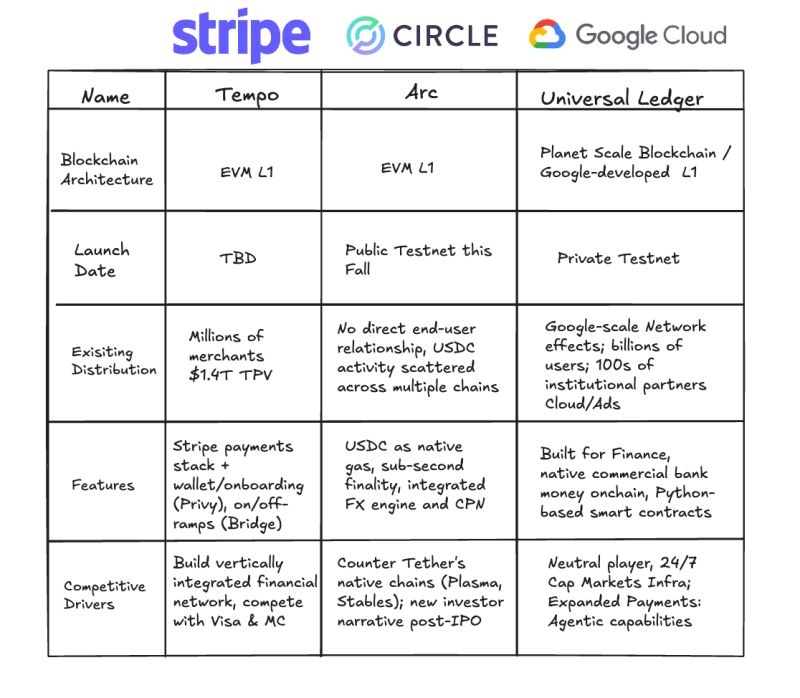
Timelines further distinguish the projects. Circle has already started piloting Arc, while Stripe is targeting a 2025 launch. Google and CME, however, have already completed the first stage of GCUL integration with broader testing slated for later this year and a full rollout expected in 2026.
Google brings a unique advantage: the global reach of its cloud platform, enabling a ledger capable of supporting billions of users and hundreds of institutions. By contrast, Stripe can rely on more than a trillion dollars in annual merchant flows, while Circle leans on USDC’s global liquidity.
In March 2024, Google Cloud and CME Group first unveiled the Universal Ledger, branding it a programmable distributed ledger for wholesale payments and asset tokenization. CME Group described the early phase of integration as a breakthrough for collateral, settlement, and fee payments as financial markets shift toward 24/7 trading.
“As the President and new Administration have encouraged Congress to create landmark legislation for common-sense market structure, we are pleased to partner with Google Cloud to enable innovative solutions for low-cost, digital transfer of value,” said CME Chairman and CEO Terry Duffy. He suggested that GCUL could “deliver meaningful efficiencies across core market functions, including margin and collateral management.”
CME and Google plan to begin direct testing with market participants later this year, aiming for a 2026 launch of services. Widmann’s Aug. 26 remarks add further clarity to that roadmap, emphasizing GCUL’s role as an open, institution-friendly infrastructure layer rather than a closed payments platform.
The announcement positions Google squarely in the race with Stripe and Circle to shape the future of global financial settlement rails. While Stripe focuses on merchants and Circle on stablecoins, Google is betting on programmability, neutrality, and scale.
Although technical details remain limited, Google says more information on GCUL’s architecture will be shared in the coming months. For now, the Universal Ledger is being pitched as a foundation for global-scale payments, institutional tokenization, and around-the-clock capital markets infrastructure.

Disclaimer of Warranty
The information provided in this article is for general informational purposes only. We make no warranties about the completeness, reliability, and accuracy of this information. Read full disclaimer

Editor's Picks

Why Zondacrypto’s Collapse Would Unfold Differently in the UAE

Walid Abou Zaki

Aug 28, 2026

8 min

The Missing Orchestration Layer Holding Back Institutional Digital Assets
Julian Sawyer
Aug 18, 2026
5 min

Beyond Crypto Access: How ARP Digital Is Building the UAE’s Digital Capital Infrastructure
Anna K.
Aug 17, 2026
8 min
Read More Articles

In the Same Space

USDU Expands UAE Reach With Crypto.com App Integration
News Desk
Sep 10, 2026
4 min

U.S. Bank Moves Its Stablecoin From Testing to Live Cross-Border Payment
News Desk
Sep 10, 2026
3 min

Visa Brings Onchain Credit to Stablecoin Card Financing
News Desk
Sep 9, 2026
3 min

Singapore’s Monetary Authority Proposes Full Reserve Backing, Stablecoin Yield Ban
News Desk
Sep 2, 2026
4 min