Advertisement
Stablecoins & Payments
Share
WA
CEO & Editor-in-Chief


G42 has been publicly identified as the sole non-bank participant among five AED stablecoin initiatives overseen by the CBUAE, while the Central Bank has set a December 2026 target for the next Digital Dirham pilot phase and announced an imminent public consultation on its stablecoin framework.
G42 has emerged as the only non-bank participant among five AED stablecoin initiatives described by the Central Bank of the UAE, adding a new dimension to the UAE stablecoin market as the regulator targets the end of December 2026 for the next phase of the Digital Dirham and prepares to revisit its existing stablecoin framework.
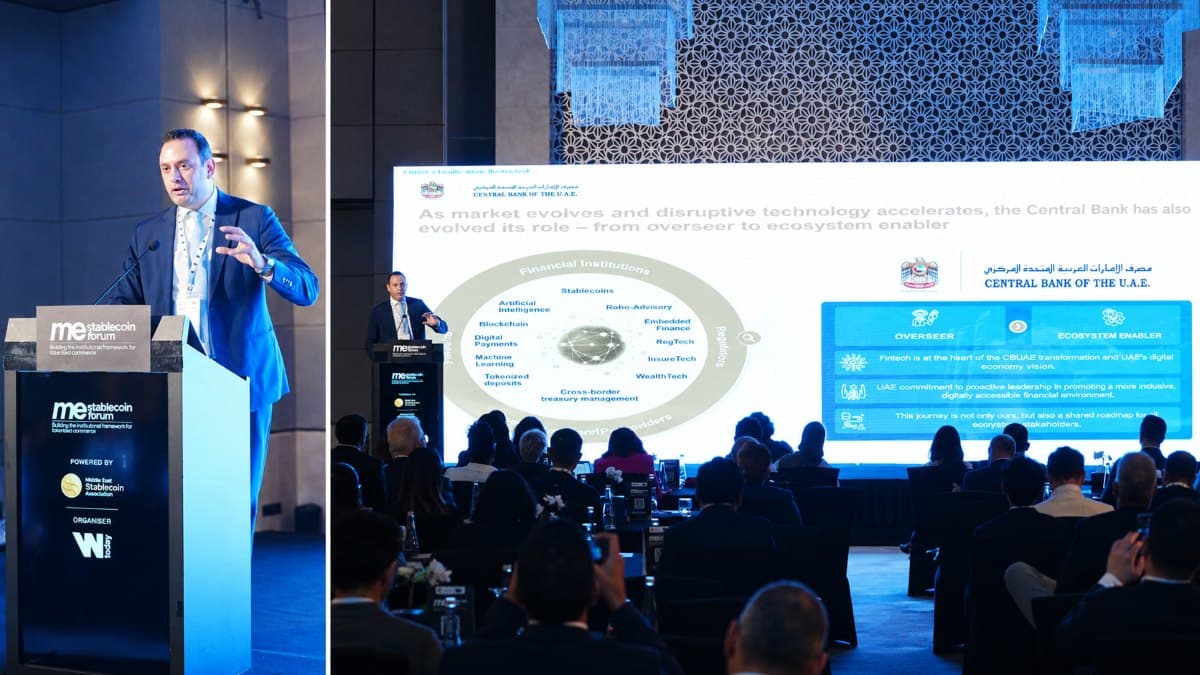
Paul Kayrouz, Chief FinTech Officer at the Central Bank of the UAE (CBUAE), disclosed the developments during the MESC Forum 2026 in Dubai on September 17, offering one of the clearest views yet of how the Central Bank sees the country's digital-money infrastructure evolving.
The announcements go beyond another stablecoin project or CBDC milestone. They point toward an architecture in which sovereign digital money, privately issued AED stablecoins and existing financial rails retain distinct roles while becoming increasingly connected.
"We're not a traditional regulator," Kayrouz told the audience. "We want to be the ecosystem leader."
Kayrouz said five Dirham stablecoin issuers are now progressing within the Central Bank's ecosystem, describing four as banks and one as a non-bank participant. He then publicly identified G42 as that non-bank participant.
According to Kayrouz, G42 has clearance to disclose its involvement and is working toward obtaining its final license. That qualification is important because the five AED stablecoin initiatives are not all at the same stage of the regulatory process.
RAKBANK, for example, publicly announced in January that it had received in-principle approval for an AED-backed stablecoin and, based on its latest disclosed status, remains at the IPA stage.
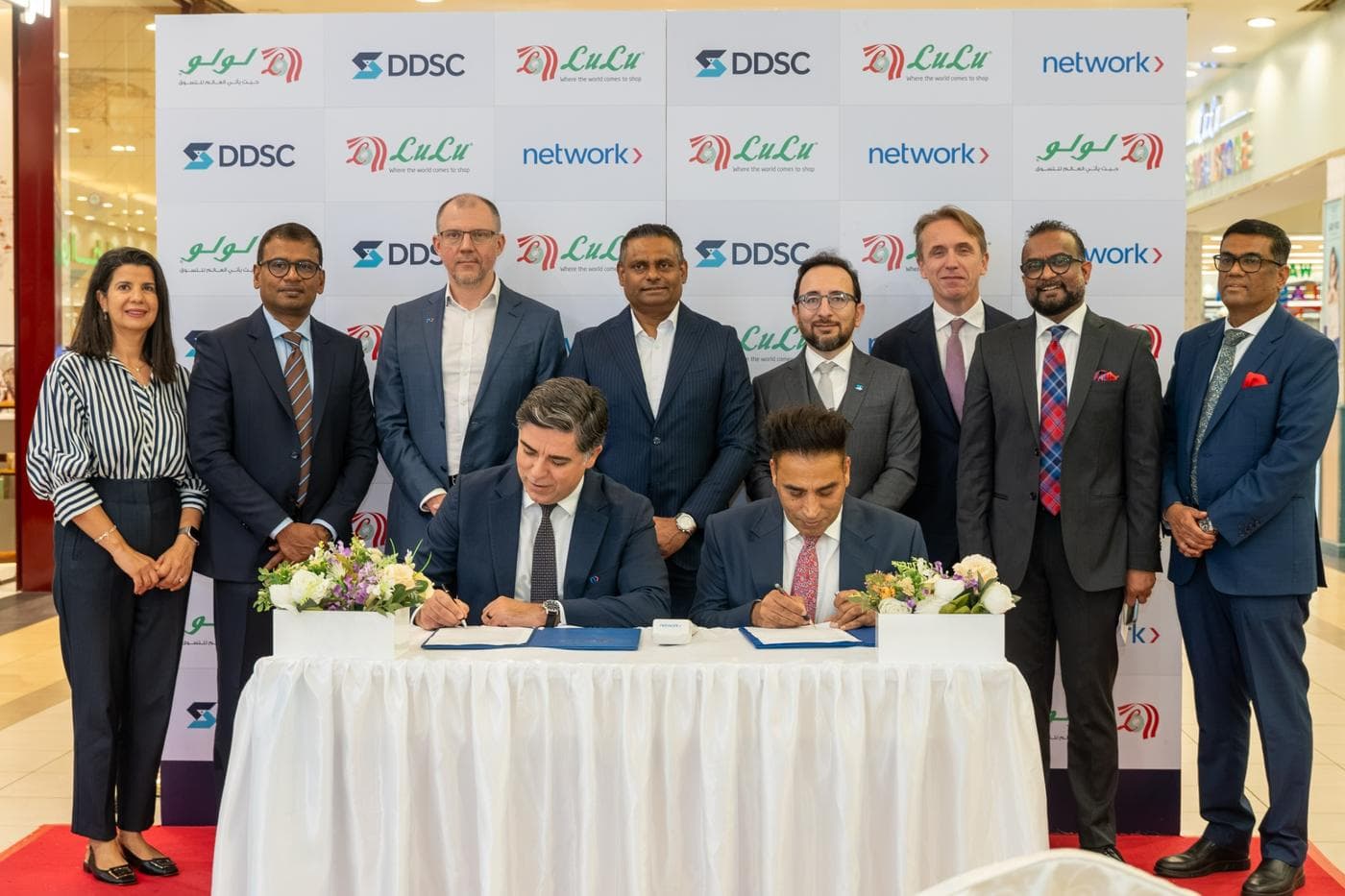
DDSC entered the publicly visible pipeline later but subsequently moved through approval and into live activity. In May, Unlock Blockchain reported an AED 110 million DDSC transaction executed by IHC on ADI Chain, marking a shift from regulatory approval toward institutional-scale use.
AE Coin and Zand AED also form part of the developing regulated AED stablecoin market.
There is an important legal distinction behind Kayrouz's description of four of the projects as banks. Under the existing Payment Token Services Regulation, a bank cannot itself act as a Payment Token Issuer, although it can establish a subsidiary, affiliate or related entity to perform the activity subject to licensing requirements.
G42 therefore adds a different profile to a UAE stablecoin market that has so far developed largely around bank-linked structures.
The group is also already connected to the Central Bank's wider financial-infrastructure strategy. In February, the CBUAE partnered with Core42, a G42 company, to build a sovereign financial cloud infrastructure for the UAE financial sector.
Its emergence in the AED stablecoin pipeline now places G42 closer to the private digital-money side of the ecosystem as well.
Alongside the stablecoin disclosure, Kayrouz provided a more concrete timeline for the Digital Dirham.
The CBUAE is targeting around the end of December 2026 for the next pilot phase, with four initial use cases expected to be enabled and four banks currently working with the Central Bank on the rollout.
A wider expansion to banks and fintech companies is expected during the first and second quarters of 2027.
The December milestone should not be seen as the beginning of the Digital Dirham program. The UAE has already spent several years developing and testing the CBDC, including domestic government transactions and cross-border settlement.
In November 2025, the UAE and China conducted a direct cross-border digital-currency payment as part of efforts to connect their financial infrastructure.
What changes with the coming phase is the move toward a broader set of real-world applications.
Kayrouz said the Digital Dirham is intended to sit at the center of the country's developing digital economy rather than operate as an isolated CBDC experiment.
His presentation showed a system increasingly being connected with Open Finance, digital identity, payments and new forms of transaction authorization.
Biometric payments offer one example. Kayrouz described an environment in which consumers could eventually authorize transactions through facial or palm biometrics while choosing between different underlying payment methods, potentially including bank money, cards, an AED stablecoin or a Digital Dirham wallet.
The CBUAE also intends to extend the concept behind instant tourist banking toward digital wallets, with visitors potentially able to open stablecoin or Digital Dirham wallets after arriving in the UAE.
The significance is not that every form of money will serve the same purpose. Rather, the Central Bank appears to be building infrastructure capable of connecting different regulated forms of money while maintaining boundaries between them.
That distinction could become even more important as the stablecoin framework itself evolves.
Kayrouz said the CBUAE will "very soon" launch a public consultation and ask market participants which provisions of the existing regulation may need enhancement.
The Payment Token Services Regulation took effect in August 2024 and established rules covering Payment Token Issuance, Conversion, Custody and Transfer, together with separate treatment for Dirham Payment Tokens and registered Foreign Payment Tokens.
Kayrouz acknowledged that some elements of the framework may not always appear entirely clear to market participants, while explaining that retaining a degree of flexibility was intentional because of how quickly the market was developing.
The timing of the consultation matters.
When the framework was introduced, the UAE's regulated AED stablecoin sector was still largely being built. Since then, projects have progressed through licensing and approval, institutional participants have entered the market, and stablecoins are beginning to appear in payments, treasury activity, digital-asset settlement and tokenized financial infrastructure.
The Central Bank will therefore be reviewing the rules with considerably more operational experience than it had when the framework was first introduced.
Kayrouz framed the broader strategy around two principal categories: the Digital Dirham as public money and regulated Dirham stablecoins as private money.
That distinction provides a useful way to understand the architecture taking shape.
The Digital Dirham represents sovereign digital currency issued by the Central Bank. AED stablecoins provide a privately issued but regulated Dirham-denominated layer, while the framework also contains a narrower route for registered foreign-currency payment tokens.
USDU, for example, sits within that foreign-currency layer rather than operating as another general-purpose domestic payment coin. The CBUAE's regulation restricts the use of Foreign Payment Tokens as a means of payment in the UAE to defined virtual-asset and virtual-asset-derivative transactions, while Dirham Payment Tokens have broader lawful domestic use.
The importance of the distinction is not the individual token, but the regulatory design: different forms of digital money can connect without necessarily being permitted to perform the same function.
Around those monetary layers, the CBUAE is building or connecting other parts of the financial system.
Open Finance is already being rolled out across banks. Centralized eKYC and KYB infrastructure is approaching deployment. Digital onboarding is being extended to visitors. Biometric payment infrastructure is moving toward implementation, while CBDCs and stablecoins are increasingly being considered alongside existing financial-market infrastructure.
This is where the strategy begins to look less like a collection of fintech projects and more like an attempt to build an interconnected financial architecture.
The cross-border component is Jisr — جسر, meaning "bridge" in Arabic — the UAE's multi-CBDC infrastructure for international settlement.
Kayrouz said more than 23 countries have signed up to participate, naming China, India, Brazil, Türkiye and Kazakhstan among them.
The UAE has already demonstrated direct CBDC settlement with China. The next objective is considerably larger: Kayrouz said the Central Bank wants the country to become a global center for cross-border settlement.
That ambition provides important context for the broader UAE stablecoin market, particularly as AED-backed tokens expand beyond domestic payment use cases.
The domestic payment case alone has never fully explained why multiple banks and major institutional groups would invest in new Dirham-backed digital-money infrastructure in a country that already has sophisticated banking and payment rails.
Cross-border settlement, corporate treasury, tokenized assets and programmable financial activity offer a wider potential role.
Kayrouz also highlighted corporate treasury, micropayments and DeFi as areas where stablecoin use cases are evolving, with firms already testing new models through the CBUAE's Innovation Hub.
The picture emerging from MESC is therefore broader than a Digital Dirham launch or another stablecoin entering the market.
G42 has now surfaced publicly within the AED stablecoin pipeline. The next Digital Dirham phase has an end-of-December target. The existing stablecoin framework is heading toward public consultation, while Jisr is extending the country's digital-money strategy beyond its domestic borders.
The central question now is how the UAE will connect these different layers of public and private digital money without losing the regulatory distinctions that give each of them a specific role.

Disclaimer of Warranty
The information provided in this article is for general informational purposes only. We make no warranties about the completeness, reliability, and accuracy of this information. Read full disclaimer

Editor's Picks

As U.S. Crypto Legislation Stalls, Circle Launches Its Own Financial Network

Walid Abou Zaki

Sep 16, 2026

9 min

Stablecoin Yield Fight Helps Derail CLARITY Act in Senate
Walid Abou Zaki
Sep 15, 2026
8 min
Why Zondacrypto’s Collapse Would Unfold Differently in the UAE
Walid Abou Zaki
Aug 28, 2026
8 min
Read More Articles

In the Same Space
Deutsche Bank Moves Into Institutional Crypto Custody With Bitcoin, Ether and Stablecoins
News Desk
Sep 17, 2026
4 min

U.S. Bank Moves Its Stablecoin From Testing to Live Cross-Border Payment
News Desk
Sep 10, 2026
3 min

Visa Brings Onchain Credit to Stablecoin Card Financing
News Desk
Sep 9, 2026
3 min
A Swiss Franc Play in Europe’s Bank-Led Stablecoin Race
Salma Naueihed
Sep 9, 2026
5 min