Advertisement
Infrastructure & Scaling
Share
CA
Senior Arabic Editor


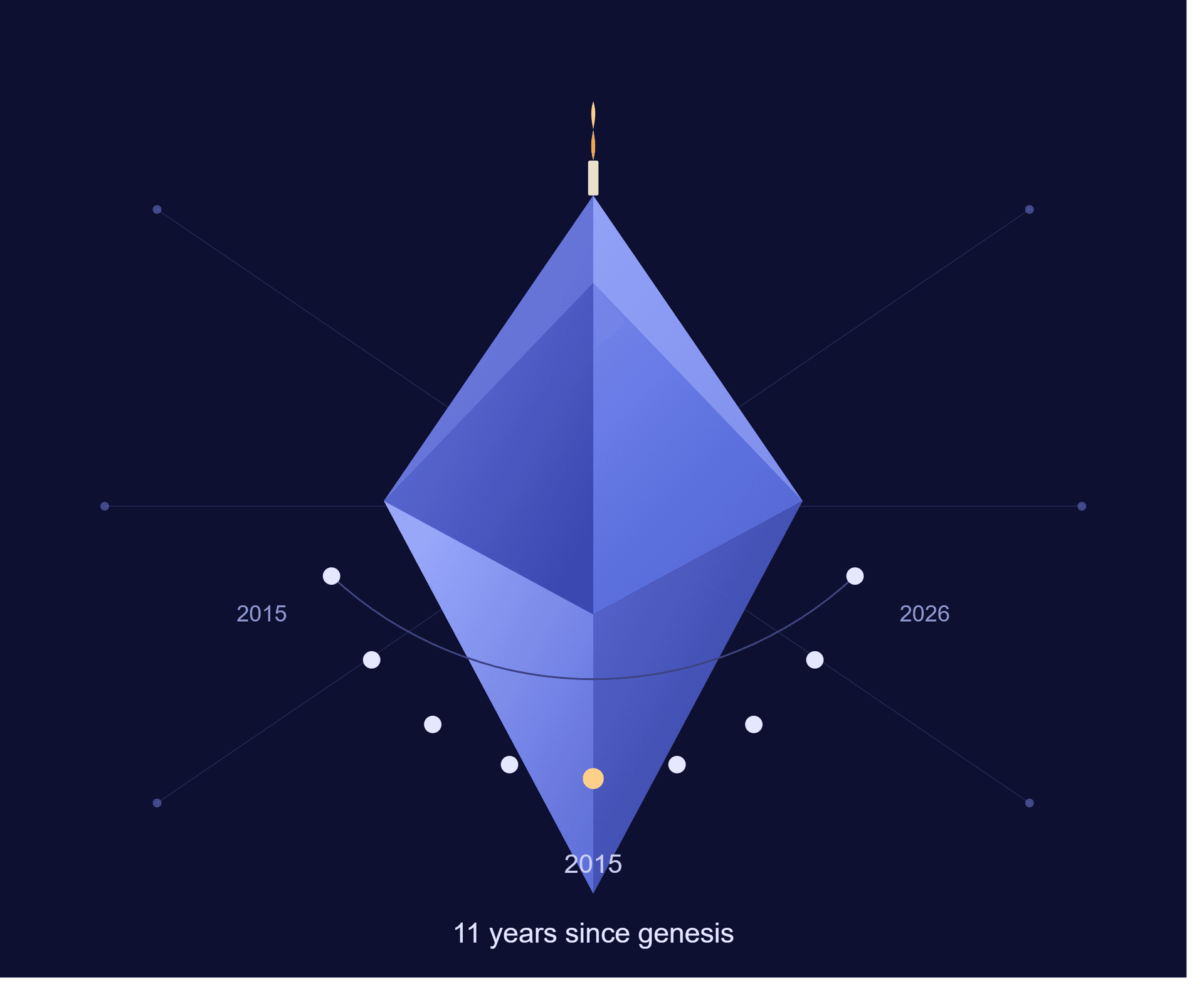
Ethereum marked its 11th anniversary on July 30, 2026, having evolved from Vitalik Buterin's 2013 whitepaper into infrastructure settling billions in daily stablecoin payments and anchoring a Layer-2 ecosystem handling roughly 95% of its transactions.
On July 30, 2015, a small group of developers mined a single block that most of the world never noticed. No countdown, no fanfare, just a genesis block confirming that a strange new idea, a "world computer" anyone could build on, actually worked.
Eleven years later, that idea underpins a sprawling ecosystem of decentralized finance, stablecoins, tokenized assets, and Layer-2 networks that now handle roughly 95% of Ethereum's daily transactions. On July 30, 2026, the network quietly marked its 11th birthday, celebrated in equal parts pride and turbulence.
Vitalik Buterin was introduced to Bitcoin by his father in 2011, at 17. He grew fascinated with it, wrote for Bitcoin Magazine, and studied computer science at Waterloo before leaving to pursue crypto full-time. Frustrated that other projects were just bolting features onto Bitcoin's limited scripting language, he proposed something bigger: a blockchain that could run any program at all, Bitcoin as a calculator, Ethereum as a smartphone.
He wrote the Ethereum whitepaper in November 2013 and presented it publicly in Miami in early 2014. A founding team formed around him, including Gavin Wood and Joseph Lubin, and a 2014 crowdsale raised roughly $18 million in BTC, distributing over 60 million ETH to early backers.
Mainnet launched on July 30, 2015, with the Frontier release, a bare-bones environment for developers to build, test, and run nodes.
The network's first real test came fast. In June 2016, an attacker exploited a flaw in a smart contract called The DAO, draining roughly 3.6 million ETH (about $50 million at the time). A built-in 28-day holding period bought the community time to respond, and after fierce debate, the majority voted to fork the chain and reverse the theft. A minority who believed "code is law" stayed on the original chain, now known as Ethereum Classic. It remains one of crypto's defining lessons in decentralized governance.
For years, Ethereum ran on energy-hungry proof-of-work mining. On September 15, 2022, it pulled off one of the boldest upgrades any live blockchain has attempted: switching its entire consensus mechanism to proof-of-stake, with zero downtime. Energy use dropped an estimated 99.9% almost overnight, and combined with the fee-burning mechanism from EIP-1559, ETH issuance fell so sharply the asset became net-deflationary during heavy usage.
Shapella (April 2023) finally let staked ETH be withdrawn, closing a gap that had made some stakers hesitant.
Then Dencun (March 2024) tackled Ethereum's worst pain point, punishing gas fees, by introducing cheap data "blobs" for Layer-2 networks via EIP-4844. The impact was immediate: average gas prices fell from around 98 Gwei to consistently under 10 Gwei, and fees on rollups like Arbitrum and Optimism dropped over 90%.
Pectra (May 2025) raised the maximum validator balance from 32 ETH to 2,048 ETH and cut validator activation time from 12 hours to about 13 minutes. Fusaka (December 2025) expanded blob capacity further with PeerDAS. Together, these upgrades doubled Ethereum's gas limit to 60 million and pushed Layer-2 fees below two cents per transaction.
By February 2026, over 50% of all ETH ever issued had passed through the staking deposit contract, with roughly 37 million ETH actively securing the network. Institutional interest has grown too, with regulated, staking-enabled ether ETPs now available from major asset managers.
It hasn't been an easy year, though. ETH has traded well below the record high it set in August 2025, and the Ethereum Foundation went through real turbulence, losing both co-executive directors and several senior researchers within months, attributed largely to internal strategy disagreements rather than any loss of confidence in the network itself.
Ethereum's next hard fork, Glamsterdam, targets the second half of 2026. Its two headline features, enshrined proposer-builder separation (ePBS) and Block-Level Access Lists, aim to make block-building fairer and unlock parallel transaction execution, supporting a much higher gas limit down the road. Further out, the roadmap points toward post-quantum cryptography, stateless clients, and zero-knowledge verification of Ethereum's own execution.
Eleven years after a handful of developers mined an unnoticed genesis block, Ethereum now settles billions in stablecoin payments daily and anchors a Layer-2 ecosystem that often out-transacts the base chain itself. None of it happened through one clever idea, it happened because a community kept shipping, even through crises and internal friction. That's arguably the highest compliment a network can earn.

Disclaimer of Warranty
The information provided in this article is for general informational purposes only. We make no warranties about the completeness, reliability, and accuracy of this information. Read full disclaimer

Editor's Picks
Why Zondacrypto’s Collapse Would Unfold Differently in the UAE

Walid Abou Zaki

Aug 28, 2026

8 min

The Missing Orchestration Layer Holding Back Institutional Digital Assets
Julian Sawyer
Aug 18, 2026
5 min

Beyond Crypto Access: How ARP Digital Is Building the UAE’s Digital Capital Infrastructure
Anna K.
Aug 17, 2026
8 min
Read More Articles

In the Same Space

Crypto-Backed Lending Spreads to Russia as Sberbank Joins Global Bank Push
News Desk
Aug 31, 2026
6 min
BIS Tests XRP Ledger to Verify Economic Statistics
News Desk
Sep 3, 2026
3 min
Iran Turns to Crypto as Sanctions Bite, But USDT Has a Control Problem
Salma Naueihed
Sep 9, 2026
5 min
Block Seeks U.S. Bank Charter for Bitcoin, Stablecoin Custody
News Desk
Sep 9, 2026
4 min