Advertisement
DeFi Infrastructure
The report evaluates the three leading Layer-1 networks across six measurable decentralization and resilience metrics.
Share
ARK Invest and Glassnode have published a joint framework comparing Bitcoin, Ethereum and Solana across six quantitative dimensions of decentralization, finding that each network reflects distinct architectural tradeoffs rather than a single decentralization standard.
ARK Invest and Glassnode have released a joint report comparing the decentralization of Bitcoin, Ethereum and Solana, using six measurable dimensions to assess how different network designs affect resilience, security and control.
ARK Invest and Glassnode argue that decentralization is better understood as a spectrum shaped by deliberate network design choices rather than as a binary characteristic.
Titled “The Decentralization Spectrum: Design Tradeoffs in Digital Assets,” the report evaluates the three blockchain networks across four design features: auditability, security, governance and ownership.
The researchers then quantify those features using six dimensions: ownership distribution, exit fluidity, network verification overhead, critical resilience threshold, blockchain reconstruction overhead, and geographic and provider resilience.
The resulting framework provides a comparative scorecard for the three networks while highlighting that no blockchain leads across every measure.
The report treats the differences between the three networks as consequences of their respective architectural choices.
Bitcoin places greater emphasis on auditability, ownership distribution and geographic resilience. Ethereum occupies a more intermediate position across the framework, while Solana prioritizes performance and coordination speed, accepting different decentralization tradeoffs in the process.
The findings provide a more granular view of the long-running blockchain trilemma, in which networks must balance decentralization, security and scalability.
Rather than assigning decentralization as a simple “yes” or “no” attribute, ARK Invest and Glassnode argue that different blockchain designs occupy different positions on the spectrum depending on the risks and performance characteristics they prioritize.
One of the report’s security measures examines how much control would need to be concentrated among a small number of entities before a network could potentially be manipulated.
The analysis considers factors including the concentration of Bitcoin mining power and blockchain staking, the capital required to acquire a 1% position, exit fluidity and client diversity.
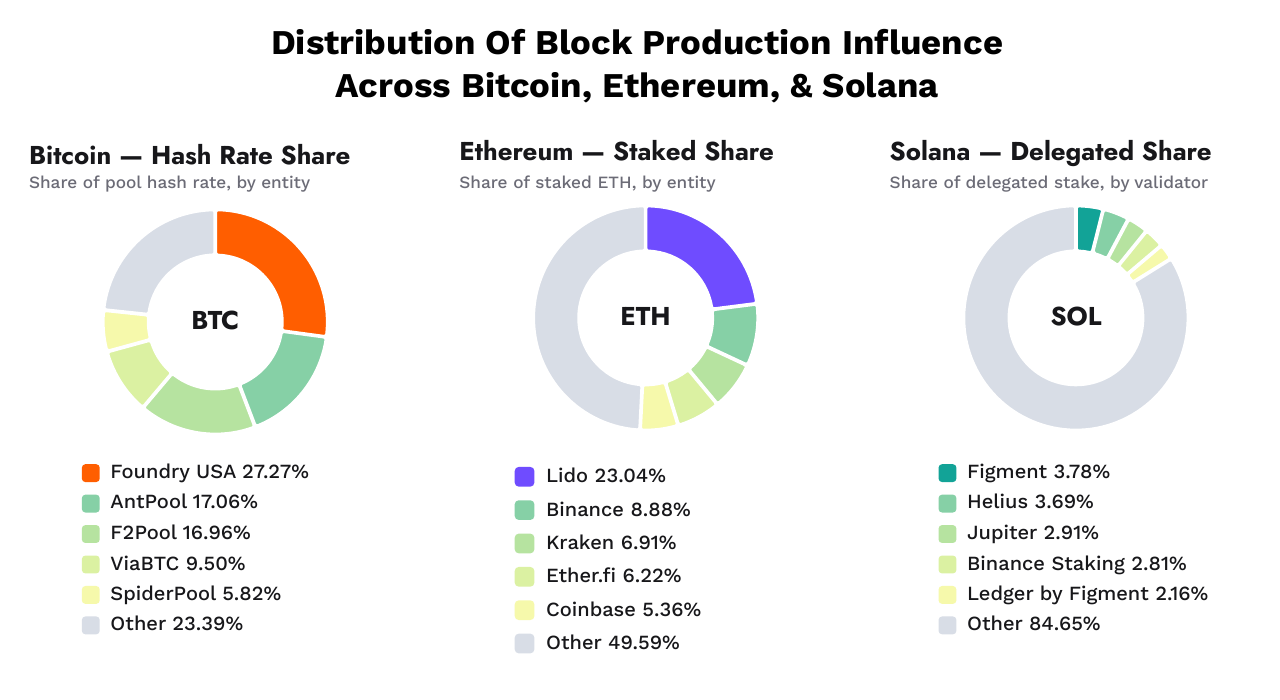
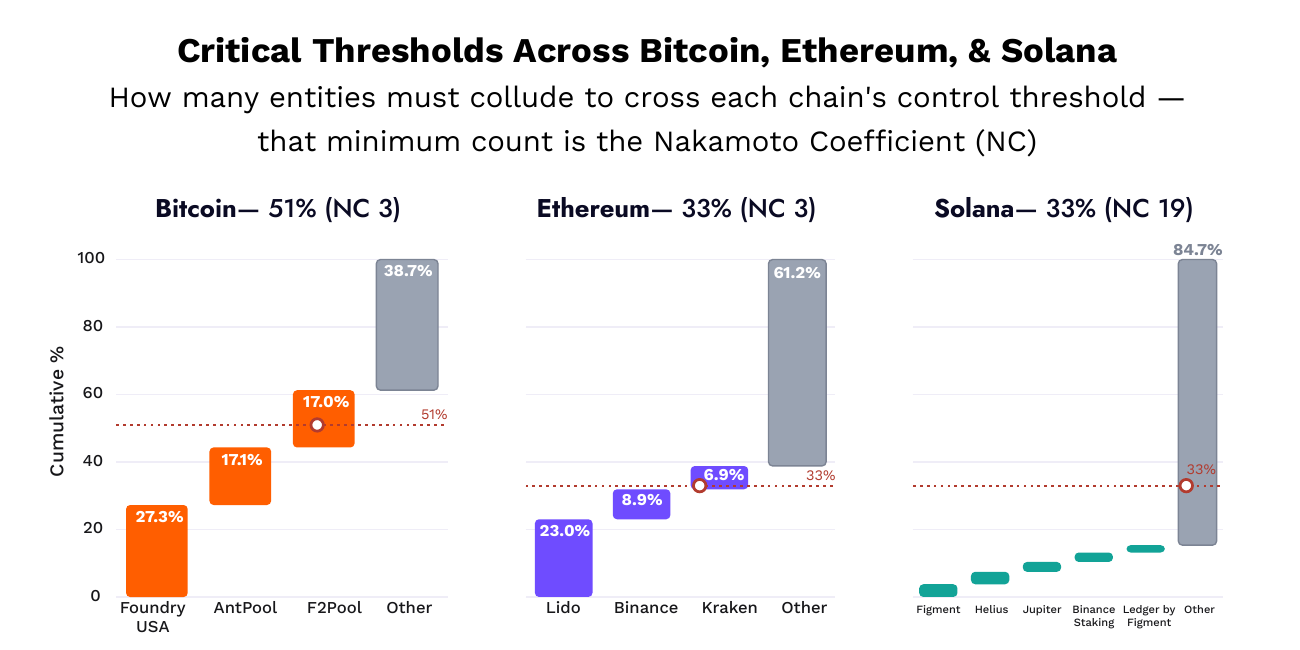
Under the report’s methodology, Bitcoin and Ethereum each reach their critical control thresholds with three entities, while Solana reaches the threshold with 19. The researchers note, however, that mining pools, staking delegation and other structural factors complicate a direct comparison between those figures.
The report also highlights differences in how quickly participants can exit their respective positions. Bitcoin miners can effectively stop contributing hash power by switching off hardware, while Ethereum validators face a substantially longer exit process (sometimes weeks), particularly during periods of stress.
The report also examines where blockchain infrastructure is physically located and which providers host it.
Bitcoin has the most geographically distributed node footprint among the three networks examined, while Ethereum relies more heavily on cloud infrastructure. The report estimates that Amazon Web Services (AWS) hosts roughly 20% of Ethereum nodes.
Solana, meanwhile, operates essentially all of its infrastructure in data centers, reflecting its architecture and performance requirements.
The geographic and provider analysis illustrates why decentralization cannot be measured solely by the number of validators or nodes. Concentration among hosting providers, geographic regions or infrastructure operators can create additional points of dependence even when a network has a large number of participants.
The quantitative framework combines six dimensions to compare the three networks.
These include how widely ownership is distributed, how easily participants can exit, the resources required to independently verify the network, the number of entities needed to reach a critical resilience threshold, the resources required to reconstruct the blockchain, and the geographic and infrastructure-provider distribution of the network.
The result is not a ranking in which one blockchain dominates every category. Instead, the report shows how each network makes different tradeoffs.
Bitcoin scores strongest in areas including auditability, ownership distribution and geographic resilience. Ethereum provides a middle-ground architecture, while Solana’s design favors throughput and coordination speed at the cost of greater concentration in some decentralization measures.
For institutional participants, decentralization can have implications beyond the philosophical question of who controls a blockchain.
The distribution of block production, infrastructure and ownership can affect a network’s resilience to censorship, coordinated attacks, infrastructure failures or changes imposed by a small group of participants.
It can also become relevant to regulatory discussions surrounding digital assets, where the structure and degree of decentralization of a network may influence how regulators assess the risks and characteristics of tokens operating on it.
By relying on measurable network properties rather than token prices or market capitalization, the ARK Invest and Glassnode framework provides a basis for comparing those structural characteristics across major blockchain networks.
The report also extends the analysis beyond the three networks’ current configurations by examining how design decisions shape their position on the decentralization spectrum.
ARK Invest and Glassnode emphasize that different use cases may justify different positions. A blockchain designed for high-throughput transactions does not necessarily face the same requirements as a network intended to provide highly auditable settlement infrastructure.
The report therefore frames decentralization as an engineering tradeoff rather than an absolute characteristic.
Its methodology also leaves room for the framework to be applied to other digital assets and networks, potentially allowing investors and institutions to compare blockchain resilience using a common set of measurable criteria.
The full report includes the underlying methodology, network data and case studies covering governance decisions such as Bitcoin’s SegWit upgrade and Solana’s SIMD-228 proposal.

Disclaimer of Warranty
The information provided in this article is for general informational purposes only. We make no warranties about the completeness, reliability, and accuracy of this information. Read full disclaimer

Editor's Picks
In the Same Space

Schwab Enables Crypto Transfers After Completing Bitcoin and Ether Trading Launch

News Desk

Oct 16, 2026

4 min

Sberbank Wins Russia Approval to Trade Bitcoin and Crypto
News Desk
Oct 15, 2026
4 min

Solana Foundation Launches DvP Program to Cut Settlement From Days to Seconds
News Desk
Oct 6, 2026
3 min

Coinbase Outlines Bitcoin’s Path Toward Quantum-Resistant Security
News Desk
Oct 14, 2026
5 min