Advertisement
Regulation & Policy
Share
SN
Senior English Editor


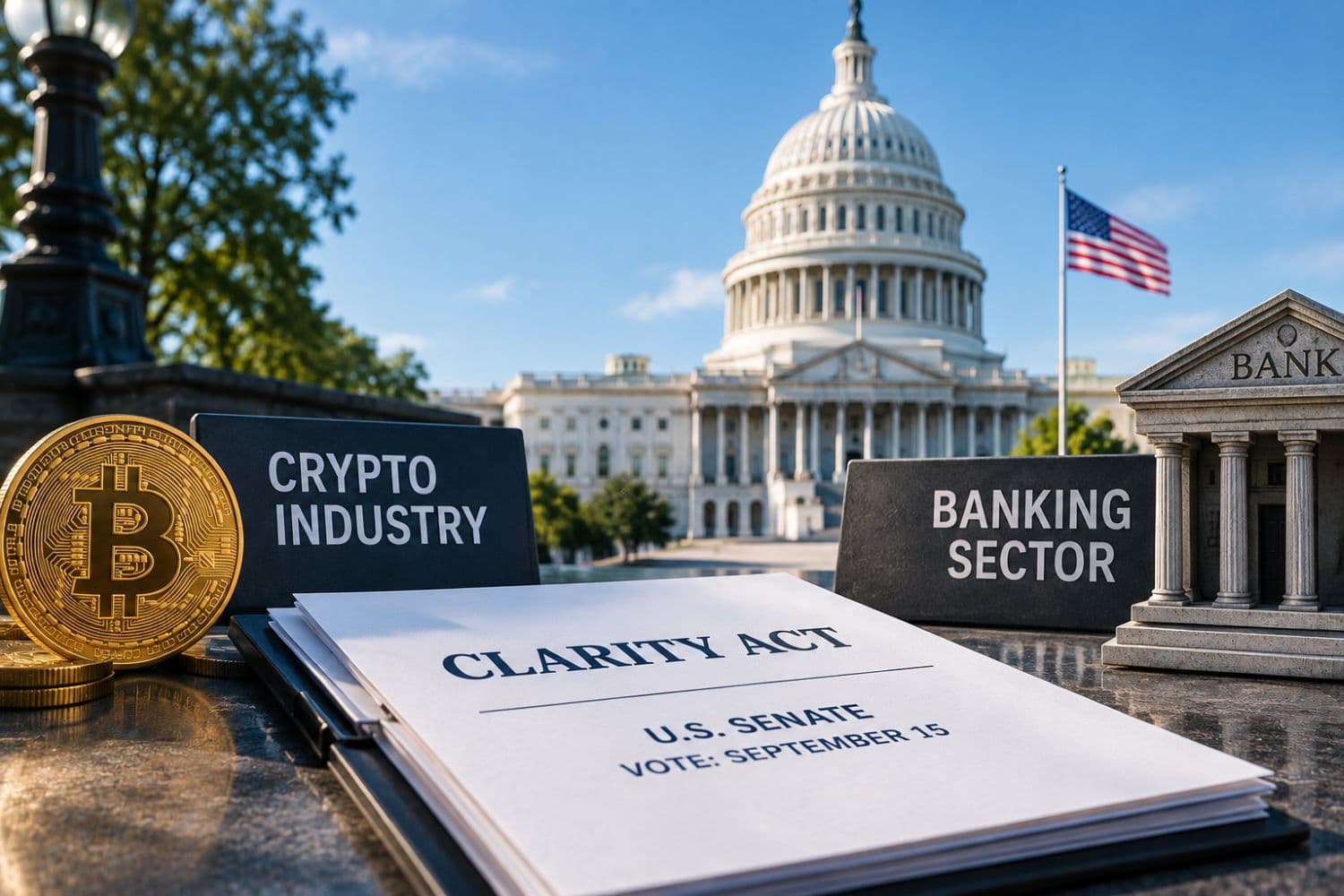
The U.S. Senate's 49–50 vote against advancing the CLARITY Act on September 15 prompted the SEC and CFTC to act independently within days, with the SEC opening a five-year Innovation Exemption for tokenized stock trading and the CFTC issuing no-action relief for passive trading software providers.
For months, the U.S. crypto industry has been waiting for Congress to answer one of its biggest questions: who regulates what?
The CLARITY Act was designed to provide that answer, establishing a federal framework for digital-asset markets and drawing clearer lines between the Securities and Exchange Commission (SEC) and Commodity Futures Trading Commission (CFTC).
On September 15, that legislative route hit a wall.
Two days later, the regulators started moving anyway.
The Senate's 49–50 vote against advancing CLARITY did not permanently end the legislation. But it stopped the bill from moving forward under that procedural vote, leaving the broader market-structure question unresolved.
What followed was strikingly fast.
On September 17, the SEC opened a temporary regulatory pathway for certain tokenized U.S. stocks to trade onchain. Hours later, the CFTC issued broader no-action relief for qualifying providers of passive trading software.
The message emerging from Washington is therefore not that crypto regulation has stopped.
It is that regulation may be moving down a different track while Congress works on the legislative one.
The most revealing part of the SEC's announcement is not simply that tokenized stocks can now trade through qualifying venues.
It is the reason the agency gives for acting now.
SEC Chair Paul Atkins explicitly linked the Innovation Exemption to Congress's failure to advance CLARITY earlier this week. The SEC, he said, is taking the step "within its statutory authority" while allowing the Commission to consider what further action may be needed.
That makes today's action more than another incremental development in tokenization.
It suggests a different regulatory sequence.
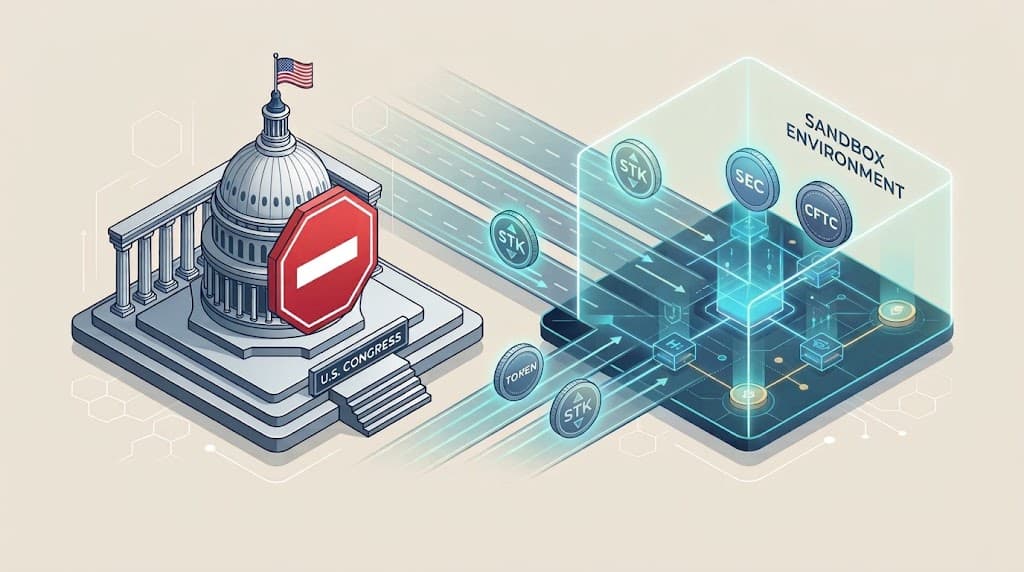
Rather than waiting for Congress to complete the market-structure framework before allowing new financial infrastructure to develop, the SEC is creating a controlled environment in which that infrastructure can operate — and be observed.
The Innovation Exemption gives qualifying Tokenized Securities Venues, or TSVs, temporary relief from the Exchange Act's definition of an exchange. It also provides conditional relief for certain liquidity providers operating through permissioned automated market maker liquidity pools.
The exemption lasts five years and comes with significant conditions.
Tokenized stocks must provide holders with the same rights and privileges as the equivalent traditional shares. Smart contracts must be public and auditable and deployed on a public, permissionless distributed ledger. Trading must stop when the underlying stock's primary market stops trading, while issuers must have an opportunity to object to their securities being traded on a TSV. Symbol and trading-volume limits also apply.
One distinction is particularly important.
This is not a pathway for synthetic stocks.
The SEC's framework is built around tokenized securities that preserve the rights attached to the underlying stock, including dividend and voting rights.
That distinction could prove significant as the market experiments with different forms of onchain exposure to traditional assets.
The temporary nature of the exemption is not a footnote. It is arguably the heart of the strategy.
Atkins describes the measure as a "bridge toward durable rulemaking." The SEC is explicitly asking for public comment and says it intends to monitor how onchain markets develop before determining what additional or permanent changes may be appropriate.
Commissioner Hester Peirce similarly described the exemptions as a way for market participants to experiment so regulators can prepare for a future in which tokenized stocks could become commonplace.
That points toward an unusual model for financial regulation:
Allow controlled experimentation first. Gather evidence. Then build more permanent rules around what the market demonstrates.
Commissioner Mark Uyeda made the same point, saying the SEC intends to observe emerging venues and market participants as it considers longer-term rules. The exemption also requires public reporting of certain transaction data, creating a basis for regulators and market participants to study how these venues operate.
In other words, the SEC is not presenting today's framework as the final architecture of tokenized markets.
It is creating a test environment.
The CFTC's move on September 17 is narrower, but its timing is difficult to ignore.
The agency's Market Participants Division issued a no-action position covering providers of passive software, under specified conditions, meaning staff will not recommend enforcement against qualifying providers for failing to register as introducing brokers or associated persons of introducing brokers.
This is not a sweeping deregulation of decentralized finance, and it should not be characterized as one.
But it fits into a broader CFTC effort to determine how existing derivatives rules apply to blockchain-native technology and software.
That effort predates this week's CLARITY setback. The SEC and CFTC have also been working together through Project Crypto, including efforts to harmonize their approach to digital assets.
That makes the emerging picture less about an SEC-versus-CFTC race for jurisdiction and more about two agencies using their respective authorities while Congress works through legislation.
There is an irony here.
One of the central purposes of CLARITY was to establish clearer jurisdictional boundaries and a durable market-structure framework for digital assets.
Instead, its failure has so far produced a rapid test of what the SEC and CFTC can accomplish without it.
That does not mean the agencies can simply recreate CLARITY through exemptions and no-action positions.
They cannot.
Congressional legislation can establish statutory rules that agency actions cannot. Temporary exemptive relief can be modified or allowed to expire. No-action positions do not carry the same durability as a federal law. And the agencies remain constrained by the authority Congress has already granted them.
The SEC itself acknowledges this distinction. Atkins has previously described legislation as indispensable to creating durable, future-proof rules, while today's Innovation Exemption is explicitly framed as an interim measure.
That leaves two processes running in parallel.
Congress can still work toward a comprehensive market-structure law.
At the same time, the regulators can continue using their existing authority to determine what parts of the digital-asset market can operate today.
The significance of the past 48 hours may therefore extend beyond tokenized stocks or a single failed Senate vote.
The sequence is becoming clear:
Congressional legislation stalls.
Existing SEC and CFTC authority is activated.
Temporary exemptions and no-action relief create room for controlled market experimentation.
The agencies observe how those markets operate.
Permanent rules can then be shaped around what is learned — while Congress retains the ability to codify, change or replace the framework.
That is a very different proposition from waiting for Congress to settle everything before the market moves.
The U.S. digital-asset policy landscape is already developing on several fronts. Congress is still advancing individual crypto-related measures, including legislation dealing with digital-asset taxation and a Strategic Bitcoin Reserve, while the broader market-structure debate remains unresolved.
But the most consequential question now may be what happens in that gap.
CLARITY was intended to provide the regulatory architecture for the next phase of U.S. digital-asset markets.
Instead, its setback may have accelerated an experiment in which the regulators begin building pieces of that architecture themselves.
The question for the U.S. digital-asset market is therefore no longer simply whether Washington will regulate crypto.
It is whether Congress will write the framework first — or whether the regulators, through a series of exemptions, interpretations and no-action positions, will have already written much of its first draft.

Disclaimer of Warranty
The information provided in this article is for general informational purposes only. We make no warranties about the completeness, reliability, and accuracy of this information. Read full disclaimer

Editor's Picks

As U.S. Crypto Legislation Stalls, Circle Launches Its Own Financial Network

Walid Abou Zaki

Sep 16, 2026

9 min
Stablecoin Yield Fight Helps Derail CLARITY Act in Senate
Walid Abou Zaki
Sep 15, 2026
8 min

Why Zondacrypto’s Collapse Would Unfold Differently in the UAE
Walid Abou Zaki
Aug 28, 2026
8 min
Read More Articles

In the Same Space

Bitcoin ETFs Lose $288.7M in Fresh Wave of Investor Selling
News Desk
Sep 16, 2026
2 min
Stablecoin Yield Fight Helps Derail CLARITY Act in Senate
Walid Abou Zaki
Sep 15, 2026
8 min

Kalshi's Bid for Non-Stop Stock Perpetuals Reignites CFTC-SEC Turf War
News Desk
Sep 11, 2026
8 min

Kraken Parent Payward Plans Onchain Perpetuals on Hyperliquid for U.S. Clients
News Desk
Sep 17, 2026
4 min