Advertisement
Infrastructure & Scaling
Share
WA
CEO & Editor-in-Chief


Gold is no longer telling the story many expected. After hitting record highs in January, spot gold fell to about $4,451.47 per ounce on March 26, while Brent crude climbed back above $104 as markets continued to price Middle East disruption risk. Bitcoin, meanwhile, is trading around $69,585, holding in the high-$60,000 range despite the same geopolitical backdrop. That divergence does not make Bitcoin immune to stress. It makes the market’s response more interesting.
The real signal is not price alone. It is whether the system behind that price is still functioning with credibility when conditions become harder. In Bitcoin’s case, that answer still appears to be yes. The network is showing signs of miner stress, but not signs of structural failure.
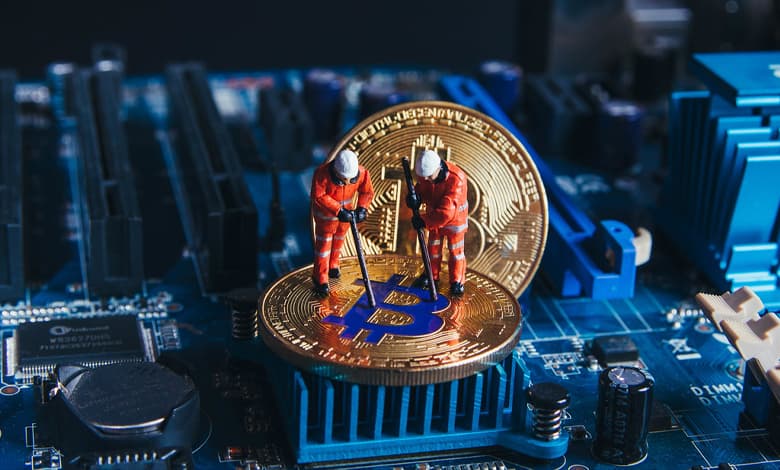
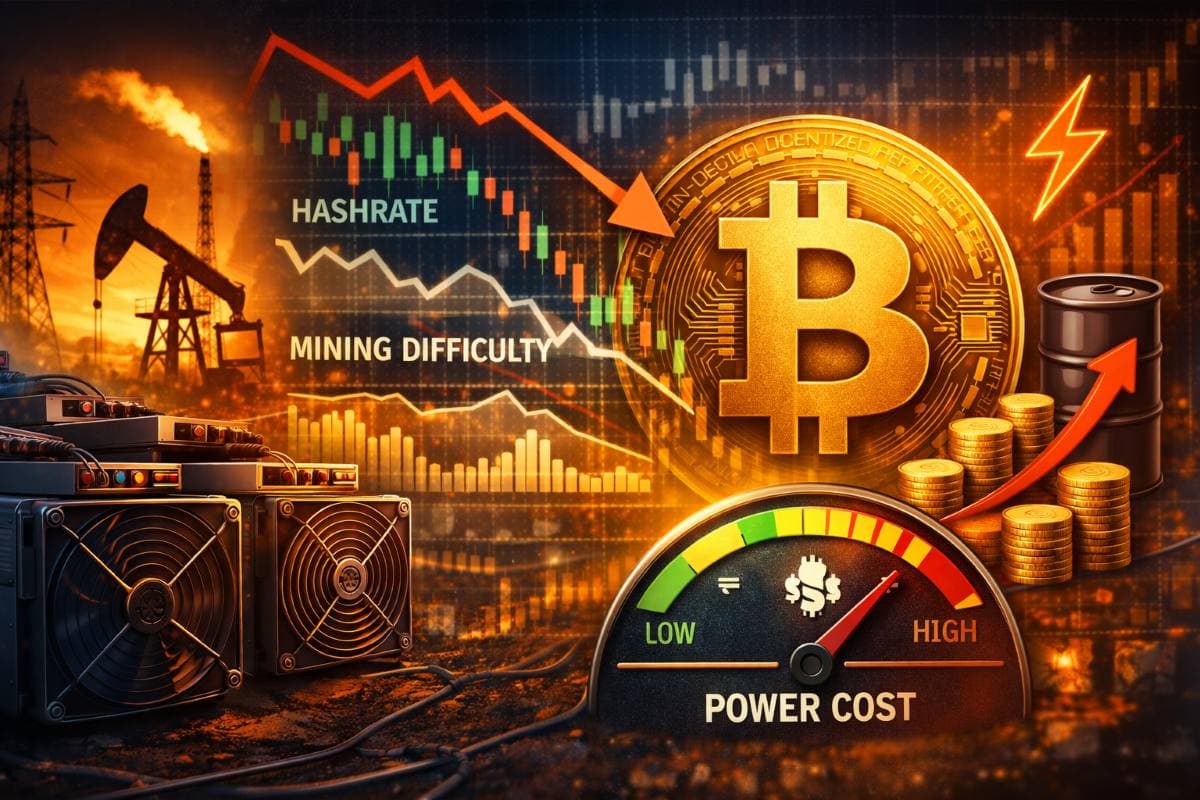
Bitcoin trading near $69,500 matters, but the stronger story is what is happening under the surface. Recent mining data showed Bitcoin difficulty dropping about 7.76% to roughly 133.79 trillion, while network hashrate retreated to around 920 EH/s. At the same time, CoinDesk reported that the average cost to produce one bitcoin had climbed to about $88,000, leaving many miners underwater at current market prices.
That does not mean Bitcoin is weakening. It means the protocol is doing what it was built to do. As weaker or less efficient miners start switching off machines, block production slows, difficulty adjusts lower, and the network rebalances. Stress moves through the mining layer first, not through Bitcoin’s core design. The result is painful for operators with high costs, but it also shows that the network can absorb pressure without losing integrity.
This is where the mining story becomes real. Rising oil prices do not hit every miner in the same way. The first operators to feel pressure are usually the least efficient, the most exposed to expensive power, or the ones that expanded with weak margins of safety. When energy costs rise while Bitcoin fails to move comfortably above production costs, the business turns unforgiving very quickly.
That is why hashrate matters. A decline in hashrate during a period like this can suggest that marginal miners are already switching off capacity because the economics no longer justify staying online. Difficulty then adjusts lower, helping stronger operators remain competitive. In that sense, high energy prices do not usually break Bitcoin. They force a selection process inside mining itself.
The outcome favors miners with cheaper electricity, newer fleets, stronger treasury management, and enough patience to survive prolonged compression in hashprice. A difficult market does not eliminate mining. It simply makes the business less forgiving for anyone who mistook expansion for resilience.
That is why NIP Group deserves to be part of this conversation. The company expanded aggressively into Bitcoin mining and said its total mining capacity would reach approximately 11.3 EH/s, a scale that would place it among the larger publicly traded mining operators and, by its own framing, the largest in MENA by disclosed capacity. NIP also said the fully deployed fleet could generate roughly 150 to 160 BTC per month, depending on network conditions.
On paper, that sounds ambitious. But mining is not a business where ambition is enough. Scale can win attention, yet it does not guarantee survivability when energy costs rise, margins tighten, and investors begin asking whether the expansion was built for a tough cycle or just for a favorable one. In mining, the real test starts after the growth headline.
If NIP’s mining push was meant to convince the market that it had found a credible new growth engine, the stock price tells a harsher story. NIPG is trading at about $0.78, compared with its $9.00 IPO price from July 2024. That means roughly nine-tenths of its value has been wiped out since listing. Markets do not usually deliver that kind of verdict because a company is merely ambitious. They do it when they are not convinced ambition is supported by durable execution.
The skepticism becomes easier to understand when looking at the company’s own reported results. For the second half of 2024, NIP reported $45.9 million in revenue but only $0.6 million in gross profit, with gross margin falling to 1.4% from 10.9% a year earlier. Net loss widened to $8.0 million from $2.0 million, while adjusted EBITDA turned negative at $7.3 million. Those are not the numbers of a company that has already earned market confidence. They are the numbers of a company that still has a lot to prove.
That does not mean NIP is finished. It does mean the burden of proof now sits squarely with management. In a bullish phase, a mining expansion can look like vision. In a harsher phase, the stock asks a simpler question: was this real execution, or just expensive timing?
If energy prices remain elevated, the future of mining becomes less democratic and more selective. That does not mean mining disappears. It means the business tilts even harder toward those with structural advantages: cheaper power, more efficient hardware, better financing, and the discipline to survive periods when producing bitcoin costs more than the market is willing to pay for it.
In that environment, weaker operators shut off first. Better-capitalized operators inherit a larger share of the active network. Difficulty adjusts, but the competitive landscape becomes harsher. Over time, the sector rewards those that were built for stress rather than those that were built for a compelling expansion narrative. Easy cycles attract entrants. Hard cycles define professionals.
This is where the UAE matters, but not in the superficial way the conversation is often framed. The country’s advantage is not that it can erase global energy pressure. It cannot. And the real story is not simply that it has several regulators. That explanation is too basic to be useful.
What matters more is that the UAE is becoming a more legible operating environment for digital assets. The importance of that becomes clearer in a difficult cycle, when operators care not only about electricity costs but also about banking access, payment rails, settlement, counterparties, and whether policy direction is becoming clearer or more fragmented. The UAE central bank’s approval of USDU, the first USD-backed stablecoin under its payment-token framework, is significant less as a headline and more as evidence that the country is building financial plumbing around digital assets rather than stopping at licensing optics.
That kind of institutional legibility does not remove risk. It makes risk easier to price. In a stressed market, that matters. When mining economics tighten, companies become less tolerant of uncertainty in every other part of the operating stack. Jurisdictions that reduce that uncertainty gain an edge, even if they do not offer the cheapest power in the world.
Bitcoin trading near $69,585 while gold reprices sharply from January highs and oil stays volatile does not prove that the world has entered a new permanent financial order. But it does show something important. Stress is separating systems that can absorb pressure from companies that only looked strong in easier conditions.
The Bitcoin network is adjusting, not breaking. Difficulty has reset lower. Hashrate has come off its highs. Some miners are under obvious strain. That is not failure. It is selection. And for companies like NIP Group, selection is exactly the problem. The market is no longer asking who expanded fastest. It is asking who can still stand if high energy prices persist and miner economics remain unforgiving.
That is what downturns do. They do not merely punish weakness. They expose structure. And in Bitcoin mining, structure is everything.

Disclaimer of Warranty
The information provided in this article is for general informational purposes only. We make no warranties about the completeness, reliability, and accuracy of this information. Read full disclaimer

Editor's Picks
In the Same Space
UAE Stablecoin Market Expands as Digital Dirham Enters Next Phase

News Desk

Sep 18, 2026

7 min
Deutsche Bank Moves Into Institutional Crypto Custody With Bitcoin, Ether and Stablecoins
News Desk
Sep 17, 2026
4 min

ADGM Puts DLT Foundation Audits and Disclosure in Focus
Walid Abou Zaki
Sep 23, 2026
7 min

Stablecoins Solved the Transfer. Saleem Wants to Solve the Last Mile.
Ola Rajeh
Sep 21, 2026
8 min