Advertisement
Infrastructure & Scaling
A defining leap toward an AI-native economy, positioning Ras Al Khaimah and the UAE at the forefront of global innovation and delivering a key prerequisite for the nation’s agentic AI government revolution
Share
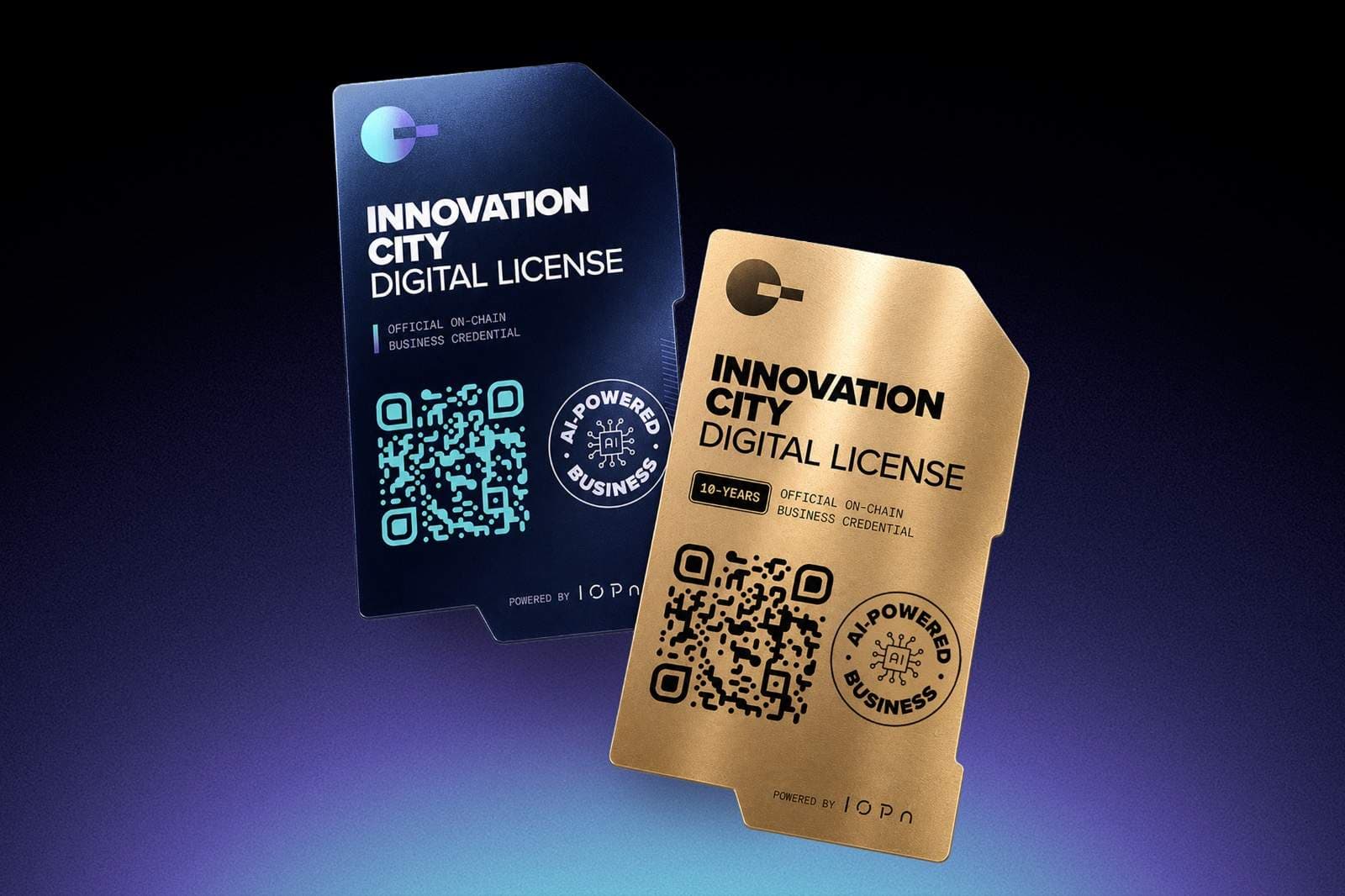
Today, Innovation City, the UAE’s premier AI-powered free zone in Ras Al Khaimah, announces the launch of the world’s first blockchain-based digital business identity system.
Every company registered here now receives a sovereign, living, cryptographically verifiable identity powered by IOPn’s native layer on blockchain, OPN chain.
This is not an upgrade. This is a complete re-architecture of how businesses exist, prove themselves, and interact in the 21st century.
In fact, for the first time in history, a business license is no longer a static PDF or a line in a government database. It is a dynamic, immutable, soul bound digital asset; removing reliance on centralized intermediaries and drastically reducing verification uncertainty.
The launch reflects a broader rethinking of how businesses are represented and authenticated in a digital-first economy. Instead of relying on fragmented systems and manual verification processes, the model introduces an on-chain identity layer intended to support faster, more transparent interactions across institutions, jurisdictions, and digital platforms.
The timing aligns with the UAE’s recently announced strategy to accelerate the adoption of artificial intelligence across government operations.
Authorities have outlined plans to transition a significant portion of federal services toward AI-driven systems within the coming years, a shift that will require infrastructure capable of supporting automated, real-time interactions between institutions and businesses.
Within this context, blockchain-based identity is increasingly viewed as a foundational layer.
Paul Dawalibi framed the initiative as a structural shift in how companies operate and interact within modern economies. He noted that traditional business identity systems, long reliant on documents and centralized databases, were not designed for a digital environment where speed, interoperability, and verification are critical.
Mojtaba Asadian described the platform as part of a broader infrastructure layer intended to support the UAE’s emerging AI-driven economic model. According to him, the system is designed to be secure, interoperable, and scalable across jurisdictions, enabling businesses to operate within a unified digital framework rather than fragmented systems.
The implications of such a system extend beyond administrative efficiency. By recording ownership structures, compliance updates, and verification data on-chain, the platform introduces a level of transparency and auditability that is difficult to achieve through traditional processes. Stakeholders, including banks, regulators, and investors, can verify corporate information in real time, reducing delays that have historically slowed onboarding and cross-border activity.
This shift could also play a role in addressing risks associated with document fraud and opaque ownership structures, particularly in global financial systems where verification often depends on intermediaries and manual checks.
At the same time, the infrastructure is designed to support interoperability and high transaction throughput, allowing digital identities to function across platforms and jurisdictions. This capability is seen as essential for enabling AI-driven systems to interact directly with verified entities, particularly as governments move toward more automated service models.
The rollout highlights the UAE’s broader ambition to be at the front of digital infrastructure development, particularly at the intersection of blockchain and artificial intelligence. While many jurisdictions continue to explore these technologies at a conceptual level, initiatives such as this suggest a shift toward practical implementation at scale.
Rather than treating digital identity as an administrative requirement, the model reframes it as a strategic asset, one that can influence access to financial services, regulatory interactions, and global market participation.
For businesses operating within Innovation City, the introduction of on-chain identity may offer advantages in terms of credibility, efficiency, and integration into emerging digital ecosystems. More broadly, it signals a transition toward a system where trust is embedded in infrastructure rather than established through intermediaries.
Innovation City has once again proven why it is the most forward-looking free zone in the UAE. While others promise digital transformation, Innovation City is delivering digital sovereignty and a new global standard. While others prepare for AI, Innovation City is building the verifiable identity layer that makes AI government possible.
This is the moment business identity stops being an administrative burden and becomes a strategic superpower.
The future of commerce has a new address.
It starts in Innovation City.

Disclaimer of Warranty
The information provided in this article is for general informational purposes only. We make no warranties about the completeness, reliability, and accuracy of this information. Read full disclaimer

Editor's Picks

Why Zondacrypto’s Collapse Would Unfold Differently in the UAE

Walid Abou Zaki

Aug 28, 2026

8 min

The Missing Orchestration Layer Holding Back Institutional Digital Assets
Julian Sawyer
Aug 18, 2026
5 min

Beyond Crypto Access: How ARP Digital Is Building the UAE’s Digital Capital Infrastructure
Anna K.
Aug 17, 2026
8 min
Read More Articles

In the Same Space

USDU Expands UAE Reach With Crypto.com App Integration
News Desk
Sep 10, 2026
4 min

Crypto Wealth Is Growing, but Traditional Wealth Infrastructure Is Not Ready
News Desk
Sep 10, 2026
4 min
DDSC and Network International Launch UAE’s First In-Store AED Stablecoin Pilot
News Desk
Sep 9, 2026
2 min

UAE's Fuze Finance Expands Into Switzerland With Regulated Crypto Infrastructure and Institutional Push
Anna K.
Sep 8, 2026
4 min