Advertisement
Insights
Share
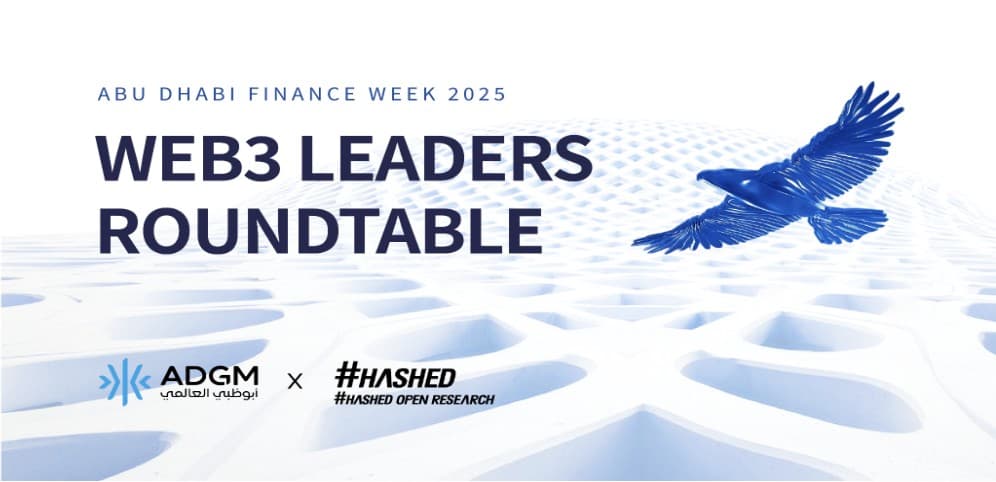
Abu Dhabi Global Market (ADGM) and Hashed Open Research have released a joint policy report examining how artificial intelligence and blockchain are reshaping financial infrastructure, following a closed-door roundtable held during Abu Dhabi Finance Week 2025.
The report consolidates discussions from a select group of around 40 senior participants representing global financial institutions, regulators, and technology firms.
Attendees included entities such as Abu Dhabi Investment Authority, BlackRock, Depository Trust & Clearing Corporation, Franklin Templeton, Circle, Consensys, and the Solana Foundation, alongside representatives from the European Commission and the government of Liechtenstein.
A central theme of the discussions was the growing integration of AI into financial systems, particularly as automated agents begin to take on more active roles in decision-making and transaction execution.
Participants noted that machine-driven activity could soon exceed the capacity of systems originally designed for human interaction, increasing the need for scalable, transparent infrastructure. In this context, blockchain-based systems were highlighted as a potential foundation for trusted financial settlement, supported by verifiable records and stronger governance frameworks.
The report also points to a shift in how tokenization is being approached. Rather than simply digitizing existing assets, institutions are beginning to rethink core market functions such as issuance, distribution, and settlement.
Examples discussed during the roundtable included efforts by major infrastructure providers to expand tokenization across capital markets, as well as early adoption of tokenized commodities attracting flows from traditional investment products.
Participants emphasized that regulatory treatment, accounting standards, and capital requirements for digital assets, particularly stablecoins, will play a critical role in determining how widely these technologies are adopted.
The report also highlights the potential emergence of AI-driven personal agents, or “digital twins,” as a future interface for interacting with financial systems.
Despite growing interest, the report identifies regulatory uncertainty as the primary obstacle to broader institutional adoption.
Challenges include high capital requirements for certain digital asset exposures under global banking rules, overlapping compliance obligations across jurisdictions, and a lack of clarity around accounting and tax treatment.
While stablecoins and real-time settlement were identified as the most advanced use cases, the report cautions that tokenization will only deliver meaningful value if supported by sufficient market liquidity and reliable redemption mechanisms.
It also warns that overly restrictive regulation at an early stage could limit innovation before risks and control frameworks are fully understood.
The report reflects the UAE’s broader strategy of positioning itself as a global hub for financial innovation. Through platforms like ADGM, the country has sought to bring together regulators, institutional investors, and technology firms to shape the next phase of financial infrastructure.
Rashed Al Blooshi, chief executive of ADGM’s Registration Authority, said the initiative underscores the importance of governance as financial systems evolve.
He emphasized that elements such as identity, permissions, auditability, and rights management will be critical to ensuring that innovation scales responsibly.
Meanwhile, Simon Seojoon Kim described the roundtable as an opportunity for global stakeholders to address how capital markets should evolve at the intersection of AI and blockchain.
More broadly, the report highlights a shift in how financial systems are being reimagined, with increasing overlap between emerging technologies and traditional market structures.
As digital assets move beyond experimentation, the focus is turning toward building infrastructure that can operate at scale while maintaining regulatory compliance and market integrity.
In that context, initiatives led from hubs like Abu Dhabi show how regional financial centers are playing a growing role in shaping the future of global finance.

Disclaimer of Warranty
The information provided in this article is for general informational purposes only. We make no warranties about the completeness, reliability, and accuracy of this information. Read full disclaimer

Editor's Picks
In the Same Space

Crypto Ads in the UAE Face New Google Rules Starting October 21

News Desk

Oct 20, 2026

4 min
Robinhood Plans Dubai Launch in 2027 After DFSA Authorization
Walid Abou Zaki
Oct 22, 2026
4 min

VARA Grants Bybit License for Spot Trading in Dubai
Walid Abou Zaki
Oct 22, 2026
6 min
Standard Chartered Extends Crypto Trading to UAE Wealth Clients
News Desk
Oct 14, 2026
3 min