
Advertisement
Interviews
Share
OW
Content Writer


Tether, a dominant player in the stablecoin market, has announced a groundbreaking partnership with Phoenix Group PLC to launch a Dirham (AED)-pegged stablecoin in the UAE. Paolo Ardoino, CEO of Tether, sat down with Unlock Blockchain to discuss this collaboration and the potential impact of the new stablecoin on the global economy, especially in emerging markets.
Since its inception in 2014, Tether has established itself as a leader in the stablecoin industry, with a market cap of over $117 billion and daily trading volumes ranging between $40 billion to $60 billion. When asked about the key to Tether's success, Ardoino attributed it to "product market fit," a concept that Tether has mastered by creating a product that meets the needs of its users. He explained, “When you create a stablecoin, you need to understand who is going to use it and how it will be used. We created the entire stablecoin market, and today, governments and the biggest banks are looking into this technology.”
Ardoino emphasized that Tether's primary focus has always been on serving the 5 billion people worldwide who live in high-inflation countries. Many of these people are unbanked, not because they are untrustworthy, but because they are too poor to be of interest to traditional banks. For these individuals, stablecoins like Tether provide a lifeline, allowing them to preserve their wealth in a way that their local currencies often cannot.
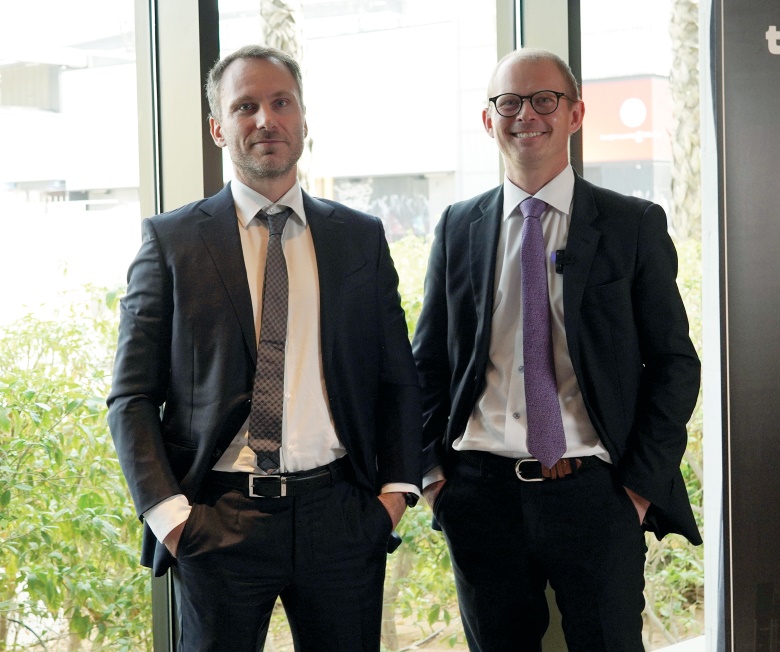
The introduction of a Dirham-pegged stablecoin is particularly significant for the UAE, a country with a strong economy and low levels of debt. Ardoino believes that the AED stablecoin will offer a new level of comfort and security for people in the region, providing an alternative that is closely aligned with the local economy. He stated, “With such a strong economy, the UAE is the perfect environment for a Dirham-pegged stablecoin that will give people the comfort they need.”
One of the most critical aspects of any stablecoin is the trust that users place in it, and Tether has faced intense scrutiny over the years regarding its reserves. Addressing these concerns, Ardoino pointed out that Tether is “more than 100% backed,” with over $100 billion in U.S. Treasury bills. He noted, “If Tether were a country, it would hold more U.S. Treasury bills than the UAE, Spain, or Australia.”
This strong backing is designed to ensure that Tether can always meet redemption requests, even in times of market stress. Ardoino highlighted the stability of Tether during the 2022 market downturn when the company processed $7 billion in redemptions within 48 hours and $20 billion over 20 days. He contrasted Tether’s resilience with the failures of several traditional banks during the same period, underscoring Tether’s commitment to risk management and financial security.
In response to questions about how Tether is using its profits, Ardoino clarified the separation between the company’s reserves and its investments. “There seems to be a little confusion between the reserves of Tether, the stablecoin, and Tether as a company,” Ardoino said. “In the last two years, Tether made around $12 billion in profit. $5 billion of those $12 billion are kept as additional excess reserves in the stablecoin. So, the $117 billion issued in USDT, plus $5 billion of undistributed profits, are kept there to further back the stablecoin. The rest, around $6 billion, is being invested in various initiatives, including Bitcoin and startups, but they are completely separate from the stablecoin reserves. It's not that AI companies are backing the stablecoin; they are completely separated.”
Tether's strategy has always been to serve the underbanked and those living in high-inflation countries. Ardoino reiterated that Tether is not interested in competing with banks in developed countries. Instead, the company focuses on providing financial stability to people in emerging markets who are often at the mercy of volatile local currencies. “We believe that the banks have a way to move money very easily, but normal people are actually struggling,” he said.
Tether's collaboration with Phoenix to launch a Dirham-pegged stablecoin is set to be a significant milestone in the UAE's financial landscape. This AED-pegged stablecoin is the first to be announced, but it likely won't be the last, as other entities are expected to follow suit. Tether plans to begin communication with the UAE Central Bank and prepare all necessary documentation and paperwork, aiming to secure approval within 2024. With its strong backing, proven resilience, and focus on serving those who need it most, Tether continues to push the boundaries of what stablecoins can achieve, offering new financial opportunities and stability to the people of the UAE and beyond.
Credit to Videographer: Milad Hatami

Disclaimer of Warranty
The information provided in this article is for general informational purposes only. We make no warranties about the completeness, reliability, and accuracy of this information. Read full disclaimer

Editor's Picks
Why Zondacrypto’s Collapse Would Unfold Differently in the UAE

Walid Abou Zaki

Aug 28, 2026

8 min

The Missing Orchestration Layer Holding Back Institutional Digital Assets
Julian Sawyer
Aug 18, 2026
5 min

Beyond Crypto Access: How ARP Digital Is Building the UAE’s Digital Capital Infrastructure
Anna K.
Aug 17, 2026
8 min
Read More Articles

In the Same Space
Is Tether Turning USDT Into a Financial Infrastructure Layer?
News Desk
Sep 10, 2026
4 min
Iran Turns to Crypto as Sanctions Bite, But USDT Has a Control Problem
Salma Naueihed
Sep 9, 2026
5 min

Wall Street’s Stablecoin Push Gets Bigger as 21 Banks Join Forces
News Desk
Sep 2, 2026
3 min

ESMA Targets Prediction Markets: Polymarket and Kalshi Face EU Scrutiny Over Authorization
News Desk
Sep 11, 2026
4 min