Advertisement
Interviews
Share
WA
CEO & Editor-in-Chief


Few people have been more immersed in the UAE’s transformation into a global crypto hub than Irina Heaver, Managing Partner at NeosLegal and one of the region’s most respected legal voices in Web3. With over 300 crypto projects advised globally and nearly two decades of legal practice in the UAE, Heaver offers first-hand knowledge of how policy, infrastructure, and entrepreneurship intersect.
In this conversation, she speaks candidly about what sets the UAE apart, how its multi-regulator structure affects founders, and why she launched the Founder’s Guide to UAE Crypto Laws—a living digital roadmap for entrepreneurs navigating one of the world’s most dynamic, yet complex, regulatory terrains.
When asked about the UAE’s position on the global crypto map, Irina is unequivocal: “We’ve had a leadership supporting entrepreneurship since 1975—long before crypto existed. JAFZA was built for traders and founders, and that mindset never changed.”
For her, “business-friendly” doesn’t just mean clear regulations. It means a full ecosystem: from residency to infrastructure, education, safety, and investor access. The UAE, she says, checks those boxes—and founders globally are noticing.
But this isn’t to say navigating the UAE is simple.
“Founders ask: Do I go to ADGM? What about VARA? How about Federal Authorities? What licenses do I actually need? And no one gives them a straight answer,” she says.
That’s because the UAE’s virtual asset regulations are uniquely structured across both federal and Emirate levels, along with separate regulation in the financial free zones. Each jurisdiction—ADGM (Abu Dhabi), VARA (Dubai), SCA (Federal)—has its own licensing framework, business focus, and operational scope:
ADGM leads on institutional finance and non-AED backed stablecoins, recently issuing the DLT Foundations Regime for DAOs.
VARA focuses on broader VASP activities, with strict compliance and granular reporting standards—especially for exchanges and custodians.
SCA, the Federal Regulator, recently launched its own VASP licensing regime, but so far no VASP licenses have been issued.
“We have plenty of choice in the UAE,” Irina clarifies. “But for a founder, that choice needs to be demystified. That’s exactly why we wrote the guide.
What sets the Founder’s Guide to UAE Crypto Laws apart isn’t just the content—it’s the intent behind it.
Created by NeosLegal, the guide is the first and only publicly available legal resource built specifically for Web3 founders, not lawyers. It breaks down the UAE’s crypto ecosystem in clear, practical language and is updated regularly as regulations evolve.
“This isn’t a legal textbook. It’s a roadmap,” says Irina. “If you even read 20% of it, you’ll already be ahead of most founders trying to navigate the region.”
Officially launched on May 2, 2025, at VC<>Startup Connect (hosted by Cointelegraph Accelerator, DMCC, and NewTribe Capital), the guide had already generated over 2,700 pre-registrations before the event. An early edition was previewed with over 300 builders at a Solana Superteam policy day in April, during which regulators and founders sat in the same room—a rare occurrence that underlines the region’s unique openness.
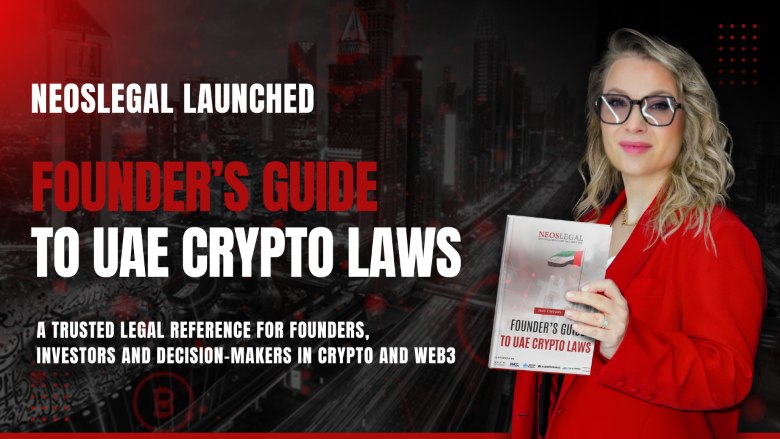
The guide distills more than a decade of regulatory insight from NeosLegal’s team into one platform, offering:
Unlike traditional law firm PDFs, this is a living document. New regulations? It gets updated. Major policy shifts? Reflected immediately. And it’s written in a way that founders can actually understand—no legal jargon or gatekeeping.
While led by Irina Heaver and the NeosLegal team, the guide includes valuable input from across the ecosystem:
The Foreword was provided by Ahmed Bin Sulayem, Executive Chairman of DMCC, with further support from ADGM and other regulators.
“What founders need is not more noise—they need direction. That’s what the guide offers.
Irina is a long-time Bitcoin maxi, but she’s skeptical of governments using crypto narratives as political props: “Bitcoin is for the people—not for governments. If countries want to hold reserves, fine. But I care more that individuals understand and use Bitcoin.”
On stablecoins, she sees progress—especially in the UAE with many projects underway.
As for RWA tokenization, Irina is cautiously optimistic. She points to missed opportunities during the STO era and questions whether current efforts are truly ready for primetime:
“Until I can log in, register, and trade tokenized assets myself, I’m not convinced. Innovation without implementation is just noise.”
Despite progress, Irina believes several things still need to be addressed:
“We can bring offshore work onshore—if we make it easier and more affordable. That’s good for founders, and good for the country.” But her core message remains clear: the UAE is ahead because it acts—not because it talks. “This isn’t a jurisdiction driven by political cycles. It’s driven by clear actions from the Leadership. And that’s exactly what Web3 builders need.”

Disclaimer of Warranty
The information provided in this article is for general informational purposes only. We make no warranties about the completeness, reliability, and accuracy of this information. Read full disclaimer

Editor's Picks
In the Same Space

Crypto Ads in the UAE Face New Google Rules Starting October 21

News Desk

Oct 20, 2026

4 min
Robinhood Plans Dubai Launch in 2027 After DFSA Authorization
Walid Abou Zaki
Oct 22, 2026
4 min
VARA Grants Bybit License for Spot Trading in Dubai
Walid Abou Zaki
Oct 22, 2026
6 min

Standard Chartered Extends Crypto Trading to UAE Wealth Clients
News Desk
Oct 14, 2026
3 min