Advertisement
Stablecoins & Payments
Share
WA
CEO & Editor-in-Chief


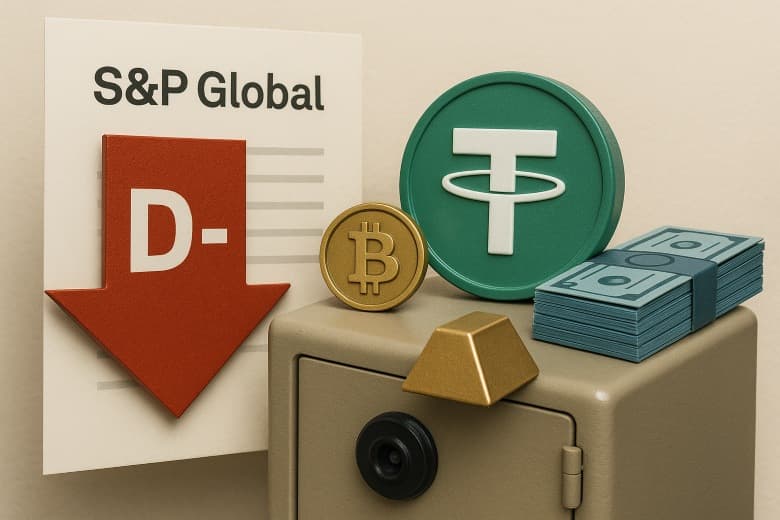
When S&P Global Ratings downgraded Tether’s USDT stability assessment to its weakest tier, the company’s reaction was immediate and familiar. Tether dismissed the move as “propaganda,” framing the downgrade as another attempt by traditional finance to undermine its position. For years, this defensive posture worked. USDT grew despite scrutiny, becoming the most widely used digital dollar across exchanges, informal markets, remittances and cross-border settlements.
But Tether is no longer the outsider it once was. With more than $180 billion in circulation, USDT has become a structural financial instrument. Its presence in emerging markets makes it a lifeline for millions. In an earlier article, I argued that regulators once needed Tether more than Tether needed regulators — and in many ways that is still true.
Yet that does not mean Tether can continue answering institutional critique with PR alone.
S&P did not accuse Tether of being insolvent. It simply pointed out the obvious: part of Tether’s reserves — even if purchased from profits — sit in volatile or less-liquid assets such as Bitcoin, gold, corporate debt and secured loans. Once these assets enter the balance sheet, they influence the overall reserve stability that backs USDT during market stress. Their volatility becomes part of the system.
Tether’s response did not address this. It questioned motives instead of engaging with the substance.
But at this scale, credibility cannot be defended with rhetoric.
This is a critical point — and one that deserves clarity.
Over the past two years, Tether has been steadily diversifying away from traditional U.S. dollar instruments, even as it continues to emphasize Treasuries in its communication:
This is, in effect, a de-dollarization strategy inside a dollar-denominated stablecoin.
The reasoning may be geopolitical, financial, or driven by Tether’s long-standing tension with U.S. regulators. But the result is the same: the world’s dominant “digital dollar” is increasingly backed by assets that are not purely U.S. dollars or dollar equivalents.
This is where the contradiction sits.
Tether wants to apply for a regulated U.S. stablecoin license.
Tether wants relevance in the UAE under a regulatory framework.
Tether cannot stay outside Europe forever under MiCA.
Yet its balance sheet is drifting away from the very financial system it seeks recognition from.
S&P called this out indirectly, but clearly. Tether’s reply ignored it.
As Tether evolves, its reserve strategy raises a broader question about identity. Buying Bitcoin aligns naturally with Tether’s origins and long-term vision of a crypto-native future. Bitcoin is volatile, but philosophically coherent.
Gold, however, sends a different message.
It reflects caution rather than conviction. It is defensible from a diversification standpoint, yet it does not strengthen Tether’s core narrative or mission. It sits in an unclear middle ground between a sovereign reserve fund and a stablecoin issuer.
This is not about whether gold is a good asset.
It is about coherence, narrative clarity and regulatory alignment.
A stablecoin cannot ask to be treated like a low-risk, liquid, dollar-backed instrument while allocating growing portions of its surplus into assets that behave like long-term macro hedges.
Tether’s ambitions are clear: it wants to operate in regulated markets, gain institutional recognition, and secure its position as the world’s dominant digital dollar. But ambitions require alignment with the standards of those markets.
If Tether wants to be taken seriously in Washington, Abu Dhabi or Brussels, it must respond to institutional assessments with institutional behavior — not slogans.
That means clearer reserve segregation, transparent disclosures, and a willingness to answer risk-based criticism on technical, not rhetorical, grounds.
Tether’s dominance has long been strengthened by the absence of real competition. It grew during a period when no major global financial institution wanted to touch stablecoins, and when regulators were still debating definitions rather than building frameworks. In many ways, Tether has been operating alone — not by design, but by timing.
But that era is ending.
Large, well-capitalized players are entering the stablecoin space, and they are doing so with regulatory alignment built in from day one. Circle’s pivot toward ARC, a tokenized cash product designed specifically for institutions, signals that the next phase of stablecoins will not be retail-first. It will be regulated, institutional and deeply integrated into traditional finance.
And Circle will not be the last mover.
The market is wide open for a global asset manager to launch a fully compliant, fully transparent, professionally audited stablecoin. A firm like BlackRock, already managing tokenized treasury funds and dominating money-market flows, could enter the market with a dollar-token that institutions trust overnight. If that happens, the competitive landscape will shift immediately.
Tether is still ahead — but the field around it is changing fast.
It cannot rely on the narrative of being irreplaceable forever.
Dominance has a lifecycle, and new entrants will not play by Tether’s old playbook.
The future of stablecoins will belong to issuers that unite scale with transparency, liquidity with regulation, and innovation with institutional-grade governance. Tether can be one of them — but only if it evolves beyond PR defensiveness and aligns with the financial role it now occupies, and the competition that is inevitably coming.
How Tether chooses to respond in this moment may define not only its future, but the next era of the global digital dollar.

Disclaimer of Warranty
The information provided in this article is for general informational purposes only. We make no warranties about the completeness, reliability, and accuracy of this information. Read full disclaimer

Editor's Picks
In the Same Space

Swiss National Bank Warns of Stablecoin Risks to Monetary Policy and Interest Rates

News Desk

Oct 1, 2026

3 min
Citi and Coinbase Put Stablecoins Behind Corporate Payments
News Desk
Sep 29, 2026
5 min
IMF Clears $139 Million Disbursement to El Salvador After Bitcoin Breach
News Desk
Oct 2, 2026
4 min
Mashreq and Citi Complete Live Tokenized Payment on Swift’s Blockchain Ledger
News Desk
Sep 30, 2026
3 min