Advertisement
Exchanges & Trading
Share
SN
Senior English Editor


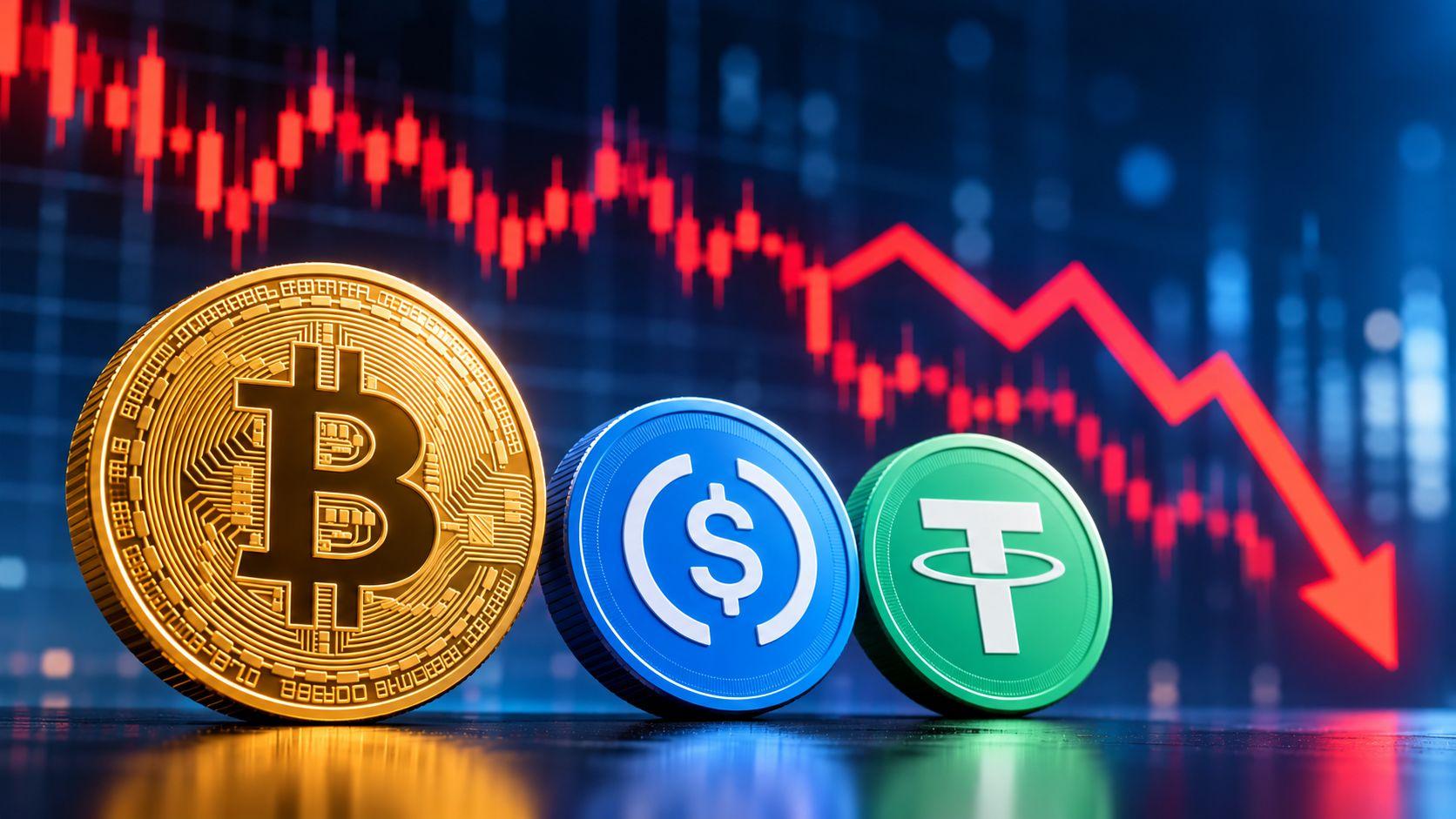
The stablecoin market shed approximately $12 billion in 30 days, led by USDT and USDC redemptions, as Binance faces public criticism from OKX founder Star Xu over its alleged role in market crashes, a $6.34 billion security incident, and questions about broader investor accountability.
The stablecoin market has shed approximately $12 billion in value over the past 30 days, adding to concerns about weakening liquidity across the crypto sector as Bitcoin fell to a four-month low. The contraction comes as Binance faces renewed criticism from OKX founder Star Xu over its alleged role in repeated market crashes, bringing questions about exchange accountability back into focus.
According to Bloomberg, citing data compiled by Kaiko, Tether’s USDT and Circle’s USDC accounted for approximately 90% of the decline.
The figures point to more than a fall in token prices. A shrinking stablecoin market can indicate that investors are redeeming tokens and moving funds out of crypto, reducing the pool of dollar-denominated liquidity available to traders. However, the contraction alone does not establish why holders are withdrawing or connect those redemptions to any single exchange.
The development marks a shift from the expansion recorded earlier this year, when stablecoin market capitalization reached $315 billion. Unlock Blockchain previously examined that growth, as stablecoins gained ground across trading, payments and institutional settlement.
The stablecoin contraction coincides with renewed public criticism of Binance from Star Xu, founder of rival exchange OKX.
Xu accused Binance founder Changpeng Zhao of misleading customers about the exchange’s role in successive October market crashes. Xu questioned how Binance could face criticism over market turmoil while asking customers to maintain a long-term outlook.
Zhao denied that Binance had been selling cryptocurrency during the latest downturn, saying the exchange was not dumping its holdings and that he had personally been buying. He also pointed to several possible factors behind Bitcoin’s decline, including exchange-traded fund outflows, economic uncertainty and security concerns.
The disagreement has roots in the October 2025 liquidation cascade, when approximately $19 billion in leveraged positions were liquidated within a day. Xu had previously criticized Binance’s lending and yield products, arguing that the treatment of Ethena’s USDe as collateral encouraged users to build leveraged positions by borrowing stablecoins against yield-bearing assets.
Binance disputed the suggestion that its products caused the crash, pointing instead to excessive leverage and thin market liquidity. The competing explanations remain important because they concern how exchange collateral policies and risk controls can amplify market stress, rather than simply reflect falling asset prices.
Unlock Blockchain's earlier examination of the October liquidation event explored the role of leverage, fragmented liquidity and exchange-specific risk mechanisms in the market turmoil.
The debate has gained another dimension following Binance’s October 29 security incident, which resulted in approximately $6.34 billion in digital assets being affected.
In its November 3 incident update, Binance said it would absorb the financial impact rather than pass the losses to customers. The exchange reported that 98% of the affected token assets had been replenished as of October 31, while approximately $2.85 billion had been frozen or intercepted. It also said it had set aside more than the amount required to cover the loss.
The FBI attributed the theft to North Korea-linked hackers, adding another major security incident to the industry's record of exchange vulnerabilities.
Binance’s response addresses the direct financial exposure of its customers. But it raises a separate question about the wider market: what happens to investors who were not directly affected by the breach but experienced losses during the resulting volatility?
A customer reimbursement commitment can restore affected balances. It cannot automatically compensate other traders for falling asset prices, forced liquidations or losses incurred across unrelated exchanges.
That distinction is central to the accountability debate. The market-wide impact of an exchange incident or a platform's risk-management decisions can extend well beyond the exchange's own customer base, while existing reimbursement mechanisms generally focus on direct losses.
The stablecoin contraction is unfolding alongside other signs of weakening demand. US spot Bitcoin exchange-traded funds recorded approximately $1.9 billion in net outflows over seven consecutive trading days through November 13, according to figures cited in recent market coverage. More than $2 billion in crypto positions were also liquidated during the weekend sell-off.
These developments suggest that the market is facing several overlapping pressures, including institutional withdrawals, leveraged position closures, macroeconomic uncertainty and declining stablecoin supply.
Binance's role in the current downturn remains disputed, and neither the stablecoin contraction nor Bitcoin's price decline proves that the exchange caused the broader market sell-off. Equally, the fact that Binance says it did not sell its holdings does not resolve the separate questions raised by Xu about its products, collateral policies and market influence.
The larger issue is whether major crypto exchanges should face greater scrutiny over how their products and internal risk systems behave during periods of extreme volatility. As centralized platforms continue to control significant trading volumes and liquidity, their decisions can have consequences that extend beyond their own users.
For now, Binance can commit to covering losses linked to its security incident, but the wider market has no comparable protection against losses arising from cascading liquidations, liquidity shortages or exchange-related disruptions. The latest stablecoin contraction and the public dispute between Binance and OKX have brought that gap into sharper focus.

Disclaimer of Warranty
The information provided in this article is for general informational purposes only. We make no warranties about the completeness, reliability, and accuracy of this information. Read full disclaimer

Editor's Picks
In the Same Space

Saylor Buys the Bitcoin Dip as Strategy Balances Accumulation With Capital Management

News Desk

Nov 17, 2026

3 min

Backpack CFTC Approval Advances Global Derivatives Plans
Walid Abou Zaki
Nov 17, 2026
4 min
MSCI Confirms Strategy’s Removal From Global Indexes
News Desk
Nov 12, 2026
4 min

Arkéa Cyberattack: Bank Security Meets Crypto Risk
Walid Abou Zaki
Nov 5, 2026
6 min