Advertisement
Funding & Capital
Share
SN
Senior English Editor


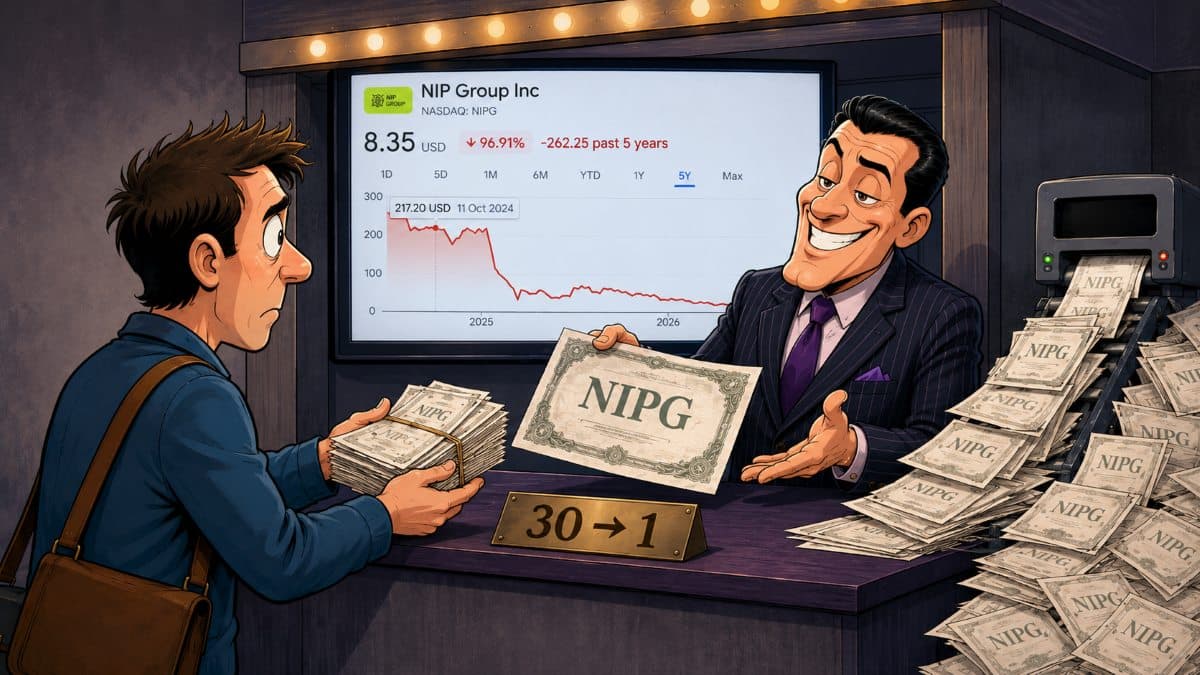
NIP Group completed a 1-for-30 reverse ADS split on July 6 to address a Nasdaq minimum bid deficiency, but on a comparable basis its ADSs are approximately 32% below their pre-split level and roughly 97% below the split-adjusted IPO price of $270, reflecting a deeper deterioration in shareholder value.
The NIP Group reverse split has pushed the company’s Nasdaq-traded ADS price back above the one-dollar threshold, but the higher quotation does not represent an economic recovery.
On July 6, the company completed a 1-for-30 reverse split of its American depositary shares, changing the ratio from one ADS representing two Class A ordinary shares to one ADS representing 60 ordinary shares. The underlying Class A shares were not reduced or cancelled. The transaction simply combined every 30 former ADSs into one new trading unit.
At the time of writing on July 22, NIPG was trading around $9. On the basis used before the reverse split, that is equivalent to approximately $0.30.
When Unlock Blockchain last examined NIP Group on June 15, the ADSs were trading near $0.44. On a directly comparable basis, the stock is now approximately 32% below the level recorded in that article, despite the apparently higher quotation.
The reverse split changed the appearance of NIP Group’s stock. It did not change the direction of the underlying market story.
NIP Group priced its initial public offering at $9 per ADS in July 2024. After accounting for the new 1-for-30 ratio, that IPO price is equivalent to $270 per current ADS. Compared with a price of around $9, the company’s ADSs are now approximately 97% below their split-adjusted IPO level.
This is a price-per-ADS comparison rather than a claim that NIP Group’s total market capitalization has fallen by exactly 97%. The company has issued hundreds of millions of additional ordinary shares since its listing, significantly changing its capital structure.
That distinction does not make the picture more reassuring.
In March, Nasdaq notified NIP Group that its ADSs had closed below the exchange’s $1 minimum bid requirement for 32 consecutive business days. The company was given until September 21 to regain compliance by maintaining a closing bid price of at least $1 for ten consecutive business days.
The reverse split may resolve that technical listing problem. It does not explain why a company that entered Nasdaq at $9, established a government-supported platform in Abu Dhabi and announced one of the region’s largest Bitcoin mining operations reached the point where such a restructuring became necessary.
The more consequential change happened beneath the ADS structure.
NIP Group had approximately 78.73 million Class A ordinary shares outstanding in June 2025. Following its first major mining-asset transaction, related issuances and a separate cancellation, that number increased to approximately 197.36 million. The company issued roughly 119.55 million shares as consideration for mining machines providing 3.11 EH/s of hash rate.
The expansion continued.
By March 31, 2026, NIP Group had approximately 365.28 million Class A shares outstanding. On May 29, it issued another 62.58 million shares to settle part of its second mining transaction, which had previously been expected to be settled through convertible notes. The latest disclosed total consequently reached approximately 427.86 million Class A shares.
In less than a year, the company’s Class A share count increased by approximately 443%, becoming more than 5.4 times larger.
An investor who retained the same number of Class A shares throughout that period would now hold only around 18.4% of their former proportional position within the Class A share pool.
That does not mean the investor automatically lost 81.6% of the monetary value of the investment. NIP Group received mining machines and computational capacity in return for the newly issued equity.
It does mean that every original share now represents a dramatically smaller claim on the company. The mining assets must therefore produce enough additional economic value to compensate shareholders for the ownership transferred to the sellers.
NIP Group has demonstrated that it acquired more hash rate. It has not yet demonstrated that value per share increased with it.
The NIP Group reverse split did nothing to reverse the underlying dilution. It reorganized how the ordinary shares are packaged and displayed to Nasdaq investors, while leaving the expanded Class A share count intact.
NIP Group’s latest detailed production update was published in January, when it reported that its initial 3.11 EH/s fleet had produced approximately 151.4 BTC between September and November 2025.
The company also said that its online mining capacity had reached 9.66 EH/s and expected the remaining transaction batches to bring total operating capacity to approximately 11.3 EH/s.
Those figures established that NIP Group had moved beyond announcing a mining ambition and had begun producing Bitcoin. But they covered an operating period that ended in November.
The company’s official release archive shows no subsequent monthly production update through July 22. Its later announcements focused on the Nasdaq deficiency, the ADS ratio change and other corporate developments rather than providing investors with a continuing record of mining output.
This absence creates an important unresolved issue.
It would be speculative to state that NIP Group has completely switched off its mining operation or that its machines are old and inefficient. The company has not publicly disclosed enough fleet-level information to support either conclusion.
Its publicly filed asset-purchase agreement states that the mining-equipment schedules were expected to include serial numbers, physical locations, specified hash rates and remaining warranty periods. It also refers separately to machines that were under maintenance or repair.
However, the public appendix does not provide the machine list. It states only “see the attachment” for both the products and the equipment under maintenance. The disclosed document therefore does not identify the machine models, manufacturing years, energy efficiency in joules per terahash, warranty profile or number of units requiring repair.
Without that information, investors cannot determine whether NIP Group acquired a competitive modern fleet or older machines whose profitability depends heavily on unusually low electricity and hosting costs.
Nor can they verify how much of the announced 9.66 EH/s remains active, what realized hash rate the fleet is delivering or whether some capacity has been curtailed because of maintenance, energy costs, hosting conditions or weak mining economics.
Unless NIP Group has materially reduced or suspended mining operations—a development it has not publicly announced—the lack of recurring production data is difficult to reconcile with the earlier presentation of mining as a major new revenue engine.
The issue is no longer nominal hash rate. It is how much capacity is operating, how efficiently it runs and what cash it produces after electricity, hosting, maintenance and other costs.
NIP Group’s deteriorating market position also places its agreement with the Abu Dhabi Investment Office in a more complicated context.
In January 2025, the company announced a multi-year partnership under which it could receive up to approximately $40 million in support over four years. The potential support was not unconditional. According to NIP Group’s regulatory filing, installments were contingent on conditions precedent, performance milestones, quantitative and qualitative KPIs and revenue targets.
It would therefore be inaccurate to describe the arrangement as an immediate $40 million cash transfer or to conclude that ADIO has already lost that amount.
The agreement was publicly framed around establishing NIP Group’s global headquarters in Abu Dhabi and building the emirate’s gaming, media and entertainment economy.
The announced plans included local employment, esports operations, an academy, creative studios, game publishing, event and talent management, internships for UAE nationals and locally registered intellectual property featuring Abu Dhabi, Al Ain and Al Dhafra.
NIP Group later connected its mining and computing expansion to the ADIO partnership, saying the strategy supported the establishment of its digital-infrastructure division headquarters in Abu Dhabi.
That creates a clear tension between the original public narrative and the company’s subsequent market identity.
ADIO’s announcement centered on gaming, entertainment, local creative capacity and talent development. NIP Group’s most visible strategic story later became Bitcoin mining, computational infrastructure and potential AI applications.
The public disclosures reviewed for this article do not provide a detailed account of how much ADIO-linked support has been earned or disbursed, which operating milestones have been completed, how many permanent positions have been created in Abu Dhabi, or what locally generated revenue and intellectual property have resulted from the partnership.
This does not establish a breach of the agreement, nor does it prove that the partnership has failed. It does make its measurable economic output more relevant as NIP Group’s listed value declines and its operating identity moves further from the gaming-centered proposition originally presented.
The partnership was announced as a contribution to Abu Dhabi’s creative and knowledge economy. Its eventual assessment will depend on what was actually built, employed, generated and retained in the emirate—not on the headline value of the agreement.
NIP Group’s mining pivot did not emerge from a position of strength in its original esports operation.
The company’s total revenue increased by 55.5% to $61.2 million during the first half of 2025, driven mainly by talent management and event production. But esports-team revenue fell 57.2% to $3.8 million.
The esports segment moved from a positive gross margin of 31.5% in the first half of 2024 to a negative 46.9% margin one year later.
NIP Group reported an overall gross loss of $1.2 million, negative adjusted EBITDA of $7.1 million and a net loss of $136.3 million. The net loss was driven mainly by $125.9 million in non-cash goodwill and intangible-asset impairments, primarily associated with the Ninjas in Pyjamas business and its weaker-than-expected performance.
The impairment was not a comparable cash outflow during the period. It was nevertheless an accounting recognition that the recoverable value of one of NIP Group’s central brands had fallen significantly below earlier assumptions.
The company was therefore not simply adding mining to a healthy esports platform. It was issuing large amounts of equity to construct a new business while the economics and assessed value of its original flagship operation were deteriorating.
NIP Group still has operating businesses, recognizable esports brands and announced mining capacity. But another strategic label, acquisition or expansion announcement is unlikely to repair its public-market credibility.
A meaningful recovery now depends on evidence.
For mining, that means recurring production figures, realized rather than installed hash rate, uptime, machine models, fleet efficiency, energy and hosting costs, Bitcoin holdings and net cash generation.
For Abu Dhabi, the relevant record is the company’s delivery against the employment, revenue, local-content and operating commitments associated with its expansion.
For shareholders, the central measurement is no longer how much total capacity NIP Group can announce. It is whether revenue, cash flow and asset value are growing faster than the number of shares outstanding.
The company has already changed its business narrative, expanded its underlying equity base more than fivefold and compressed its ADSs through a 1-for-30 ratio change.
The NIP Group reverse split may help address the company’s Nasdaq compliance problem. But until its mining assets produce transparent and sustainable value per share, the higher quotation will remain a cosmetic repair applied to a deeper economic problem.

Disclaimer of Warranty
The information provided in this article is for general informational purposes only. We make no warranties about the completeness, reliability, and accuracy of this information. Read full disclaimer

Editor's Picks
In the Same Space

Crypto Ads in the UAE Face New Google Rules Starting October 21

News Desk

Oct 20, 2026

4 min

Standard Chartered Extends Crypto Trading to UAE Wealth Clients
News Desk
Oct 14, 2026
3 min
USDU on Solana: Universal Expands Its Institutional Reach
Walid Abou Zaki
Oct 13, 2026
4 min

Kraken Wins Final VARA Approval to Launch UAE Crypto Services
News Desk
Oct 12, 2026
4 min