Advertisement
Tokenization & RWA
The IMF says tokenization can lower costs and speed up settlement, but continuous trading, automation and thinner liquidity could also allow financial stress to spread faster.
Share
SN
Senior English Editor


The IMF's October 2026 Global Financial Stability Report warns that tokenization, while improving settlement efficiency and market access, could accelerate liquidity shocks and contagion by removing the friction that traditionally gives markets time to absorb stress.
Financial markets are built around speed, but not necessarily maximum speed. The International Monetary Fund is warning that as tokenization removes some of the delays and intermediaries embedded in traditional markets, it could also remove buffers that have historically given investors and policymakers time to respond to stress.
In Chapter 3 of its October 2026 Global Financial Stability Report, the IMF examines the expansion of tokenized financial assets and argues that tokenization could improve settlement, reduce costs and expand market access. But as these markets scale, the same features that make them more efficient could create new channels for liquidity shocks, leverage and contagion to spread more quickly.
The issue, therefore, is not simply whether financial assets can move faster on blockchain infrastructure. It is whether financial market infrastructure and regulation can absorb shocks when they do.
Tokenization can combine the issuance, transfer, ownership records and settlement of financial assets on programmable digital infrastructure. This can reduce reconciliation, shorten settlement times and automate processes that traditionally depend on multiple intermediaries.
Those efficiencies are increasingly moving beyond experimentation. The IMF estimates that the public market for tokenized real-world assets reached about $65 billion by July 2026, excluding private tokenized markets, repurchase agreements and stablecoins. Fixed-income assets accounted for about $48 billion, while tokenized equities represented about $2.3 billion. Tokenized repo activity was significantly larger, reaching about $371 billion based on a 30-day moving average.
But the IMF highlights an important trade-off: some of the frictions being removed by tokenization can also function as shock absorbers.
Traditional markets have defined trading hours, settlement cycles and layers of intermediaries. These structures can create inefficiencies, but they also provide periods in which investors, financial institutions and authorities can assess developments before transactions and liquidity demands continue to accumulate.
With tokenized markets operating continuously and settlement occurring in near real time, that pause can become shorter or disappear.
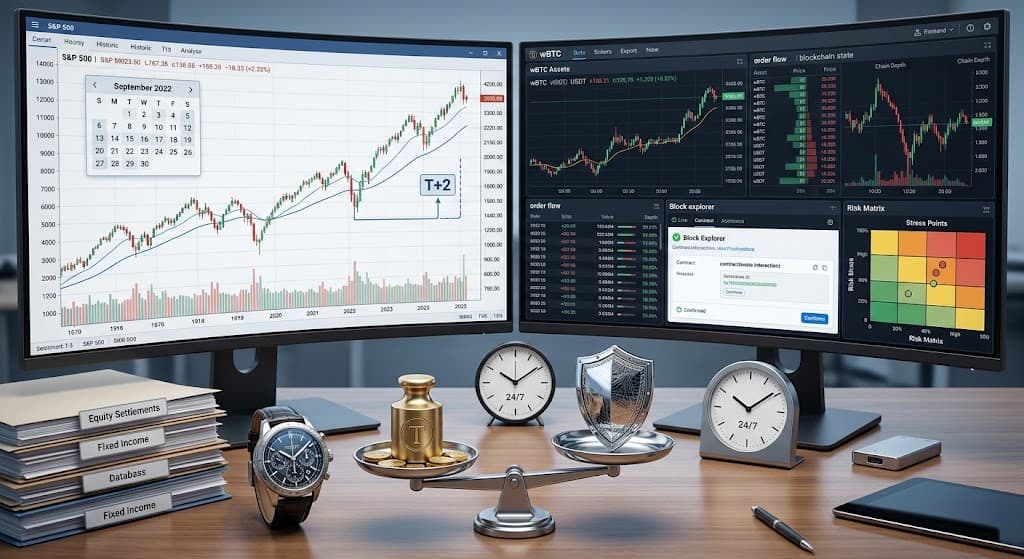
The IMF's analysis of tokenized US equities offers an early indication of how this could play out.
Across five liquid equity-linked tokens traded on 11 venues, more than half of trading activity occurred outside regular US market hours. Around 80% of trades involved less than one share, highlighting the ability of tokenization to support fractional trading and extend market access.
The efficiency comes with a notable difference in market behavior.
Realized volatility for the tokenized equities was roughly 1.5 times that of comparable traditional markets. The IMF attributes part of the difference to thinner liquidity and continuous trading, which captures price movements during nights and weekends that conventional equity markets do not.
The IMF cautions that these markets remain small and developing, meaning the findings should not be treated as evidence that tokenized markets will always be more volatile.
But the comparison illustrates a broader point: putting an asset on a continuously operating digital market does not simply reproduce the characteristics of its traditional counterpart.
It changes when the asset trades, how liquidity behaves and how quickly participants can react to changing prices.
The risks become more significant when tokenization is combined with automated financial processes.
Smart contracts can execute transactions without manual intervention. Oracles can feed external information into blockchain-based applications. Collateral can be reused across transactions, while automated mechanisms can trigger margin calls or liquidations when predefined conditions are met.
These features can make markets more efficient under normal conditions. During stress, however, they can also cause financial adjustments to happen simultaneously or in rapid succession.
The IMF warns that tokenization could therefore change rather than eliminate existing financial risks. Operational and governance failures can become more important as markets depend on code and infrastructure, while automated liquidation and collateral reuse can amplify liquidity, leverage and contagion risks.
That distinction matters for regulators. A financial system does not necessarily become safer simply because fewer intermediaries are involved. Risk can instead migrate toward the infrastructure, platforms and mechanisms that coordinate transactions.
The question of what asset is used to settle tokenized transactions is another part of the IMF's analysis.
The Fund points toward central bank money as the guiding principle for securities settlement, reflecting its role as a risk-free settlement asset. By contrast, using private deposit tokens or stablecoins can introduce additional credit and liquidity risks linked to the issuer, while potentially creating new channels for contagion and concentration.
This makes the growth of tokenized markets partly a question about the architecture of money itself.
If securities, collateral and payments increasingly move on-chain, the settlement asset connecting those markets can become an important source of either stability or systemic exposure.
The IMF has previously highlighted a similar issue, noting that tokenization can deepen the connection between traditional financial markets and crypto markets as more real-world assets move onto blockchain infrastructure.
For now, the IMF does not characterize tokenization as a major systemic threat. The market remains relatively small compared with conventional financial markets, limiting its potential to generate system-wide instability.
That could change as tokenized securities, money-market funds, deposits, repos and other financial instruments become more widely used.
At greater scale, the financial system would have to manage a market infrastructure that operates more continuously, settles more quickly and relies more heavily on programmable processes.
The challenge for regulators will therefore extend beyond creating rules for individual tokenized products. It will involve ensuring that legal frameworks, settlement systems, interoperability standards, operational controls and liquidity safeguards remain capable of containing shocks when transactions can move almost instantly.
Tokenization promises to make financial markets faster and more efficient. The IMF's warning is that speed itself can become a financial-stability variable.
The success of tokenized finance may ultimately depend not on how quickly assets can move, but on whether the infrastructure around them can keep pace when markets move in the wrong direction.

Disclaimer of Warranty
The information provided in this article is for general informational purposes only. We make no warranties about the completeness, reliability, and accuracy of this information. Read full disclaimer

Editor's Picks
In the Same Space

IMF Clears $139 Million Disbursement to El Salvador After Bitcoin Breach

News Desk

Oct 2, 2026

4 min
“One Financial System”: What OKX’s New Investors Are Backing
Walid Abou Zaki
Oct 8, 2026
6 min
Greece Proposes 10% Crypto Gains Tax as Digital Assets Enter Tax Framework
Salma Naueihed
Oct 8, 2026
5 min
Samsung Brings USDC to 82M Galaxy Devices as Stablecoins Move Into Consumer Wallets
News Desk
Oct 8, 2026
5 min