Advertisement
Infrastructure
Share
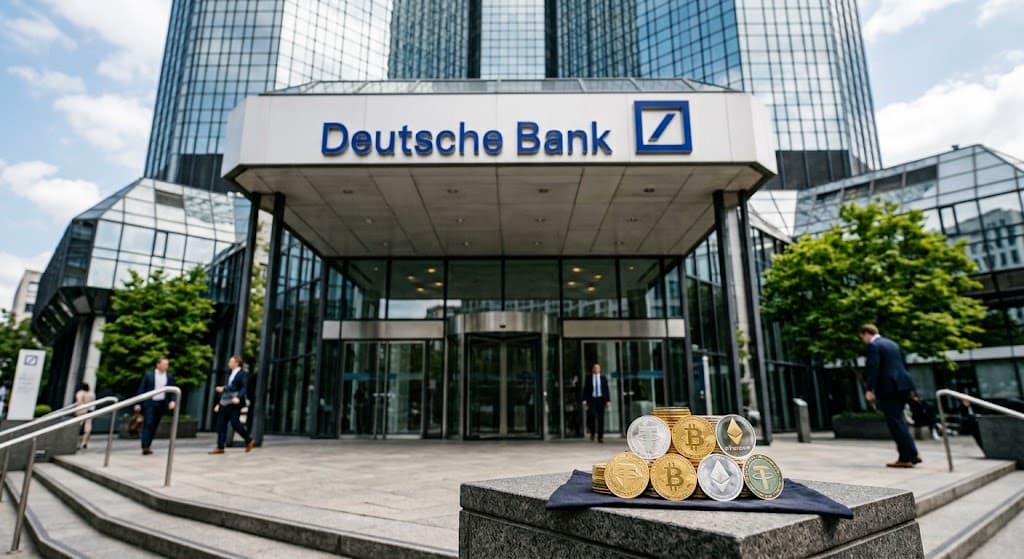
Deutsche Bank has launched its BaFin-approved Digital Asset Custody (DAC) service for European institutional and corporate clients, supporting Bitcoin, Ether, USDC, EURC, and AllUnity's EURAU stablecoin. The live service marks the bank's transition from regulatory preparation to active digital-asset custody operations.
Deutsche Bank has launched its digital-asset custody service for institutional and corporate clients in Europe, bringing its plans to offer regulated cryptocurrency safekeeping into live operations following approval from Germany’s Federal Financial Supervisory Authority (BaFin).
The service, called Digital Asset Custody (DAC), allows eligible clients to hold and transfer selected digital assets through infrastructure managed by the bank. Deutsche Bank oversees clients’ digital wallets and private keys, removing the need for institutions to develop and maintain their own custody systems.
The initial offering supports Bitcoin, Ether and three stablecoins: Circle’s USDC and EURC, alongside AllUnity’s euro-backed EURAU. The service is available to eligible clients of Deutsche Bank’s Corporate Bank and Investment Bank, including companies, asset managers, hedge funds, custodians, brokers and sovereign institutions.
The launch follows the bank’s September announcement that it planned to introduce the service during 2026, subject to regulatory approval. Its activation marks a shift from development and regulatory preparation to live digital-asset custody operations.
The DAC platform is designed to support the safekeeping and transfer of digital assets, with several layers of security and operational controls.
These include hardware-based protection for private keys, separation of responsibilities among personnel, multi-person transaction approvals, and distinct warm and cold storage environments. The bank has also established backup and recovery arrangements intended to protect against unauthorized access, lost keys and technical failures.
At launch, the service focuses on custody and transfers rather than providing a broader cryptocurrency trading platform. Deutsche Bank said the range of supported assets could expand over time, depending on client demand, regulatory requirements and its internal product-approval and risk-management processes.
Tokenized financial instruments are also included in the bank’s longer-term roadmap.
Alongside the custody launch, Deutsche Bank signed a memorandum of understanding with Deutsche Asset Management, its majority-owned asset-management business formerly known as DWS, to explore further cooperation in digital assets.
The proposed collaboration covers tokenized money market funds, crypto-asset exchange-traded commodities (ETCs) and stablecoins. The two businesses will examine potential arrangements involving custody and settlement, liquidity management, treasury operations and product distribution.
The agreement also connects Deutsche Bank’s custody infrastructure with the asset manager’s existing digital-asset activities. Deutsche Asset Management is involved in AllUnity, the stablecoin venture behind EURAU, which is among the assets supported by the new custody service.
The asset manager reported €1.22 trillion in assets under management as of September 30, according to The Block. However, the memorandum outlines areas for exploration rather than confirming the launch of specific joint products.
Deutsche Bank has been developing its digital-asset capabilities for several years. In 2023, it partnered with digital-asset infrastructure provider Taurus to develop custody and tokenization services. The bank’s latest launch builds on that work and its subsequent preparations to serve institutional clients under Europe’s regulatory framework.
The bank has also indicated that it intends to expand its digital-asset activities beyond Europe. In October, Reuters reported that Deutsche Bank was preparing to extend its custody offering to major Asian financial centers in 2027, as part of a broader strategy involving cryptocurrency custody and blockchain-based financial products.
The launch comes as established financial institutions develop infrastructure for holding, transferring and settling digital assets. Rather than replacing conventional banking services, these offerings allow banks to extend existing custody and asset-servicing capabilities to blockchain-based instruments.
For Deutsche Bank, the immediate step is providing eligible European institutions with a regulated channel for holding and transferring selected cryptocurrencies and stablecoins. Its planned work with Deutsche Asset Management points to potential expansion into tokenized investment products and related services, although those initiatives remain at the exploration stage.

Disclaimer of Warranty
The information provided in this article is for general informational purposes only. We make no warranties about the completeness, reliability, and accuracy of this information. Read full disclaimer

Editor's Picks

Binance After the $6.3B Hack: A Turning Point for the Exchange

Walid Abou Zaki

Nov 2, 2026

10 min
“One Financial System”: What OKX’s New Investors Are Backing
Walid Abou Zaki
Oct 8, 2026
6 min

When Assets Move—or Stop—Without Consent: The Limits of Crypto Wallet Control
Walid Abou Zaki
Sep 29, 2026
6 min
Read More Articles

In the Same Space

Ethereum Postpones Glamsterdam Hardfork Over Smart Contract Security Risks
News Desk
Nov 6, 2026
3 min

Is ETH the Next Bitcoin? Vitalik Reopens the Store-of-Value Debate
News Desk
Nov 9, 2026
7 min

$106 Million Mystery Crypto Heist Hits EU Entity Days After Binance Breach
News Desk
Nov 3, 2026
4 min
FAB Activates Digital Asset Financing Framework With Komainu
News Desk
Nov 4, 2026
4 min