Advertisement
Research & Analysis
Share
Binance Research's H1 2026 on-chain markets report shows tokenized RWAs surged 50% to $34 billion, BNB Chain captured nearly one-third of tokenized equities, and Ethereum usage rose while network revenue fell 53% due to lower gas fees.
Binance Research has released its latest "Half-Year 2026: On-Chain Markets" report, providing an overview of key trends shaping the digital asset industry during the first six months of the year.
The report examines developments across blockchain infrastructure, tokenized real-world assets (RWAs), decentralized finance (DeFi), prediction markets, and on-chain security, revealing a market where adoption continued to expand even as growth patterns shifted across different sectors.
According to Binance Research, Ethereum recorded approximately 50% growth in network usage during the first half of 2026. However, despite increased on-chain activity, the report projects that the network's annual revenue could decline by 53%.
Researchers attributed the divergence to Ethereum's higher gas limit, which increased to around 60 million, allowing the network to process more transactions while significantly lowering transaction costs.
Average gas fees reportedly declined by 75% compared with 2025, with lower fees more than offsetting the benefits of higher throughput.
The report suggests this trend highlights a broader challenge for Ethereum, raising questions about whether Layer 1 scaling and lower transaction costs alone are sufficient to sustain long-term revenue growth without stronger demand for blockchain applications.
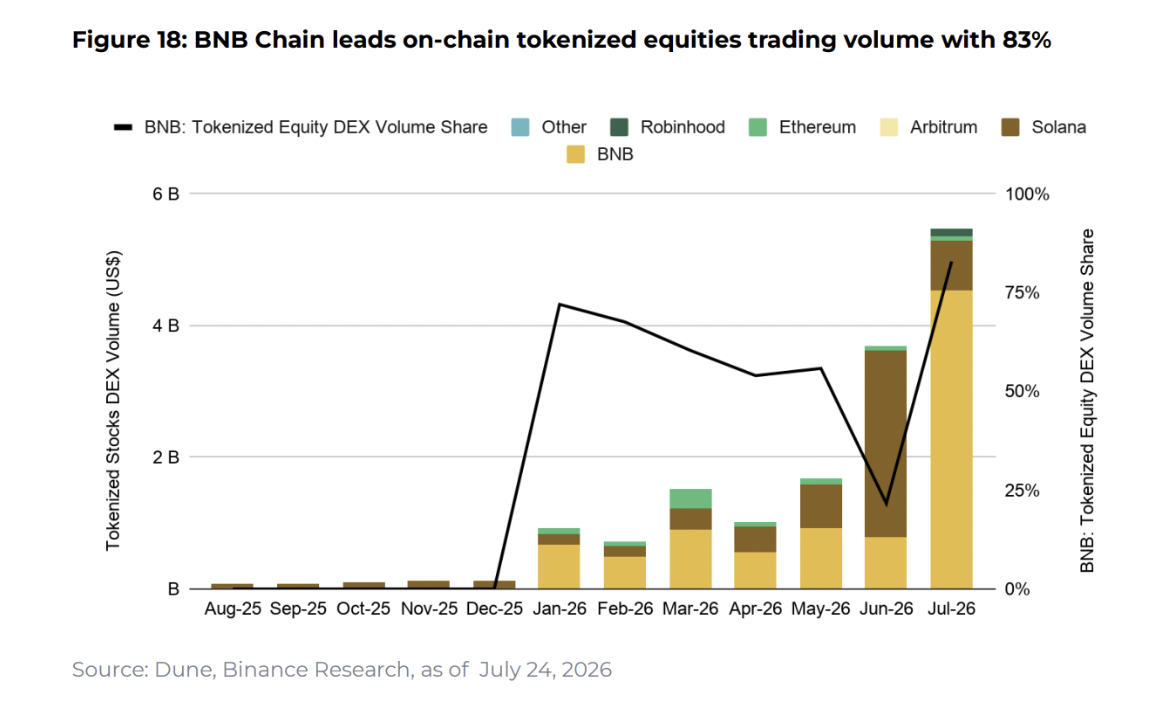
Binance Research also found that BNB Chain emerged as the largest blockchain for tokenized equities during the first half of the year.
The value of tokenized equities issued on BNB Chain increased from approximately $34 million at the beginning of 2026 to $652 million by July, surpassing Ethereum and accounting for nearly one-third of the on-chain tokenized equities market.
Monthly trading volume for tokenized stocks exceeded $4.5 billion in July, representing roughly 83% of the sector's total trading activity.
At the same time, BNB Chain's tokenized real-world asset market capitalization grew 107%, increasing its share of the overall on-chain RWA market from 9.8% to 13.5%.
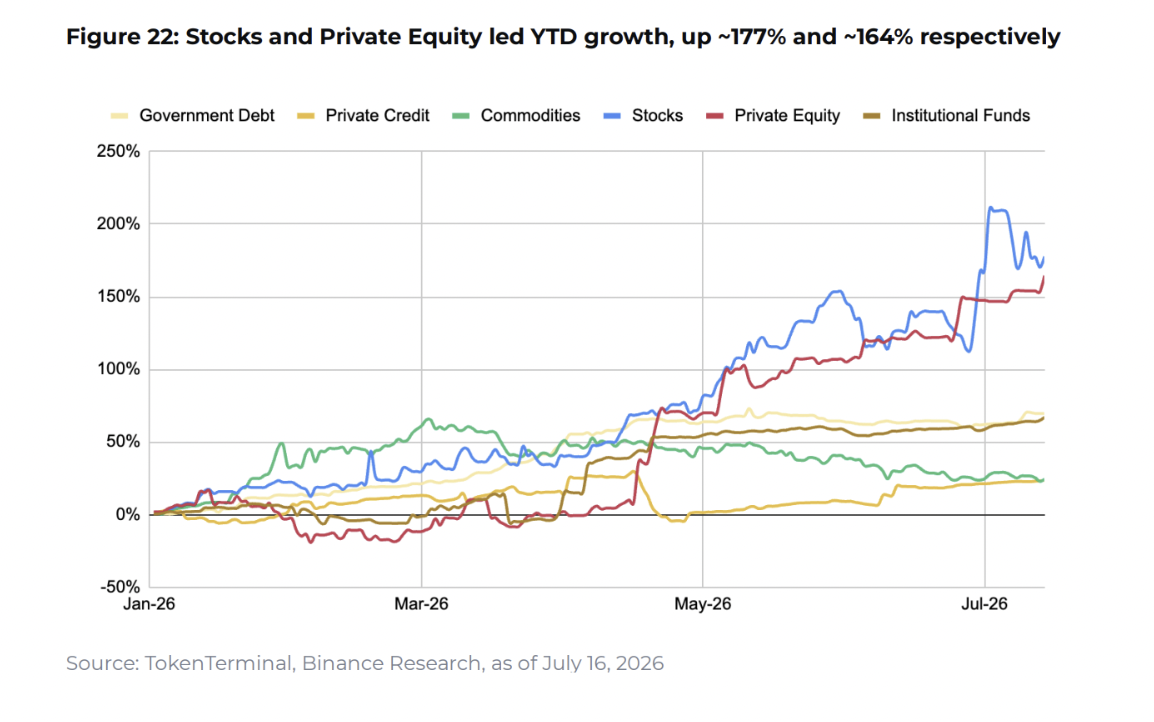
The report highlights continued momentum in the tokenization sector, with the total value of on-chain real-world assets rising from approximately $22 billion in January to around $34 billion by mid-July, representing growth of more than 50%.
Among the fastest-growing categories were tokenized stocks and private equity, which expanded 177% and 164%, respectively, since the beginning of the year.
Binance Research attributed the growth to improving regulatory clarity and increasing availability of tokenized investment products, including bStocks, xStocks, and Ondo Global Markets.
Looking ahead, the research team projects the tokenized RWA market could reach approximately $661 billion under its base-case scenario and as much as $1.6 trillion in a bullish outlook.
Prediction markets also experienced significant growth during the first half of the year.
According to the report, monthly trading volume climbed from $27.7 billion in January to $51.6 billion in June, representing an 86% increase.
Researchers linked much of the growth to trading activity surrounding the FIFA World Cup, although non-sports prediction markets also expanded considerably.
Trading outside sports-related events increased 136% year-to-date, suggesting broader adoption beyond major sporting events.
The report found that Kalshi and Polymarket together accounted for approximately 92% of total prediction market trading volume in June.
Binance Research also observed an unusual trend in blockchain security.
While the number of reported hacks and exploits increased from 83 to 207 during the first half of 2026, total financial losses declined sharply from approximately $2.3 billion to $972 million.
According to the report, the figures indicate that although attacks have become more frequent, their financial impact has become increasingly concentrated.
Nearly 60% of all losses stemmed from two major operational failures involving Drift and KelpDAO, illustrating how a small number of infrastructure-related incidents accounted for a disproportionate share of total losses.
Looking beyond the first half of the year, Binance Research believes the next phase of on-chain market development will depend on whether secondary market liquidity evolves alongside token issuance.
"The next phase will depend on whether secondary liquidity and collateral mobility develop as quickly as primary issuance," the report stated.
The findings suggest that while blockchain adoption continues to accelerate across tokenization, decentralized finance, and prediction markets, future growth may increasingly depend on improving market infrastructure rather than simply expanding the number of on-chain assets.

Disclaimer of Warranty
The information provided in this article is for general informational purposes only. We make no warranties about the completeness, reliability, and accuracy of this information. Read full disclaimer

Editor's Picks

As U.S. Crypto Legislation Stalls, Circle Launches Its Own Financial Network

Walid Abou Zaki

Sep 16, 2026

9 min

Stablecoin Yield Fight Helps Derail CLARITY Act in Senate
Walid Abou Zaki
Sep 15, 2026
8 min

Why Zondacrypto’s Collapse Would Unfold Differently in the UAE
Walid Abou Zaki
Aug 28, 2026
8 min
Read More Articles

In the Same Space

Bitcoin Takes Hit as Iran Rising Tensions Send Oil Above $100
News Desk
Sep 14, 2026
6 min

MENA Crypto Transaction Volume Reaches $350 Billion as Saudi Arabia Leads Growth
News Desk
Sep 7, 2026
6 min

ESMA Targets Prediction Markets: Polymarket and Kalshi Face EU Scrutiny Over Authorization
News Desk
Sep 11, 2026
4 min

UK Pledges $676M and 500 Officers in Money Laundering Crackdown
News Desk
Sep 16, 2026
3 min