Advertisement
Research & Analysis
Share
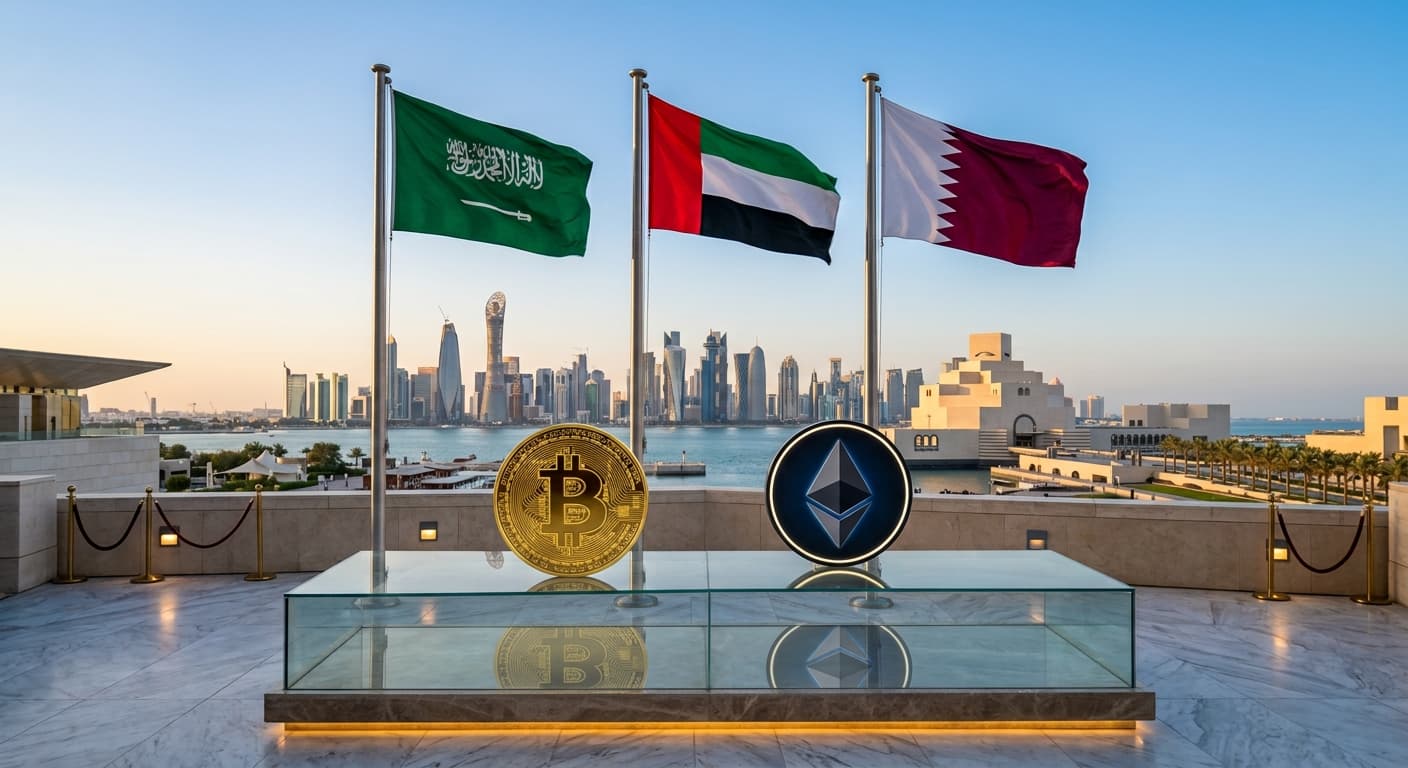
MENA's crypto transaction volume reached $338.7 billion between July 2023 and June 2024 about 7.5% of global crypto flows, with Saudi Arabia posting the region's fastest growth at 154% year-on-year, driven by institutional activity and demographic tailwinds.
The Middle East and North Africa’s digital-asset market is expanding rapidly, with annual transaction volumes approaching $350 billion, up sharply from roughly $100 billion in 2022.
The growth reflects more than rising trading activity. Institutional participation, the wider use of stablecoins, expanding regulatory frameworks and growing investment in fintech, blockchain and digital payments are reshaping the region’s role in the global digital-asset economy.
The latest estimate, cited by the Bitcoin Policy Institute, points to a region becoming increasingly connected to global crypto flows and investment. But the expansion is not following a single path.
Economic pressures are helping drive digital-asset adoption in some countries, while Gulf states are increasingly focused on building regulated markets and attracting institutional capital, technology companies and blockchain businesses.
The result is a regional market that is growing quickly, but for very different reasons.
Saudi Arabia stands out not for the largest transaction volume, but for the pace at which its crypto economy has expanded.
Chainalysis data covering July 2023 to June 2024 showed that cryptocurrency activity in Saudi Arabia grew 154% year on year, the fastest rate recorded in the region. Qatar followed with growth of 120%.
Turkey, meanwhile, remains the region’s largest crypto economy by transaction value, with more recent estimates putting its annual activity at close to $200 billion.
The contrast highlights the different forces shaping adoption across MENA. Turkey’s market has developed partly against a backdrop of economic and monetary pressures, while Saudi Arabia is seeing stronger momentum from institutional activity, technology investment and a young population.
The region’s crypto market also looks markedly different from a retail-driven trading ecosystem.
Chainalysis found that 93% of transaction value recorded between 2023 and 2024 involved transfers of at least $10,000, pointing to substantial participation from businesses and larger investors.
Saudi Arabia’s growth has accelerated despite the absence of a comprehensive digital-asset regulatory framework comparable to those developed in some neighboring Gulf markets.
Demographics also provide a potential tailwind. Around 63% of Saudi citizens are under the age of 30, while government investment in fintech, gaming, blockchain and digital payments is helping expand the country’s broader technology ecosystem.
That combination gives Saudi Arabia a potentially significant role in the region’s next phase of digital-asset growth, even as questions around the regulatory treatment of crypto remain.
The UAE has taken a different route, putting specialized regulatory structures at the center of its digital-asset strategy.
Dubai and Abu Dhabi have developed dedicated frameworks for virtual assets, helping attract exchanges, market makers, fintech companies and global digital-asset firms while providing a regulated environment for experimentation with blockchain and Web3 technologies.
Two institutions are particularly important to that architecture: Dubai’s Virtual Assets Regulatory Authority (VARA) and Abu Dhabi Global Market (ADGM).
The approach has helped position the UAE as one of the region’s more developed digital-asset jurisdictions, combining regulation with investment and technology development.
Chainalysis recorded more than $30 billion in crypto inflows to the UAE during the period under review, making it the region’s third-largest crypto economy.
Decentralized finance activity also expanded, rising 74% year on year, while decentralized exchange activity increased 87% to approximately $11.3 billion.
The numbers suggest that the UAE’s role is extending beyond cryptocurrency trading toward a broader digital-asset ecosystem.
The headline figure of roughly $350 billion can obscure how different the region’s individual markets actually are.
Turkey’s large transaction base is shaped partly by its economic environment. Gulf markets, meanwhile, are increasingly combining institutional investment with fintech development, regulatory experimentation and efforts to attract global digital-asset companies.
Regulatory approaches also vary significantly.
The UAE has established some of the region’s most developed licensing and supervisory structures for virtual assets. Qatar has introduced a digital-asset framework through the Qatar Financial Centre, while Saudi Arabia has continued to support blockchain and fintech initiatives without adopting a comparable comprehensive framework for cryptocurrency trading platforms.
That divergence is becoming one of the defining characteristics of the regional market.
Rather than converging around a single model, MENA’s digital-asset economy is developing along several parallel tracks.
Available transaction data reinforces the scale of the expansion.
Between July 2023 and June 2024, cryptocurrency transaction value across the Middle East and North Africa reached $338.7 billion, equivalent to approximately 7.5% of global crypto transaction volume.
The figure is broadly consistent with the more recent estimate of around $350 billion, although the two numbers should not be treated as identical. Differences in measurement periods and methodologies can account for the gap.
The same caution applies to Saudi Arabia’s 154% growth figure. That percentage relates specifically to Chainalysis’ July 2023-June 2024 measurement period and should not be presented as a 2026 growth rate.
Still, the broader direction is clear: digital-asset activity has become significant enough in MENA to represent a meaningful share of global crypto flows.
The conflict involving Iran has also highlighted another dimension of digital-asset use in the region: resilience during periods of geopolitical and economic disruption.
Crypto and stablecoins can serve different functions in economies facing financial restrictions, currency volatility or limited access to international financial infrastructure. In those environments, digital assets can be used for value preservation, transfers and access to global financial networks.
That dynamic differs from the model emerging in the Gulf.
Countries such as the UAE are increasingly focused on building regulated digital-asset markets, attracting institutional investors and global crypto companies, and expanding blockchain and Web3 applications across financial and commercial sectors.
These two trends can coexist.
In one part of the region, digital assets can function as a practical financial tool in response to economic constraints. In another, they are being developed as part of a regulated technology and investment ecosystem.
That makes MENA’s digital-asset story less about a single regional crypto model and more about multiple forms of adoption developing at the same time.
The numbers ultimately point to a region whose importance in the global digital-asset economy is growing, but whose markets are being driven by very different forces.
Turkey leads in overall transaction value. Saudi Arabia and Qatar have posted some of the region’s fastest growth rates. The UAE is building a more institutionalized and regulated ecosystem around digital assets.
Meanwhile, stablecoins, institutional participation, fintech investment and blockchain development are pushing crypto beyond its traditional identity as a trading market.
The more important shift may therefore be structural.
Digital assets are increasingly becoming part of the region’s financial, technological and economic infrastructure, whether through regulated institutional markets in the Gulf or direct financial use in economies facing greater monetary and financial constraints.
For MENA, the crypto story is no longer simply about how much is being traded. It is increasingly about what digital assets are becoming part of the region’s economy.

Disclaimer of Warranty
The information provided in this article is for general informational purposes only. We make no warranties about the completeness, reliability, and accuracy of this information. Read full disclaimer

Editor's Picks
In the Same Space

Crypto Ads in the UAE Face New Google Rules Starting October 21

News Desk

Oct 20, 2026

4 min
Kraken Wins Final VARA Approval to Launch UAE Crypto Services
News Desk
Oct 12, 2026
4 min

OKX UAE Adds Tokenized U.S. Stocks to Its VARA-Regulated Platform
Anna K.
Oct 12, 2026
4 min
Standard Chartered Extends Crypto Trading to UAE Wealth Clients
News Desk
Oct 14, 2026
3 min