Advertisement
Stablecoins & Payments
Share
Standard Chartered, OCBC, and StraitsX completed a proof of concept under MAS's BLOOM initiative, testing interoperability between their separate tokenized deposit networks to enable cross-bank US dollar payments outside conventional banking hours.
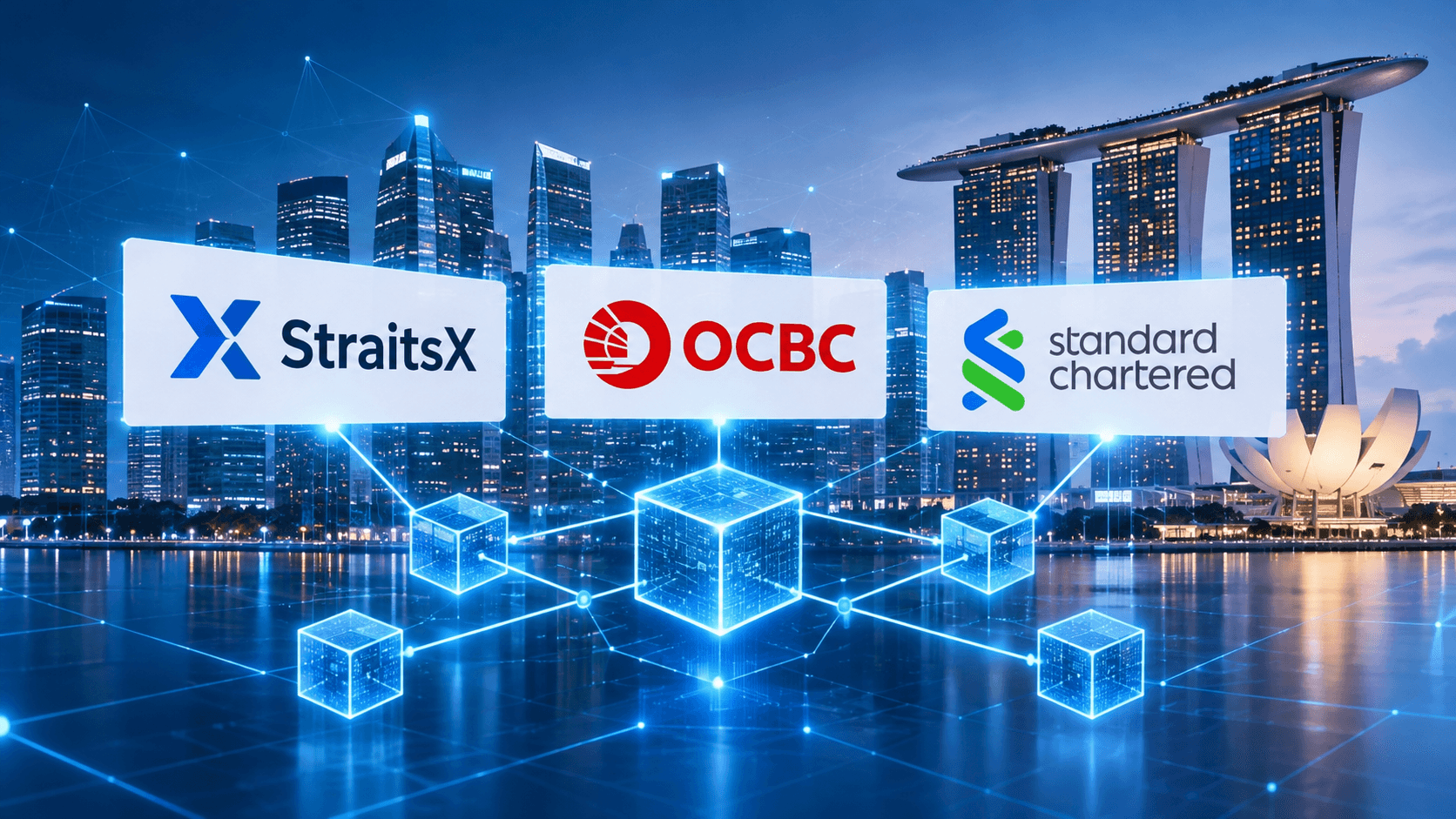
Standard Chartered, OCBC and Singapore-based payments infrastructure provider StraitsX have completed a proof of concept testing how tokenized deposits issued by different banks can be used for payments between financial institutions.
Conducted under the Monetary Authority of Singapore's (MAS) BLOOM initiative, the experiment connected the banks' separate tokenized deposit ecosystems through StraitsX's shared settlement infrastructure, addressing a key challenge in institutional blockchain adoption: interoperability between independently operated financial networks.
The participants successfully tested US dollar payment flows outside conventional banking cut-off hours, demonstrating how shared infrastructure could enable near-real-time settlement between banks while reducing the need for bilateral prefunding arrangements.
The development follows a broader push among financial institutions to connect tokenized money networks and extend blockchain-based settlement beyond individual banking ecosystems. Earlier this week, DBS and J.P. Morgan's Kinexys launched a commercially operational solution enabling institutional clients to transfer US dollars between their tokenized deposit accounts in Singapore and the United States around the clock.
The proof of concept involved three participants with distinct roles. Standard Chartered and OCBC provided their respective tokenized deposit environments, while StraitsX coordinated payments between them through its settlement infrastructure.
The system handled several stages of the payment process, including payment initiation, compliance screening, liquidity checks, settlement and confirmation.
The challenge stems from the structure of tokenized deposits. Unlike freely transferable digital assets, these tokens represent claims against the commercial banks that issue them. As banks develop separate blockchain-based deposit systems using different platforms and standards, transferring value between those environments requires additional infrastructure and settlement arrangements.
StraitsX's shared model was designed to bridge these systems, allowing payment instructions and settlement information to move between the participating banks after the required compliance and liquidity checks.
The participants also found that the approach could reduce the need for bilateral prefunding, under which banks maintain funds with one another in advance to facilitate transactions.
The controlled tests successfully completed US dollar payment flows outside traditional banking hours, with the model demonstrating the potential for settlement within minutes.
However, the initiative remains at the proof-of-concept stage. Any commercial implementation would require further regulatory engagement, participant approvals and assessments covering settlement finality, liquidity management, legal responsibilities and financial-crime controls.
The experiment adds to a series of institutional initiatives exploring how banks can connect their tokenized deposit systems rather than operating isolated blockchain networks.
On November 16, DBS and Kinexys by J.P. Morgan launched a commercially operational interoperability solution allowing institutional clients to transfer US dollars between tokenized deposit accounts in Singapore and the United States. Ant International became the first client to use the service for treasury and liquidity management.
The launch marked a transition from experimentation to commercial deployment, demonstrating that interoperability between different banking networks can support operational cross-border payments.
The development also builds on earlier experiments involving traditional financial infrastructure. In September, Citi and DBS completed a weekend cross-border tokenized deposit transfer through Swift's blockchain-based Digital Ledger, settling the transaction between Singapore and the United States within minutes.
These initiatives reflect a broader shift in institutional blockchain adoption. Banks are increasingly focusing on connecting existing financial systems and enabling different forms of digital money to operate across networks, rather than developing isolated tokenization projects.
The Standard Chartered, OCBC and StraitsX experiment forms part of BLOOM, which stands for Borderless, Liquid, Open, Online and Multi-currency.
Led by the Monetary Authority of Singapore, the initiative brings together financial institutions, payment networks, technology providers and policymakers to develop infrastructure for domestic and cross-border payments involving tokenized commercial bank money and regulated stablecoins.
Its work focuses on improving interoperability, coordinating settlement arrangements and establishing common approaches that reduce the need for financial institutions to negotiate separate arrangements with every counterparty or market.
The initiative expanded its policymaking participation in October, when Bank Negara Malaysia and the Bank of Thailand joined MAS, bringing additional Southeast Asian central banks into the collaboration.
BLOOM's broader objective is to support the use of different forms of digital money across institutions and jurisdictions while addressing regulatory expectations, settlement requirements and operational risks.
The experiment highlights an important consideration for banks exploring tokenized deposits: the technology's potential depends not only on the ability to issue digital representations of commercial bank money, but also on whether those representations can work across different financial networks.
For corporate treasurers and financial institutions, interoperability could improve access to liquidity across markets, reduce reliance on conventional banking cut-off times and support more continuous cross-border settlement.
This is particularly relevant to international financial centres such as the UAE, where banks serve multinational businesses and manage liquidity across multiple currencies and jurisdictions.
As financial institutions in the Middle East explore tokenized assets, stablecoins and blockchain-based payment infrastructure, the Singapore experiment offers an example of how shared settlement systems could connect separate banking environments without requiring institutions to abandon their existing banking relationships.
The distinction between tokenized deposits and stablecoins will also remain important. Tokenized deposits represent claims against issuing commercial banks, while stablecoins are issued under separate arrangements and operate within their own regulatory and contractual frameworks.
The growing number of institutional experiments suggests that the next stage of financial tokenization will depend increasingly on connecting these different forms of money and the networks supporting them.
For banks, the challenge is moving beyond isolated tokenized products towards infrastructure that allows digital money to move between institutions, markets and jurisdictions while preserving the compliance and settlement safeguards underpinning traditional finance.

Disclaimer of Warranty
The information provided in this article is for general informational purposes only. We make no warranties about the completeness, reliability, and accuracy of this information. Read full disclaimer

Editor's Picks
In the Same Space
The World Bank Is Exploring USDC for Global Development Fund Transfers

News Desk

Nov 18, 2026

4 min

Monad Joins Visa's Push to Make Stablecoin Settlement Multi-Chain
News Desk
Nov 11, 2026
5 min
Toss Brings Crypto to 30 Million Users as Its Bank Tests Stablecoin Transfers
News Desk
Nov 16, 2026
4 min

Visa Expands Stablecoin Payments With Western Union’s USDPT Integration
News Desk
Nov 13, 2026
5 min