Bitcoin at the Fault Lines of Power: Iran, Venezuela, and the New Financial Order

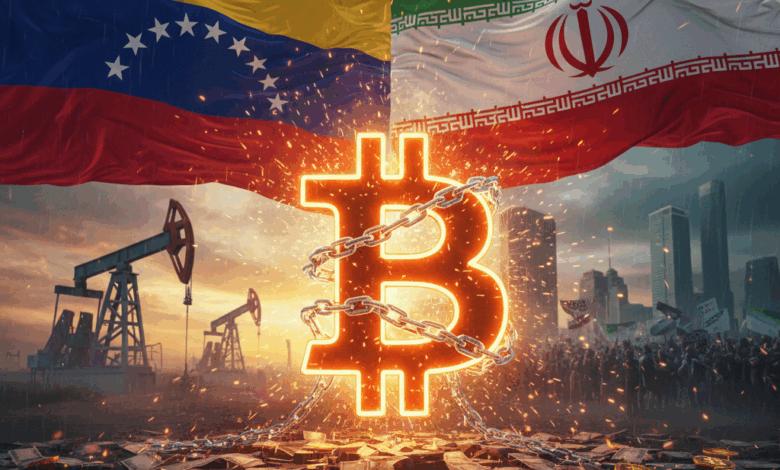
As 2025 drew to a close and 2026 began, Iran and Venezuela have re-emerged at the center of global geopolitical attention.
Both countries are pivotal players in the global energy system, and both are navigating profound political and economic pressure. Yet their relevance today extends far beyond oil. Increasingly, they are becoming real-world test cases for how states and populations respond to financial isolation by turning to digital assets.
What links Iran and Venezuela is not only their status as major energy producers under sanctions, but their growing role as laboratories for financial adaptation. In both cases, cryptocurrencies are no longer a fringe phenomenon or a speculative curiosity. They are evolving into tools of political and financial hedging, used by individuals, institutions, and potentially states themselves to navigate a fractured global financial order.
Maduro’s Fall and the Market Shockwave
The arrest of Nicolás Maduro was not merely a domestic political event; it sent an immediate shock through global financial markets. Venezuela, home to the world’s largest proven oil reserves, suddenly found itself under renewed scrutiny as Washington and international actors began contemplating a broader restructuring of its energy and financial systems.
In oil markets, the reaction was swift and volatile. Initial fears of export disruptions and infrastructure instability added a short-term risk premium, pushing prices up by roughly three dollars per barrel. Over the medium term, however, markets began pricing in a different scenario: a potential surge in Venezuelan oil supply under a new political framework. That prospect has raised expectations of downward pressure on crude prices, with some forecasts pointing toward levels below $50 per barrel.
This possible collapse in traditional energy prices introduces a complex dynamic for digital assets. Lower energy costs could improve Bitcoin mining margins, while geopolitical instability reinforces crypto’s role as a hedge.
Notably, Bitcoin demonstrated remarkable resilience following the news, holding above the $90,000 level despite widespread uncertainty. This stability signals a maturing market, one that increasingly behaves less like a high-risk speculative asset and more like a sovereign-grade digital hedge.
Fueling this narrative are persistent reports that Venezuela’s former regime may have accumulated substantial “shadow reserves” of Bitcoin, potentially exceeding 600,000 BTC. The fate of these holdings remains unclear. Would they be subject to international seizure? Frozen indefinitely? Or gradually absorbed into global liquidity? Even the uncertainty itself has become a market factor.
Meanwhile, the traditional race to safety intensified. Gold surged to record highs above $4,400 per ounce, reaffirming its role as the default refuge for states. Bitcoin, however, has emerged as a parallel option, particularly for individuals and institutions seeking to bypass energy-linked sanctions and financial chokepoints. In Latin America, where currency instability and institutional fragility are persistent concerns, crypto is increasingly viewed as a geopolitical hedge rather than a speculative trade.
Venezuela’s Bitcoin Paradox
Venezuela occupies a unique position in the global crypto landscape. For years, the country quietly leveraged Bitcoin to bypass U.S. financial sanctions and facilitate certain international transactions. According to PANews, Venezuela officially holds at least 240 BTC as of December 2022, valued at approximately $22 million.
Yet official policy has been inconsistent. In May 2024, authorities banned Bitcoin mining, citing pressure on the national power grid. Earlier that year, the state-backed digital currency, the Petro, was quietly discontinued, reflecting a broader failure of centralized digital currency experiments.
Politically, the debate over crypto remains unresolved. In September 2024, opposition leader María Corina Machado publicly floated the idea of incorporating Bitcoin into national reserves, an indication of deep internal divisions over how digital assets might factor into Venezuela’s economic reconstruction.
Beyond official disclosures, unconfirmed reports circulating since 2018 suggest Venezuela may have converted portions of its gold reserves into Bitcoin and settled oil transactions using stablecoins such as USDT. These reports, which were never formally verified, claim holdings could reach as high as 600,000 BTC, potentially worth between $56 and $67 billion at current prices. Some narratives allege that nearly $2 billion in gold was exchanged for Bitcoin during periods when prices were significantly lower.
Whether accurate or not, these figures have unsettled markets. From a risk perspective, any future move by U.S. authorities to seize or freeze digital assets linked to the former regime could temporarily constrain supply and drive short-term volatility. Large-scale liquidation, however, remains unlikely due to the sheer size of the holdings and the technical challenges of tracing and unwinding them.
Iran: Protests, Sanctions, and Digital Adaptation
Iran, meanwhile, is facing its own convergence of internal unrest and external pressure.
Worsening economic conditions, persistent sanctions, and rising social tensions have accelerated the decline of the Iranian rial, pushing citizens and businesses to seek alternatives beyond the traditional financial system.
Foreign media reports indicate that Tehran has signaled willingness to accept cryptocurrencies in certain arms and defense-related export transactions, which is a major move that would mark one of the first explicit uses of crypto in official state-level trade.
The decision reflects a strategic shift: reducing reliance on the global banking system and embracing decentralized assets that are harder to block or monitor.
From a market standpoint, crypto adoption in Iran is not merely grassroots. It is increasingly institutional and strategic. Bitcoin and stablecoins have become tools for preserving value, managing inflation risk, and bypassing the friction of sanction-restricted banking channels.
If sustained, Iran’s approach could serve as a model for other sanctioned or economically constrained states, positioning the country as a testing ground for how digital assets integrate into real-economy trade under pressure.
Gold and Bitcoin: A New Dual Hedge
Together, Iran and Venezuela illustrate a broader transformation underway in global finance. In moments of geopolitical stress, markets are no longer choosing between gold and Bitcoin, they are embracing both.
Gold remains the physical hedge against fiat collapse. Bitcoin is emerging as the technological hedge against sanctions, asset freezes, and cross-border financial control. While gold is difficult to transport or liquidate under military or political blockades, digital assets offer speed, portability, and decentralized liquidity.
The Venezuelan case epitomizes this shift. Where states once relied exclusively on gold bars in vaults, the idea of sovereign digital reserves, potentially amounting to hundreds of thousands of Bitcoin, now carries real strategic weight. This evolution suggests that digital assets are becoming embedded in national financial security frameworks.
At the same time, Bitcoin’s gradual decoupling from traditional equity markets during geopolitical flashpoints reinforces its status as “digital gold,” with an added layer of tactical flexibility.
A Financial Order Being Rewritten
Looking ahead, unresolved questions loom large. If reports of massive state-linked Bitcoin holdings are confirmed, could we see renewed calls to blacklist or restrict certain coins based on origin? Some licensed exchanges already apply heightened scrutiny, or outright refusal, to Bitcoin linked to jurisdictions such as North Korea or China.
What is clear is that developments in Iran and Venezuela during 2025–2026 are no longer isolated political crises. They represent a turning point in the evolution of the global financial system. Power is no longer defined solely by control over oil fields or shipping lanes, but by access to cryptographic keys, decentralized networks, and digital liquidity.
This is not merely the digitization of money, it is the redefinition of financial sovereignty itself.