Regulation & Policy
Share
The Central Bank of Iran is preparing to launch its digital currency, the Digital Rial, as part of a broader initiative to modernize the country’s banking system and strengthen international financial cooperation. Mohammad Reza Farzin, Governor of the Central Bank of Iran, revealed these plans during the 11th Annual Conference on Modern Banking and Payment Systems, as reported by Tasnim News Agency.
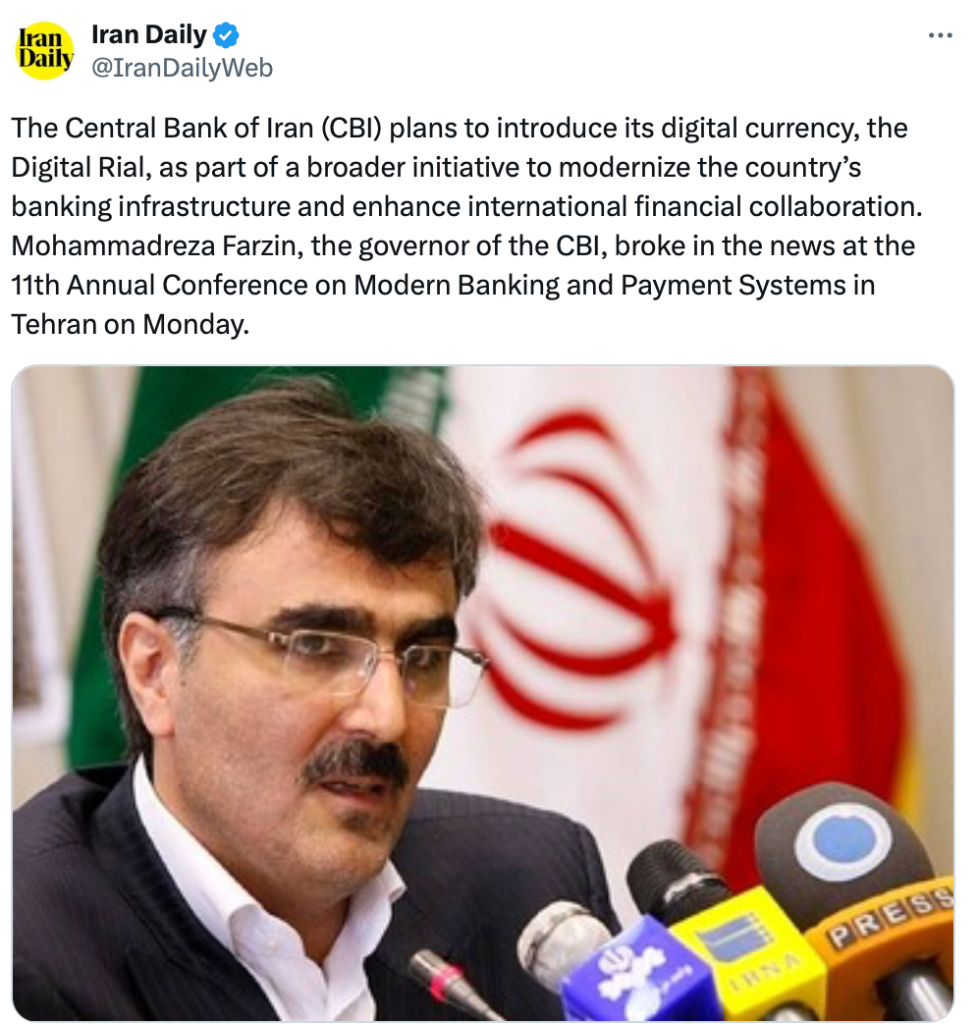
Farzin described the conference as a key opportunity to evaluate policies and define the future direction of Iran’s banking system. “As the Governor, this platform allows me to evaluate strategies and set the course ahead. We will incorporate the insights shared here into our policymaking,” he said.
Farzin highlighted the strengths and challenges of Iran's banking system, noting its strong digital infrastructure. “Iran's Shetab payment network, with transactions processed in under two seconds, is among the most efficient in the region,” he emphasized.
Farzin confirmed that the Digital Rial would soon be operational and underscored the Central Bank's commitment to modernizing banking. “Developing innovative banking systems is a central bank's responsibility worldwide, and we are determined to fulfill this duty in Iran,” he added.

Disclaimer of Warranty
The information provided in this article is for general informational purposes only. We make no warranties about the completeness, reliability, and accuracy of this information. Read full disclaimer
Addressing international banking challenges, Farzin acknowledged the impact of sanctions but also highlighted Iran's progress with alternative financial solutions. “Sanctions remain a significant hurdle, but we've made notable strides in recent years,” he said, referencing the introduction of the "ACU-MIR" system.
The ACU-MIR platform, designed for Asian financial cooperation, acts as an alternative to SWIFT, enabling transactions with countries like India and Pakistan. Farzin pointed out that the system became fully operational on October 2 and has enhanced Iran’s ability to navigate sanctions effectively.
“We've replaced SWIFT with this platform and strengthened our ties with BRICS, which is shaping global trade with a strategic plan through 2025,” Farzin noted. He explained that the BRICS plan focuses on expanding the use of local currencies, providing Iran with opportunities to integrate into the system. “China and Russia are already advancing in this direction, and we aim to settle transactions using BRICS currencies,” he said. Additionally, he mentioned a cross-border settlement platform in its early stages, which could further facilitate international financial transactions.
Regarding regional connectivity, Farzin shared updates on linking Iran's Shetab payment network with Russia's MIR system. “Recently, Shetab connected with Russia's MIR, and several banks are now operational on the system,” he stated. Although the rollout is still in its early stages, Farzin expressed optimism about its expansion.
Looking ahead, Farzin announced plans to allow Russian tourists to use Iran’s point-of-sale systems this winter and enable Iranian tourists to access Russian POS services by early 2025.



Editor's Picks
UAE Stablecoins: Why They Are Built to Travel, Not Stay Local

Walid Abou Zaki

Feb 28, 2026

8 min
The Central Bank of the UAE Clearing the Noise Around Article 62
Walid Abou Zaki
Feb 25, 2026
5 min

Europe’s Crypto Purge: Did Lithuania Just Kick Out Innovation — and is the UAE the Beneficiary?
Salma Naueihed
Feb 18, 2026
7 min
Read More Articles

In the Same Space

Binance Sues Wall Street Journal Over Iran-Related Investigation Report
News Desk
Mar 12, 2026
2 min

Iran Conflict Unlikely to Dent Bitcoin Mining Hashrate, Analysts Say
News Desk
Mar 3, 2026
3 min

Bitcoin Falls Toward 65,000 Dollars Amid Middle East Tension
News Desk
Mar 2, 2026
3 min

Kazakhstan Pushes Forward Crypto Industry Growth with Presidential Directive
Chantal Assi
Mar 13, 2026
3 min