Advertisement
Regulation & Policy
Share
During the Annual Congress of Forex club in Tunisia the Tunisian Central bank announced the testing of a blockchain enabled digital currency in collaboration with Universa Blockchain from Russia. The currency will be under test for several months before officially being launched.
The annual congress discussed “Central Bank Digital Currency (CBDC) and opportunities for financial integration in Maghreb “and brought together international and national experts from the digital world. Namely, Hervé Tourpe, Chief Digital Advisor of the International Monetary Fund (IMF), Néji Ghandri, Member of the Executive Board of Amen Bank, Elyès Berrayana, Omar Bouattay, Head of Universal Hub AFRICA and Antonios Koumbarakis, PwC, Legal FS Regulatory and Compliance Services.
According to Alexandre Borodich, Chief Executive Officer of Universa, “Electronic banknotes cannot be counterfeited – each such banknote, like the paper version, is protected by cryptography, it, like the paper counterpart, has its own digital watermarks. And the production of such a banknote is 100 times cheaper than wasting ink, paper, electricity for the printing press, “ He added, “Tunisia will not issue additional paper money to issue electronic money. Instead, part of the country’s paper money will go into the pledge of electronic money. With the launch of the program, individuals can also switch to the E-dinar.”
Each CBDC digital note is a digital equivalent of an actual paper note with its face value and serial number, which exists in digital form and is protected from forgery by Universa Blockchain technologies. Mr. Marouane Abassi, Head of Central Bank Tunisia showed a symbolic operation to transfer one dinar from one account to another using the new system. The implementation will be in testing mode for the next several months after which it will go into public use.
Tunisia’s digital money is not a cryptocurrency, but a CBDC (Central Bank Digital Currency), said Alexander Borodich, founder of the Russian blockchain platform Universa, on the basis of which new payment methods can be issued. The new virtual currency is secured by real banknotes.
Two thousand kiosks will appear in Tunisia, where citizens can replenish their digital wallet. At the initial stage, they will pay via the browser on the smartphone, and later a mobile application will be available. You will be able to send digital money or make a purchase by scanning a QR code.
The Central Bank of Tunisia later published a clarification on the news about the launch of its digital currency. The clarification reads as follows, "Following rumours about the Central Bank of Tunisia (BCT)’s adoption of a digital currency solution and its commitment with a foreign company for the establishment of this solution, the BCT denies all of these groundless allegations and information. To this effect, it clarifies the mentioned ambiguities and specifies what follows:

Disclaimer of Warranty
The information provided in this article is for general informational purposes only. We make no warranties about the completeness, reliability, and accuracy of this information. Read full disclaimer

Editor's Picks

Stablecoin Yield Fight Helps Derail CLARITY Act in Senate

Walid Abou Zaki

Sep 15, 2026

8 min
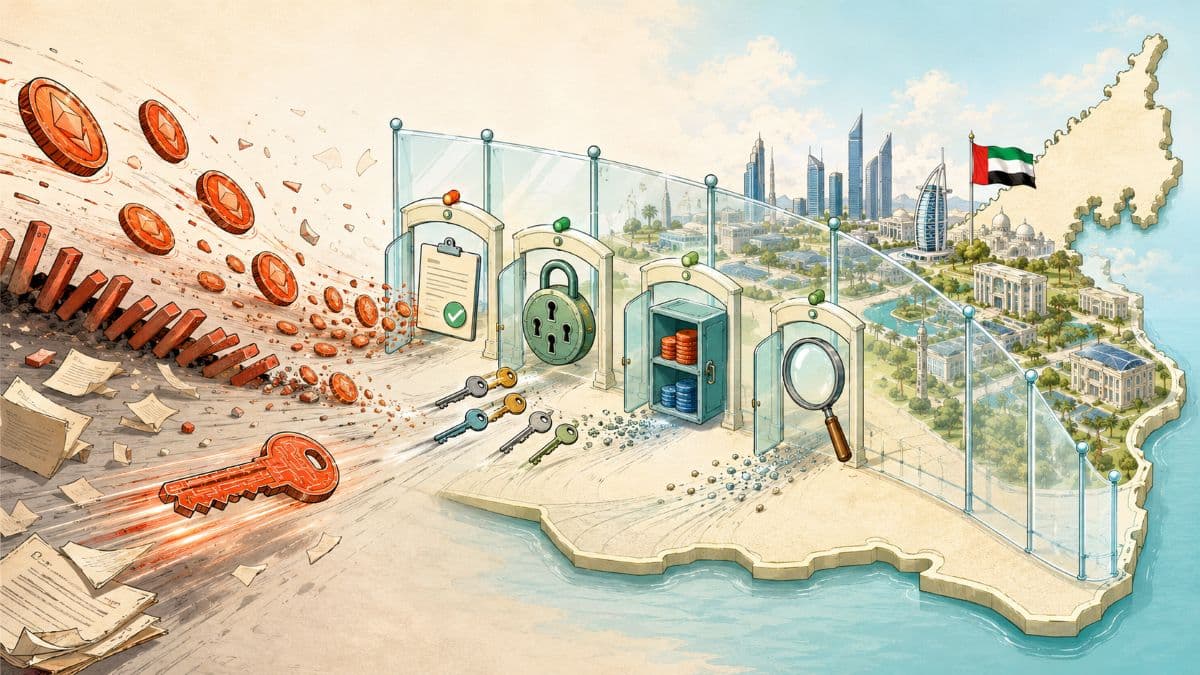
Why Zondacrypto’s Collapse Would Unfold Differently in the UAE
Walid Abou Zaki
Aug 28, 2026
8 min

The Missing Orchestration Layer Holding Back Institutional Digital Assets
Julian Sawyer
Aug 18, 2026
5 min
Read More Articles

In the Same Space

EU Puts Crypto Wallets on 24-Hour Breach Clock as Revolut Data Leak Highlights Security Risks
News Desk
Sep 14, 2026
5 min

ESMA Targets Prediction Markets: Polymarket and Kalshi Face EU Scrutiny Over Authorization
News Desk
Sep 11, 2026
4 min

Kalshi's Bid for Non-Stop Stock Perpetuals Reignites CFTC-SEC Turf War
News Desk
Sep 11, 2026
8 min

SEC Seeks to Allow Blockchain as Official Ledger for Tokenized Securities
News Desk
Sep 11, 2026
7 min