Advertisement
Regulation & Policy
Share
WA
CEO & Editor-in-Chief


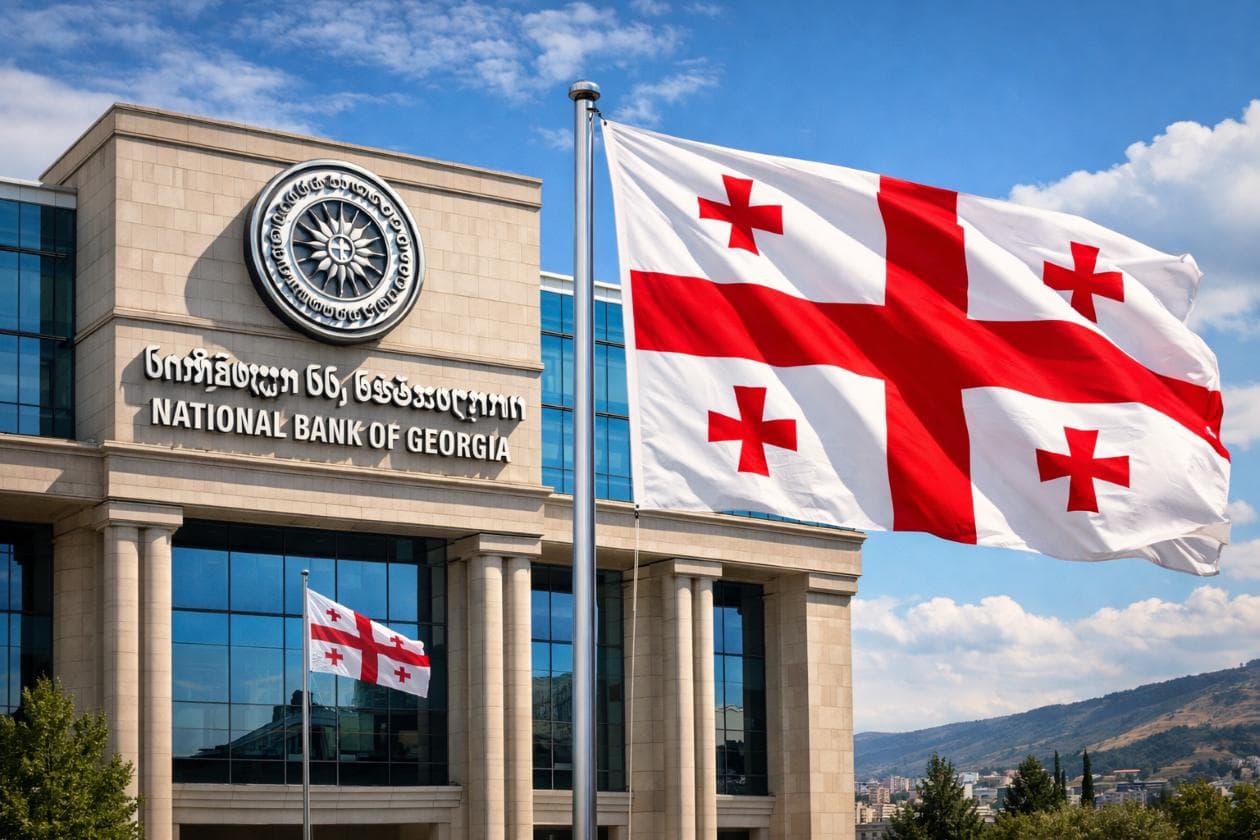
A new stablecoin regulatory environment is beginning to take shape across more markets, and Georgia is now showing signs of joining that shift. The National Bank of Georgia said on March 10 that it has developed a regulation for the initial offering of stable virtual assets by a Virtual Asset Service Provider, pointing to a more defined approach to stablecoin issuance rather than broad crypto oversight alone.
The move matters because it reflects a wider trend. As stablecoins become more central to payments, settlement, and digital finance, regulators are increasingly moving beyond generic crypto rules and toward dedicated frameworks focused on issuance, reserves, redemption, transparency, and risk controls. In Georgia’s case, the NBG’s announcement suggests the country is preparing for that next phase.

Nino Jelaidze, Vice Governor of the National Bank of Georgia, framed the new rule as part of a broader strengthening of virtual asset regulation. She said the regulation governing the initial offering of stable virtual assets, commonly referred to as stablecoins, is designed to protect consumer rights, improve risk management standards in the financial sector, and align with international standards. She also said stable virtual assets in circulation must be fully backed by reserve assets that meet high liquidity and credit-rating requirements, while issuance must begin with an offering document and be followed by external-auditor verification.
That gives the story a stronger angle than simply saying Georgia is regulating crypto. What appears to be emerging is a more specific stablecoin environment, one built around clear issuance standards and closer supervision. The NBG said the new regulation covers the prerequisites for initial offerings and subsequent services, while also defining rights and obligations for the parties involved. It introduces core concepts such as stable virtual assets, reserve assets, offering documents, and redemption. It also requires any stable virtual asset in circulation to be fully backed by reserve assets.
The structure becomes even clearer when linked back to Georgia’s wider VASP framework. On its VASP page, the National Bank of Georgia already lists a broad set of regulated virtual asset activities, including exchange between virtual assets and fiat, transfer services, custody and safekeeping, portfolio management, trading platform administration, lending, and initial coin offerings of convertible virtual assets. That means the stablecoin measure does not appear in isolation. It looks more like a specialized layer being added on top of an existing supervisory perimeter.
This is an important point for the article. Georgia is not building its digital asset rules from scratch. The NBG said the new stablecoin regulation builds on amendments made to the Organic Law on the National Bank of Georgia on December 17, 2025, which gave the central bank full supervisory authority over VASPs, including prudential supervision, consumer rights protection, cybersecurity, and operational risk management. The stablecoin rule therefore looks like a continuation of a broader institutional buildout already underway.
One of the most notable parts of the announcement is the benchmarking. The NBG said it evaluated legal and regulatory frameworks from multiple jurisdictions while drafting the rule, including the United States, the European Union’s MiCA regime, Dubai’s VARA framework, the United Kingdom, and Singapore. It also said it used analytical materials and recommendations from the IMF and IOSCO, while continuing technical cooperation with the World Bank and the OSCE.
For regional readers, the explicit reference to Dubai’s VARA stands out. VARA has become one of the more visible digital asset regulatory models globally, especially for markets looking for a structured but commercially relevant framework. By naming VARA alongside MiCA, the US, the UK, and Singapore, Georgia signals that it is watching a broad mix of regulatory approaches as it shapes its own stablecoin environment.
The substance of the Georgian rule also points to a more mature approach. According to the NBG, the regulation sets rules around reserve-asset composition and proportional metrics, segregated storage of capital and reserve assets, redemption at the request of holders, transparency, reporting, operational and technological risk management, and capital requirements. That places stable virtual assets in a more serious regulatory category, one that increasingly resembles financial infrastructure rather than a side segment of the crypto market.
Taken together, Georgia’s move adds to the sense that stablecoins are entering a new policy phase globally. The conversation is no longer only about licensing exchanges or registering crypto firms. It is increasingly about how countries create the legal and supervisory conditions for stablecoin issuance itself. In Georgia, that next layer now appears to be taking shape under the country’s broader VASP framework.

Disclaimer of Warranty
The information provided in this article is for general informational purposes only. We make no warranties about the completeness, reliability, and accuracy of this information. Read full disclaimer

Editor's Picks

Why Zondacrypto’s Collapse Would Unfold Differently in the UAE

Walid Abou Zaki

Aug 28, 2026

8 min

The Missing Orchestration Layer Holding Back Institutional Digital Assets
Julian Sawyer
Aug 18, 2026
5 min

Beyond Crypto Access: How ARP Digital Is Building the UAE’s Digital Capital Infrastructure
Anna K.
Aug 17, 2026
8 min
Read More Articles

In the Same Space

Kalshi's Bid for Non-Stop Stock Perpetuals Reignites CFTC-SEC Turf War
News Desk
Sep 11, 2026
8 min

Iran Turns to Crypto as Sanctions Bite, But USDT Has a Control Problem
Salma Naueihed
Sep 9, 2026
5 min

US and UK Launch Joint Effort to Tackle Crypto Investment Fraud
News Desk
Sep 4, 2026
5 min

CFTC Seeks Dismissal of CME Challenge to Kalshi Bitcoin Perpetuals
News Desk
Sep 3, 2026
4 min