Advertisement
Stablecoins & Payments
Share
WA
CEO & Editor-in-Chief


The United Arab Emirates is not a country in need of better domestic payments. Bank transfers are instant, digital adoption is high, and the banking system is among the most stable in the region. Yet despite this, UAE stablecoins — particularly those issued by banks and regulated entities — are becoming an increasingly visible part of the financial landscape.
Several AED-backed stablecoins have already been approved with banks as issuers, alongside offshore stablecoins licensed under UAE regulatory frameworks. More initiatives are widely expected to follow. At first glance, this appears counterintuitive. Globally, stablecoins are often framed as tools to fix broken payment systems or bypass weak banking infrastructure. None of these challenges meaningfully apply to the UAE.
The explanation lies not in domestic disruption, but in function. UAE stablecoins are emerging primarily as outward-facing instruments — designed to support cross-border settlement, foreign exchange activity, and institutional or payments-led flows — while leaving the role of the dirham inside the country unchanged.
In a purely domestic context, UAE stablecoins struggle to justify themselves. The UAE already operates one of the most efficient payment environments globally, with real-time bank transfers, strong financial inclusion, and high trust in regulated institutions. In that setting, stablecoins can reasonably be described as a solution looking for a problem — a view frequently heard in the market.
Banks are testing business-to-business settlement and treasury movements, but these pilots reflect technical exploration rather than clear unmet demand. Local payments do not require public stablecoins to function more efficiently, and domestic economic activity remains well served by existing rails.
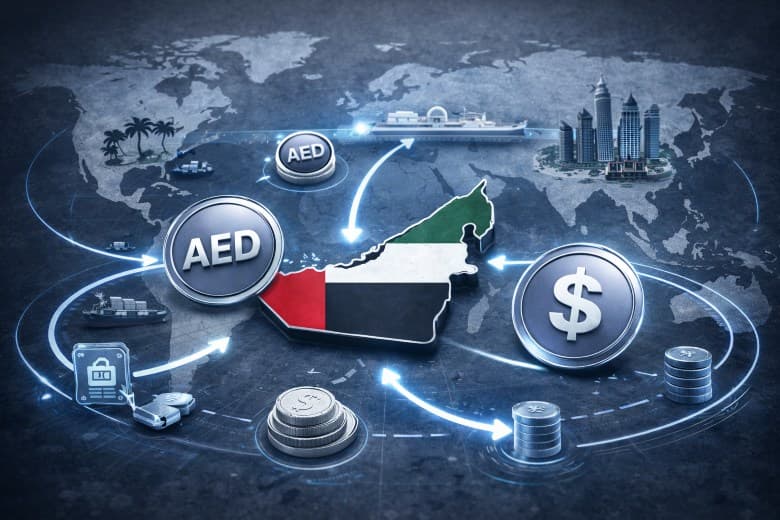
The equation changes once foreign exchange is introduced. UAE stablecoins begin to make sense not as payment tools, but as FX instruments — enabling conversion in and out of AED in on-chain environments. When paired with the ability to move seamlessly between AED-denominated stablecoins and other major stablecoins, such as USD-backed instruments, the value proposition becomes clearer. Both sides of the trade sit on-chain, settlement is instantaneous, and currency conversion becomes part of the same digital workflow.
In that context, UAE stablecoins are not solving a domestic payments problem. They are enabling on-chain denomination and on-chain conversion, which is where their relevance truly emerges.
A more useful lens is to examine how the dirham is used in practice.
The AED is structurally an outflow currency. Large expatriate populations earn in dirhams and send money abroad. Trade, logistics, aviation, construction, and services generate continuous cross-border flows toward Africa, South Asia, and parts of Southeast Asia. In this context, the dirham’s defining feature is not long-term holding, but movement.
AED-backed stablecoins align naturally with this role. They operate as settlement instruments — moving value between institutions, netting obligations, and clearing positions before exiting into another currency system. From this perspective, UAE stablecoins are less about encouraging people to hold dirhams abroad, and more about making dirham-denominated flows more efficient once they leave the domestic economy.
The clearest signal lies in who the issuers are — and how their institutional DNA shapes their stablecoin strategy.
Large institutions such as First Abu Dhabi Bank and groups linked to IHC are structurally global by nature. Their balance sheets, client bases, and strategic interests are regional and international. For players of this scale, the bottleneck is not local payments, but cross-border settlement, treasury coordination, and large-ticket institutional flows.
A different — but equally deliberate — logic applies to smaller and more specialised banks.
RAKBANK is not positioned as a global trade finance heavyweight, and does not need to be. Its value proposition sits between local payments, personalized banking services, and regulated crypto rails. Many clients actively prefer working with a smaller bank that offers flexibility and tailored engagement rather than being one account among millions at a universal bank. RAKBANK’s integration with Bitpanda, allowing customers to buy and sell digital assets directly from its banking app, reinforces this positioning. The bank sits at the intersection of retail payments and crypto access, rather than competing with large institutions on balance sheet scale.
AEcoin reflects an even clearer payments-first logic. Through the AEC Wallet, AEcoin is designed as a pure payment instrument, with crypto acting as a rail rather than a speculative layer. The ability to top up AEcoin using digital assets via Emcoin positions it squarely as a bridge between traditional payments and on-chain value movement. This is not a trade finance play — it is a payments and FX utility built for programmability and interoperability.
This picture becomes more interesting when viewed alongside MBank, which has articulated ambitions tied to Africa and emerging market corridors. In that context, payments-led stablecoins and USD settlement instruments become complementary tools rather than competing ones.
Not all stablecoins operating under UAE regulatory frameworks are AED-backed.
USDU, licensed under the framework of Abu Dhabi Global Market and registered with the Central Bank of the UAE, is the first USD-backed stablecoin formally approved under the national Payment Token Services Regulation. The token is issued by Aquanow in coordination with established banking partners, including MBank and Emirates NBD, providing institutional reserve backing and integration into regulated settlement infrastructure.
Structurally, USDU is aligned with institutional crypto and banking ecosystems and is not intended as a domestic retail payment instrument. Its design prioritizes regulated digital-asset settlement, USD liquidity, and interoperability with other payment and stablecoin rails, reinforcing its role as a settlement layer rather than a replacement for local payment systems.
Viewed alongside AEcoin and MBank-linked payment infrastructure, USDU begins to resemble a USD settlement leg within a broader, partially closed loop: AED-denominated payment rails on one side, regulated USD settlement on the other, with crypto rails enabling conversion and movement between the two. This configuration is particularly relevant for Africa-facing corridors, where USD liquidity, local currency volatility, and settlement efficiency intersect.
Allowing mainland UAE entities to interact with USDU for compliant settlement does not imply domestication. It reflects regulatory comfort with interoperability under clear rules, not currency substitution.
Despite the growing number of UAE stablecoins, one principle remains consistent: economic activity inside the UAE continues to be denominated and settled in AED.
Stablecoins may function as settlement or transit instruments in cross-border and FX contexts, but they do not redefine the unit of account for local commerce, salaries, or domestic obligations. In practice, value may move through different rails, but the dirham remains the monetary anchor inside the economy.
The idea of UAE stablecoins “travelling” is sometimes misread as an attempt to replace the US dollar in trade or settlement. In reality, this reflects settlement diversification, not currency displacement.
Most global trade remains priced in USD, benchmarked to USD, and hedged against USD exposure. Using AED as a settlement leg in certain corridors does not change this. As long as the dirham remains pegged to the dollar, AED-based settlement complements the dollar system rather than challenging it.
What changes is the infrastructure — not the currency order.
Much of the outward focus of UAE stablecoins is directed toward Africa and Asia. This is sometimes interpreted as an attempt to export the dirham as a replacement currency. In practice, the objective is narrower.
These regions represent corridors of trade, remittances, payroll, and services. Local currencies remain in place, and end users continue to receive funds in domestic units. UAE stablecoins operate at the institutional and payments layer, facilitating FX conversion, clearing, and netting before value exits into local systems.
UAE stablecoins are often discussed through the lens of local adoption. Issuer profiles, regulatory structure, and use-case alignment suggest a different reading.
They are being built to travel — to support cross-border settlement, FX activity, and payments-led corridors — while the dirham remains firmly anchored at home. Their significance lies less in how widely they are used inside the country, and more in how they enable on-chain denomination and on-chain conversion beyond it.
That distinction — between movement and monetary anchoring — is likely to define how UAE stablecoins evolve as more banks, payment institutions, and sovereign-linked entities enter the field.

Disclaimer of Warranty
The information provided in this article is for general informational purposes only. We make no warranties about the completeness, reliability, and accuracy of this information. Read full disclaimer

Editor's Picks
In the Same Space

Robinhood Plans Dubai Launch in 2027 After DFSA Authorization

Walid Abou Zaki

Oct 22, 2026

4 min

VARA Grants Bybit License for Spot Trading in Dubai
Walid Abou Zaki
Oct 22, 2026
6 min

Crypto Ads in the UAE Face New Google Rules Starting October 21
News Desk
Oct 20, 2026
4 min

Standard Chartered Extends Crypto Trading to UAE Wealth Clients
News Desk
Oct 14, 2026
3 min