Advertisement
Institutional Adoption
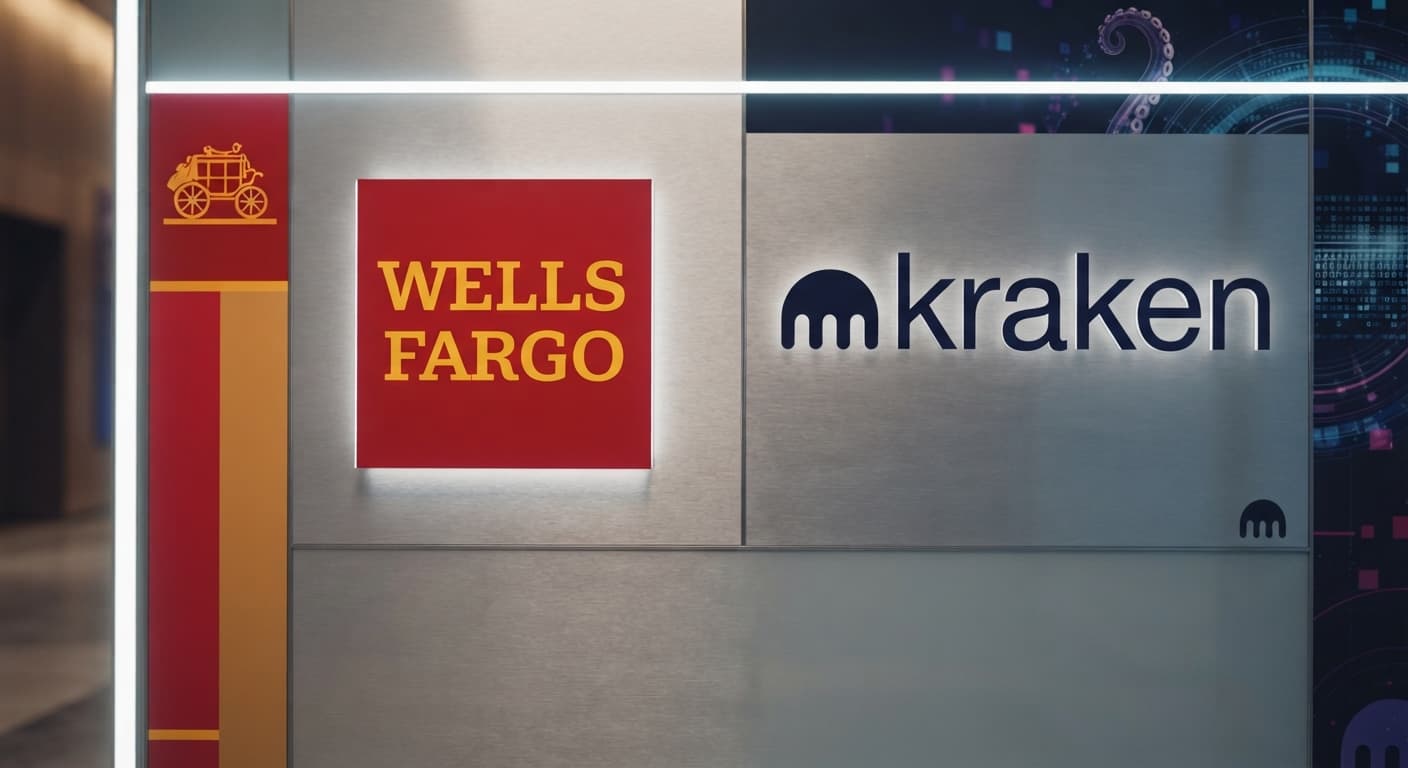
Wells Fargo is reportedly exploring Payward as a crypto liquidity provider, adding to the Kraken parent’s growing network across banking, trading, settlement and tokenized markets.
Share
Wells Fargo is in talks with Payward, Kraken's parent company, over a potential liquidity arrangement for the bank's crypto trading activities, reflecting Payward's broader push to serve as institutional digital-asset infrastructure for traditional finance.
Wells Fargo is reportedly in discussions with Payward, the parent company of Kraken, over a potential arrangement that would see Payward provide liquidity for the bank’s crypto trading activities.
The talks, reported by CoinDesk, come as major banks move deeper into digital assets while increasingly relying on specialized infrastructure providers rather than building every part of their crypto market capabilities internally. No agreement has been finalized, and the discussions may not result in a deal.
For Payward, however, the talks fit into a broader institutional expansion that is taking the company beyond its roots as the operator of crypto exchange Kraken and toward a wider role across trading, settlement and tokenized markets.
The potential Wells Fargo arrangement would position Payward as a liquidity provider behind a traditional bank’s digital-asset trading activity.
That distinction is important. Rather than a major bank building an exchange or taking on every element of crypto-market infrastructure itself, the model allows it to access specialized digital-asset liquidity through an established crypto-market operator.
Payward has been pursuing this institutional role across several areas.
The company has separately been in discussions with BNY over a potential infrastructure partnership that could span digital assets, custody, trading, payments and other financial-market services.
The developments point to a broader shift in how traditional finance is approaching digital assets: banks can retain their client relationships and regulated financial operations while connecting to crypto-native infrastructure where specialized capabilities are required.
Payward’s institutional ambitions became more visible in September when Nasdaq invested $100 million in the company through Nasdaq Ventures.
The investment was tied to plans for Nasdaq Equity Tokens, with a targeted launch in the second quarter of 2027, while Nasdaq is also providing market-surveillance technology across Payward’s trading operations.
Unlock Blockchain previously reported on the investment and Payward’s expansion into tokenized equities.
That relationship is significant because it extends Payward’s role beyond conventional crypto trading. The company is increasingly positioned at the intersection of digital assets, traditional securities and market infrastructure.
The Wells Fargo discussions therefore come against the backdrop of a wider strategy rather than as an isolated banking relationship.
The potential Payward relationship also sits alongside Wells Fargo’s own move into blockchain-based financial infrastructure.
In August, Wells Fargo introduced tokenized deposits for corporate payments, using blockchain technology to enable the movement of bank money in a digital format.
Unlock Blockchain also reported in June that Wells Fargo was among major U.S. banks working on a coordinated tokenized-deposit network targeting 2027, alongside JPMorgan, Bank of America and Citi.
The two developments illustrate the different layers of the institutional digital-asset stack.
Banks are building blockchain-based forms of money and payment infrastructure, while specialist firms such as Payward can provide access to digital-asset markets, liquidity and related trading infrastructure.
That model could allow traditional financial institutions to participate more deeply in digital assets without having to replicate the entire technology and market structure themselves.
Payward’s institutional push is also extending beyond the U.S.
On October 5, Payward and Singapore Gulf Bank announced a partnership for around-the-clock U.S. dollar settlement for digital-asset transactions, initially targeting selected institutional clients in Asia and the Gulf.
The arrangement adds a settlement layer to Payward’s expanding institutional offering, complementing its role in trading and liquidity.
For financial institutions operating across multiple time zones, continuous fiat settlement can help reduce one of the structural limitations of traditional banking infrastructure: markets may operate around the clock, while conventional settlement systems do not always match that pace.
The partnership therefore adds another dimension to Payward’s positioning as an infrastructure provider connecting traditional financial systems with digital-asset markets.
The Wells Fargo talks are not evidence that banks are handing their digital-asset operations to crypto companies. Instead, they point toward a more layered market structure.
Traditional banks are developing tokenized deposits, blockchain-based payment systems and other forms of onchain financial infrastructure. At the same time, crypto-native companies are building the trading, liquidity, custody and settlement capabilities that can connect those systems to digital-asset markets.
Payward’s expanding relationships with institutions such as Nasdaq, BNY, Singapore Gulf Bank and potentially Wells Fargo show how that division is beginning to take shape.
The significance of the Wells Fargo talks, therefore, extends beyond a potential crypto liquidity arrangement. They indicate that as banks enter digital-asset markets, the next phase may be less about replacing traditional finance with crypto and more about connecting the two through specialized infrastructure.
For Payward, that could turn the company’s role from simply operating a crypto exchange into providing some of the market plumbing through which traditional financial institutions access digital assets.

Disclaimer of Warranty
The information provided in this article is for general informational purposes only. We make no warranties about the completeness, reliability, and accuracy of this information. Read full disclaimer

Editor's Picks

When Assets Move—or Stop—Without Consent: The Limits of Crypto Wallet Control

Walid Abou Zaki

Sep 29, 2026

6 min

Where Do the Dollars Behind the UAE’s Crypto Economy Sit?
Anna K.
Sep 21, 2026
9 min

As U.S. Crypto Legislation Stalls, Circle Launches Its Own Financial Network
Walid Abou Zaki
Sep 16, 2026
9 min
Read More Articles

In the Same Space

ECB Considers Three Models for Tokenizing Central Bank Money Onchain
News Desk
Oct 2, 2026
4 min
When Assets Move—or Stop—Without Consent: The Limits of Crypto Wallet Control
Walid Abou Zaki
Sep 29, 2026
6 min

VARA Tightens Proof-of-Reserves Audit Standards for Dubai VASPs
News Desk
Oct 7, 2026
4 min

Russia Opens Regulated Crypto Market as Sberbank, VTB Enter First Registries
Salma Naueihed
Oct 7, 2026
4 min